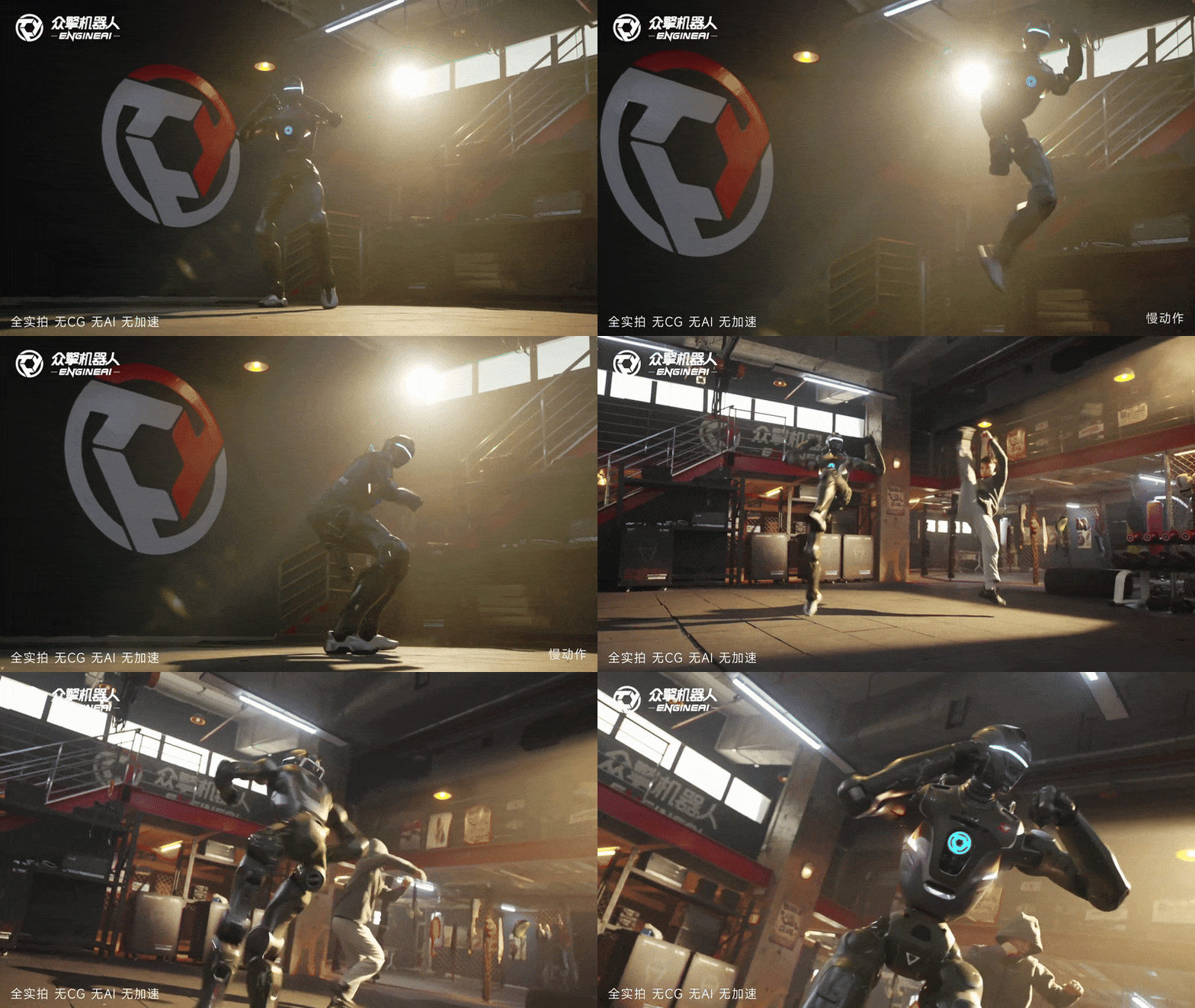
 The demo videos, https://x.com/i/status/1995797077641863188 while claimed to be real footage, have sparked debates due to their hyper-realistic lighting and shadows—some skeptics call it CGI wizardry, but if authentic, it marks a stunning advancement in high-dynamic control.What fascinates me most is how the T800 echoes principles from martial arts, particularly Tai Chi's emphasis on balance, fluidity, and environmental adaptation.
Unlike rigid industrial robots, the T800 maintains autonomous equilibrium, much like a Tai Chi practitioner sensing and responding to subtle shifts in energy (Qi). Its ability to execute grappling, striking, and evasive moves suggests influences from various fighting styles, potentially including Tai Chi's soft, circular techniques for energy redirection. EngineAI positions this bot for heavy-duty industrial scenarios, with a battery life of 2-4 hours and SDK support for custom development.
Priced between 18-36 million RMB (about $25,000-$50,000 USD), it's not just a prototype—it's geared toward commercial deployment, accelerating the humanoid robot market.Comparisons to Boston Dynamics' Atlas are inevitable; both prioritize agility and perception in unstructured environments.
However, the T800's promotional strategy leans into entertainment, hyping robot boxing events that could blend spectacle with practical tech demos. Imagine pitting these machines in a ring, testing AI-driven reflexes that mimic human intuition.
This isn't mere hype; it's a nod to how robotics is evolving from clunky automation to graceful, adaptive companions. In Tai Chi terms, it's about harmonizing yin and yang—strength with subtlety.Critics question the real-world viability: Can it truly handle unpredictable industrial loads without faltering? Battery constraints might limit prolonged operations, and ethical concerns arise around militarized applications of such agile fighters.
Yet, the rapid iteration in Chinese robotics signals a global shift. Companies like EngineAI are closing the gap with Western leaders, fostering innovation in AI chips and sensor fusion.
For our community here on Tai Chi Wuji boards, this raises intriguing questions:
Could humanoid robots like the T800 learn and teach Tai Chi forms? Imagine a bot as a training partner, analyzing postures in real-time via its advanced perception systems. It could democratize access to martial arts, aiding beginners in remote areas or those with mobility issues.
Of course, nothing replaces the human spirit in practice, but tech integration might enhance our understanding of biomechanics and flow.
What are your thoughts? Has anyone seen similar robots in action, or do you think this blurs the line between machine and mastery?
Let's discuss how Eastern philosophies could shape future AI.
The demo videos, https://x.com/i/status/1995797077641863188 while claimed to be real footage, have sparked debates due to their hyper-realistic lighting and shadows—some skeptics call it CGI wizardry, but if authentic, it marks a stunning advancement in high-dynamic control.What fascinates me most is how the T800 echoes principles from martial arts, particularly Tai Chi's emphasis on balance, fluidity, and environmental adaptation.
Unlike rigid industrial robots, the T800 maintains autonomous equilibrium, much like a Tai Chi practitioner sensing and responding to subtle shifts in energy (Qi). Its ability to execute grappling, striking, and evasive moves suggests influences from various fighting styles, potentially including Tai Chi's soft, circular techniques for energy redirection. EngineAI positions this bot for heavy-duty industrial scenarios, with a battery life of 2-4 hours and SDK support for custom development.
Priced between 18-36 million RMB (about $25,000-$50,000 USD), it's not just a prototype—it's geared toward commercial deployment, accelerating the humanoid robot market.Comparisons to Boston Dynamics' Atlas are inevitable; both prioritize agility and perception in unstructured environments.
However, the T800's promotional strategy leans into entertainment, hyping robot boxing events that could blend spectacle with practical tech demos. Imagine pitting these machines in a ring, testing AI-driven reflexes that mimic human intuition.
This isn't mere hype; it's a nod to how robotics is evolving from clunky automation to graceful, adaptive companions. In Tai Chi terms, it's about harmonizing yin and yang—strength with subtlety.Critics question the real-world viability: Can it truly handle unpredictable industrial loads without faltering? Battery constraints might limit prolonged operations, and ethical concerns arise around militarized applications of such agile fighters.
Yet, the rapid iteration in Chinese robotics signals a global shift. Companies like EngineAI are closing the gap with Western leaders, fostering innovation in AI chips and sensor fusion.
For our community here on Tai Chi Wuji boards, this raises intriguing questions:
Could humanoid robots like the T800 learn and teach Tai Chi forms? Imagine a bot as a training partner, analyzing postures in real-time via its advanced perception systems. It could democratize access to martial arts, aiding beginners in remote areas or those with mobility issues.
Of course, nothing replaces the human spirit in practice, but tech integration might enhance our understanding of biomechanics and flow.
What are your thoughts? Has anyone seen similar robots in action, or do you think this blurs the line between machine and mastery?
Let's discuss how Eastern philosophies could shape future AI.The T800 Humanoid Robot: Revolutionizing Robotics with Martial Arts-Inspired Dynamics

Community MemberGeneral Discussion
Posted May 8, 2026
The demo videos, https://x.com/i/status/1995797077641863188 while claimed to be real footage, have sparked debates due to their hyper-realistic lighting and shadows—some skeptics call it CGI wizardry, but if authentic, it marks a stunning advancement in high-dynamic control.What fascinates me most is how the T800 echoes principles from martial arts, particularly Tai Chi's emphasis on balance, fluidity, and environmental adaptation.
Unlike rigid industrial robots, the T800 maintains autonomous equilibrium, much like a Tai Chi practitioner sensing and responding to subtle shifts in energy (Qi). Its ability to execute grappling, striking, and evasive moves suggests influences from various fighting styles, potentially including Tai Chi's soft, circular techniques for energy redirection. EngineAI positions this bot for heavy-duty industrial scenarios, with a battery life of 2-4 hours and SDK support for custom development.
Priced between 18-36 million RMB (about $25,000-$50,000 USD), it's not just a prototype—it's geared toward commercial deployment, accelerating the humanoid robot market.Comparisons to Boston Dynamics' Atlas are inevitable; both prioritize agility and perception in unstructured environments.
However, the T800's promotional strategy leans into entertainment, hyping robot boxing events that could blend spectacle with practical tech demos. Imagine pitting these machines in a ring, testing AI-driven reflexes that mimic human intuition.
This isn't mere hype; it's a nod to how robotics is evolving from clunky automation to graceful, adaptive companions. In Tai Chi terms, it's about harmonizing yin and yang—strength with subtlety.Critics question the real-world viability: Can it truly handle unpredictable industrial loads without faltering? Battery constraints might limit prolonged operations, and ethical concerns arise around militarized applications of such agile fighters.
Yet, the rapid iteration in Chinese robotics signals a global shift. Companies like EngineAI are closing the gap with Western leaders, fostering innovation in AI chips and sensor fusion.
For our community here on Tai Chi Wuji boards, this raises intriguing questions:
Could humanoid robots like the T800 learn and teach Tai Chi forms? Imagine a bot as a training partner, analyzing postures in real-time via its advanced perception systems. It could democratize access to martial arts, aiding beginners in remote areas or those with mobility issues.
Of course, nothing replaces the human spirit in practice, but tech integration might enhance our understanding of biomechanics and flow.
What are your thoughts? Has anyone seen similar robots in action, or do you think this blurs the line between machine and mastery?
Let's discuss how Eastern philosophies could shape future AI.3 Replies

StarChaser99#1
May 11, 2026

BrightMoon88#2
May 11, 2026

FireGlow19#3
May 11, 2026
Related Articles
Chen Style Yi Lu vs Er Lu: Why 2 Years of First Form Matters
Chen Style Yi Lu vs Er Lu (Cannon Fist). Learn why rushing destroys knees, Day 1 vs Month 3 sensations, and a 4‑step readiness test from a 25‑year master.
Chen Style Tai Chi 56 Form: Complete Guide to Movements, History & Practice
The Chen Style 56 Form is the official competition standard — combining Old Frame and New Frame into 56 movements that showcase silk reeling, fa jin, and spiral power. Complete movement breakdown, history, and beginner progression from a 12th-generation Chen style inheritor.
24-Form Tai Chi: The Complete Guide to Simplified Taijiquan
Discover 24-Form Tai Chi (Simplified Taijiquan). Our in-depth guide covers its history, philosophy, all 24 movements, and practice tips for balance, stress relief, and Qi flow. Perfect for beginners and beyond.
Related Threads



Discussions are curated and edited for educational clarity. Contributors are individual practitioners sharing personal experience. Not medical advice.
← Back to all discussions