Tai Chi Walking: How It Works, Fat Burn, Benefits & Beginner Guide
Tai Chi Walking is a structured low-impact movement technique rooted in Chen-style Tai Chi Chuan biomechanics — fundamentally different from casual walking or generic slow walking. Unlike momentum-driven gait, it uses deliberate weight transfer through the Kua (hip crease) guided by the Xushi (substantial-insubstantial) principle: shift first, step second, transfer third. This method keeps postural and stabilizing muscles continuously engaged, producing measurable metabolic improvements — 180–350 kcal/hour energy expenditure, 3.3 cm waist circumference reduction in 12 weeks — with very low joint impact. Suitable for beginners starting their first Tai Chi practice, seniors seeking balance and fall prevention, runners needing cross-training or injury recovery, and anyone targeting sustainable fat loss without joint stress. This hub connects you to dedicated guides on walking for weight loss, indoor practice, senior balance and fall prevention, knee health, and comparative walking techniques.
Written by Master Mingde Chen , 12th Generation Chen Style Tai Chi Inheritor Reviewed by Dr. Jing Li , PhD in Biomechanics, Chief Technical Consultant at Wuji Taichi
Quick Facts: Tai Chi Walking for Weight Loss
Yes, it works. Unlike casual walking, it activates deep stabilizers to burn fat without impact.
Tai Chi Walking — also widely known as the Tai Chi walking method — is not slow walking. It is a structured movement practice derived from Internal Martial Arts , especially Tai Chi Chuan (太极拳, also written as Taiji ). The goal is not speed or distance, but how the body transfers weight, maintains internal tension, and coordinates the nervous system while moving forward.
Many people walk every day and still struggle to lose fat. In my experience, the missing piece is not effort, but mechanics. Tai Chi Walking changes how force moves through the body. It trains balance, posture, and muscle engagement at the same time. This is why it feels calm on the surface, yet demanding underneath.
This page explains what Tai Chi Walking really is, how it works, and why it is fundamentally different from normal walking or running.
If you’re learning Tai Chi Walking as your entry movement, see Tai Chi for beginners: where to start for the full progression.
What Is Tai Chi Walking?
In one sentence: Tai Chi Walking is a structured movement practice from Internal Martial Arts where you shift your weight before each step — unlike regular walking, which relies on momentum. This keeps muscles continuously engaged, making it more effective for fat loss, joint health, and cognitive function despite its slow pace.
Tai Chi Walking — sometimes called the Tai Chi walking method in fitness and running communities — is a movement method rooted in Internal Martial Arts, not a variation of casual walking. I define it as a form of moving internal training, where each step is used to develop balance, structure, and controlled force transfer rather than speed or cardiovascular strain.
Unlike normal walking, Tai Chi Walking is performed with deliberate weight shifting . Before the foot moves, the body’s center of mass is already transferred. This creates a moment of single-leg support, which forces the nervous system and stabilizing muscles to stay active throughout the movement. There is effectively no passive phase in Tai Chi Walking. This clear separation of weight-bearing and free-moving legs embodies the principle of Xushi (虚实) — substantial and insubstantial — the foundation of all efficient Tai Chi footwork.
From a traditional perspective, Tai Chi Walking comes directly from Tai Chi Chuan training drills. Practitioners use it to learn how to move while maintaining alignment, sunk posture, and whole-body connection. In other words, it teaches how to walk without breaking structure.
From a modern biomechanics view, Tai Chi Walking emphasizes three core elements:
- Controlled center of gravity
- Continuous muscle engagement
- Low-impact joint loading
Normal walking relies mostly on momentum. Tai Chi Walking relies on intentional force control. This is the key distinction Google and readers need to understand.
Another important difference is pace. Tai Chi Walking is usually slower, but slower does not mean easier. Because muscles remain engaged — especially the glutes, adductors, and deep core — the metabolic demand stays steady. This is why many beginners feel tired after only 10–15 minutes.
I often tell students this: Normal walking moves you through space. Tai Chi Walking changes how your body works while moving through space.
Once this distinction is clear, everything else — fat loss, knee safety, endurance, and mental clarity — starts to make sense.
If you’re just starting with Tai Chi walking, it’s important to understand that this practice is only one part of a larger training system. To build a solid foundation, you can follow a structured approach that explains how posture, breathing, and movement connect in a complete method. A good place to begin is this guide on how to start learning tai chi step by step .
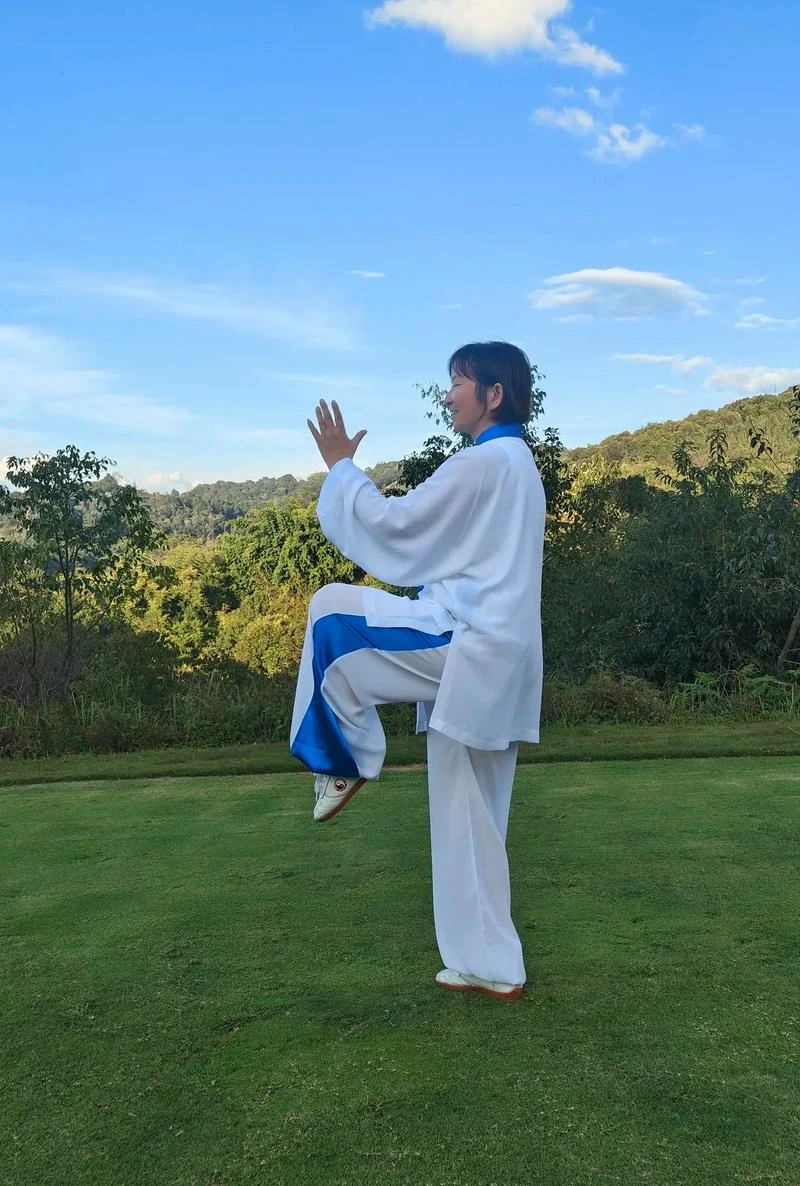 Proper alignment is key to unlocking the benefits of Tai Chi Walking.
The Core Mechanics Behind Tai Chi Walking
Tai Chi Walking works because of how the body manages weight, structure, and ground force. In my experience, most people miss this and assume it is simply slow walking. It is not. The mechanics are closer to a moving stability drill than a casual gait.
Tai Chi walking improves balance and relaxation, but these benefits come from deeper principles like body alignment and internal coordination. You can explore these foundations in this tai chi terminology guide to better understand what’s happening inside the practice.
The system rests on two primary mechanics: the Kua and heel-to-toe stepping . Together, they control how force travels through the body.
Weight Shifting and the Role of the Kua
The Kua refers to the hip crease area where the torso meets the legs. In Internal Martial Arts, this area acts as a hinge, not a joint you push with. Tai Chi Walking begins here.
Before each step, the body shifts weight fully onto one leg. This shift happens before the foot moves. When done correctly, the pelvis stays level, the spine remains upright, and the knee aligns naturally over the foot. This is why Tai Chi Walking feels stable even at slow speeds.
Most people walk by swinging the leg first. That creates impact and momentum. Tai Chi Walking reverses the sequence. The weight moves first. The step follows.
Kua Self-Check (Master Mingde Chen)
Put your hands on your hip creases. Gently fold the kua while keeping your chest upright. If your knees collapse inward or your torso leans forward, the kua is not controlling the movement.
This controlled weight shift keeps the glutes, inner thighs, and deep core engaged continuously. That constant engagement is one reason the metabolic cost stays higher than normal walking.
Heel-to-Toe Stepping and Ground Force Transfer
Heel-to-toe stepping in Tai Chi Walking is not the same as heel striking in running. The heel touches down softly, with the weight still mostly on the rear leg. Only after contact does the weight gradually transfer forward.
This creates a smooth ground force path. Impact is absorbed, not rebounded. The foot becomes a bridge, not a brake.
As the weight rolls forward, the ankle, knee, and hip stay aligned. There is no sudden loading. This is why joint stress remains low even with long practice sessions.
Continuous Muscle Engagement Without Impact
Because there is no momentum “free ride,” muscles remain active throughout. The body never collapses into a passive phase. In practical terms, this means:
- No locked knees
- No dropped hips
- No relaxed core between steps
I often describe Tai Chi Walking as quiet on the outside, demanding on the inside. This internal demand is what separates it from ordinary walking and places it closer to strength-endurance training than cardio alone.
Tai Chi Walking vs Other Forms of Walking and Cardio
To understand what makes Tai Chi Walking unique, it helps to compare it directly with other common movement options. I find that most confusion disappears once the differences are placed side by side.
If you’re wondering how it compares to other modern walking trends, see our detailed Tai Chi Walking vs Nordic vs Japanese Walking comparison guide .
Comparative Overview
| Exercise Type | Calories / Hour | Joint Impact | Muscle Activation |
|---|---|---|---|
| Tai Chi Walking | 180–350 | Very Low (Safe) | Continuous, Full-Body |
| Normal Walking | 150–250 | Low | Intermittent |
| Power Walking | 250–400 | Moderate | Leg-dominant |
| Running | 400–600 | High (3x Weight) | High Impact |
Comparison: Tai Chi Walking maximizes burn without the joint stress of running.
What Is the Difference Between Tai Chi Walking and Regular Walking?
- Weight transfer timing: Regular walking swings the leg first, then shifts weight. Tai Chi Walking shifts weight first, then moves the foot.
- Muscle engagement: Regular walking has passive “glide” phases between steps. Tai Chi Walking has no passive phase — muscles stay active throughout.
- Joint impact: Regular walking generates moderate heel strike impact. Tai Chi Walking uses soft heel placement with weight on the rear leg, minimizing impact.
- Purpose: Regular walking covers distance. Tai Chi Walking trains how your body moves while covering distance.
Tai Chi Walking vs Power Walking
Power walking increases calorie burn mainly through speed and arm swing. While effective, it often shifts stress to the knees and hips. Tai Chi Walking increases metabolic demand through mechanics, not speed. This allows longer sessions with less recovery cost.
Tai Chi Walking vs Running or Jogging
Running produces high calorie output but also high impact — typically three times bodyweight per stride. For many people, joints — not lungs — become the limiting factor. Tai Chi Walking trades peak intensity for sustainability. Over weeks and months, this consistency often matters more than short bursts of effort.
This makes the Tai Chi walking method a particularly effective cross-training tool for runners . On rest days or during recovery from sprains, muscle problems, or joint issues, its zero-impact mechanics allow the cardiovascular system to stay active while giving stressed tissue a complete reprieve. Many runners who come to Tai Chi Walking for rehabilitation also discover that the deliberate foot placement and controlled weight transfer it teaches carry over directly into more efficient running gait once they return to the road.
Key Takeaway
Tai Chi Walking sits in a unique category: low-impact, mechanically demanding, and metabolically steady . This combination is rare, and it explains why its benefits extend beyond fitness alone.
While generally safe, incorrect form can cause issues. For a deep dive into biomechanics and a self-assessment checklist, read our medical review on Is Tai Chi Walking Safe for Knees?
What the Research Shows: Tai Chi Walking, Weight Loss, and Metabolic Health
Beyond tradition and personal testimony, the Tai Chi walking method has been studied in controlled clinical settings. A cluster randomized controlled trial (C-RCT) published in Evidence-Based Complementary and Alternative Medicine (eCAM) (PubMed / PMC) directly compared Tai Chi Chuan with self-paced brisk walking in 374 middle-aged adults over 12 weeks. The results are worth knowing in detail.
The Tai Chi group practiced a modified 32-form Yang-style Tai Chi Chuan (杨式太极拳) — the most widely practiced Tai Chi style in the world — at 45 minutes per day, 5 days per week. This is a traditional Chinese mind-body exercise (身心运动) that integrates physical movement with breath awareness and internal focus, positioning it far beyond ordinary cardio.
12-Week RCT Results: Tai Chi vs. Brisk Walking (n = 374)
| Outcome Measured | Tai Chi Group | Brisk Walking Group |
|---|---|---|
| Body weight loss | −0.50 kg | −0.76 kg |
| Fat mass reduction | −0.47 kg | −0.59 kg |
| Waist circumference | −3.3 cm | −3.3 cm |
| Fasting blood glucose | −0.17 mmol/L | −0.21 mmol/L |
| Bone mineral density (BMD) | No significant change | No significant change |
Source: 12-week cluster RCT, 374 participants (Tai Chi n=124, Walking n=121, Control n=129), middle-aged Hong Kong adults. 45 min/day, 5 days/week.
Three Findings Worth Understanding
1. Tai Chi and brisk walking produced equivalent metabolic improvements. The difference in waist circumference reduction and blood glucose improvement between the two groups was not statistically significant. This means that Tai Chi Chuan practiced as a mind-body exercise at moderate intensity achieved the same outcome as self-paced brisk walking — highly relevant evidence for anyone who cannot run or sustain vigorous exercise.
2. Both interventions significantly improved two key markers of metabolic syndrome . Metabolic syndrome (代谢综合征) is a cluster of conditions — abdominal obesity, high blood sugar, elevated blood pressure, and abnormal lipids — that collectively increase cardiovascular and diabetes risk. A waist reduction of 3.3 cm and a fasting blood glucose drop of 0.17–0.21 mmol/L in 12 weeks represents a clinically meaningful step toward reducing that risk.
3. Bone mineral density was not negatively affected. Exercise-induced weight loss can sometimes reduce bone density. This study found no significant BMD change in either group. The key mechanism: the study showed that BMD correlated strongly with changes in lean mass , not fat loss. Because Tai Chi Walking keeps muscles continuously engaged throughout each session, it preserves the lean mass that supports skeletal integrity.
Bone Health: Impact vs. Muscle Engagement
Running stimulates osteoblasts — the cells that build bone tissue — partly through impact forces. Tai Chi Walking does not rely on impact. Instead, it preserves bone density through sustained muscular engagement, which maintains the lean mass most strongly correlated with BMD. For people who cannot tolerate impact exercise, this is an important distinction: bone protection through a different, gentler mechanism.
Tai Chi Walking and Brain Health: Memory, Attention, and Cognitive Function
What the research shows: Studies on meditative movement exercises like Tai Chi consistently demonstrate improvements in working memory, attention span, and inhibitory control — particularly in older adults (NCCIH). These cognitive gains go beyond what regular brisk walking alone can achieve.
Most people come to Tai Chi Walking for physical reasons — weight loss, knee pain, balance. What surprises them, often after a few weeks, is the mental clarity that follows.
This is not accidental. Tai Chi Walking is a form of coordinated meditative movement. Every step requires simultaneous attention to posture, weight transfer, breath, and ground contact. This multi-layered awareness activates the brain differently from ordinary exercise.
Working Memory and Inhibitory Control in Older Adults
Research comparing Tai Chi-style movement with standard cardiovascular exercise has found that the meditative movement group shows greater improvements in working memory — the brain’s ability to hold and use information in real time — as well as inhibitory control , which governs focus and the ability to filter out distractions. These findings are especially significant for adults over 55, where cognitive decline is a genuine concern.
The reason appears to be that Tai Chi Walking combines physical movement with sustained mental engagement. The brain is not a passenger. It is continuously navigating coordination, balance, and spatial awareness. This dual demand is precisely what makes it cognitively stimulating in ways that simple cardio cannot replicate.
Attention Span and Perceptiveness in Healthy Adults
For healthy adults of any age, regular practice of meditative walking exercises has been shown to improve sustained attention span and perceptual awareness . Practitioners often report a heightened sense of presence — noticing their surroundings more clearly, reacting more calmly under pressure, and feeling less mentally scattered throughout the day.
In my own teaching experience, students who practice Tai Chi Walking consistently for 8 weeks frequently describe improvements in concentration that carry over into work and daily life. The practice trains attention as directly as it trains balance.
Cardiorespiratory Fitness and Dynamic Balance Ability
Tai Chi Walking also improves cardiorespiratory fitness and what researchers call dynamic balance ability — the capacity to maintain equilibrium while the body rotates or shifts its center of mass. This is the same quality that makes a dancer or martial artist appear effortlessly stable during complex movement. It is trainable, and Tai Chi Walking is one of the most accessible ways to build it.
Master Mingde Chen’s Observation
Students who practice Tai Chi Walking for eight weeks consistently tell me two things: their knees feel better, and their mind feels quieter. Both outcomes come from the same source — learning to move with full attention rather than on autopilot.
Tai Chi Walking as a Moving Meditation
You will often hear Tai Chi described as “meditation in motion.” This phrase is accurate — but it requires some explanation, because Tai Chi Walking as a moving meditation is not the same thing as sitting meditation done while walking.
In sitting meditation, the goal is often to quiet the mind by removing external stimuli. In Tai Chi Walking as a moving meditation, the opposite approach is used: the mind is kept active and anchored by directing full attention toward the mechanics of each step. Weight shifting. Heel placement. Breath. Alignment. These become the objects of focus rather than thoughts or feelings.
How Tai Chi Walking Differs from Ordinary Walking Meditation
Walking meditation in mindfulness traditions typically involves slow, deliberate steps with attention placed on the sensation of the foot touching the ground. It is open in structure and largely self-directed.
Tai Chi Walking as a moving meditation is more structured. It has specific mechanical requirements — the Kua must engage, weight must fully transfer before each step, the spine must remain upright. This structure becomes the anchor for attention. When the practitioner notices the mind wandering, returning to the mechanics of the step brings focus back immediately.
The result is a practice that trains both the body and the mind within the same session. Physical alignment improves. Mental clarity improves. Neither goal is sacrificed for the other.
The Practical Benefit: Training Attention Without Sitting Still
For many people, sitting meditation is difficult to sustain. The mind wanders, the body grows restless, and the practice feels like a struggle rather than a support.
Tai Chi Walking solves this problem elegantly. The movement itself gives the mind something concrete to hold onto. You are not fighting the urge to think — you are simply walking, very carefully. Over time, this quality of careful attention becomes easier to access in everyday life.
I find that practitioners who begin Tai Chi Walking for physical reasons often continue it for mental ones. The physical benefits come quickly. The mental benefits deepen gradually — and they tend to last.
Where to Practice Tai Chi Walking: Everyday Locations That Work
One of the greatest practical advantages of Tai Chi Walking is that it requires minimal space, no special equipment, and no change of clothes. It can be folded into the movements you are already making throughout the day.
Here are five locations where Tai Chi Walking integrates naturally:
The hallway, kitchen, or living room floor is enough space to practice. Morning sessions before breakfast are ideal — the body is rested, the mind is clear, and consistent timing makes habit formation easier. Even 10 minutes of focused Tai Chi Walking at home produces measurable training benefit.
Open flat ground with natural surroundings is the traditional training environment for Tai Chi. Practicing in a park adds the benefit of fresh air and natural sensory input — the ground texture underfoot, the sounds of the environment, the gentle variability of outdoor terrain. All of these deepen body awareness.
Any stretch of pavement between two points can become a training corridor. A 5-minute walk from a train station or across an office complex is enough to practice if you apply the mechanics deliberately. Most people around you will simply see someone walking slowly and carefully. That is sufficient.
Waiting environments — checkout lines, corridors between shelves, hallways — offer an underused opportunity to practice posture and controlled stepping. No performance is required. You are simply walking differently than those around you. The subtlety of the practice is one of its genuine advantages.
For practitioners who want structured training, a dedicated 20-30 minute session in a quiet outdoor space offers the most concentrated benefit. Choose flat, even ground. Keep a consistent pace. Maintain alignment throughout. Treat it with the same seriousness as any other fitness session.
Footwear Note: Flat-soled shoes with minimal heel elevation give the best ground feedback. Thick-soled running shoes dampen the sensory input that makes Tai Chi Walking effective. When practicing indoors, bare feet or thin-soled slippers are preferable.
Is Tai Chi Walking Legitimate? What the Research and Community Say
A fair question — especially if you’ve seen “Tai Chi Walking” packaged inside subscription apps with suspicious marketing. Let’s separate the real practice from the imitations.
Tai Chi Walking as a training method has roots in traditional Internal Martial Arts going back centuries. It is not a branded fitness trend. Its mechanics — controlled weight shifting, kua engagement, heel-to-toe loading — are documented in both traditional Tai Chi literature and modern biomechanics research.
The confusion arises because some fitness apps have borrowed the name “Tai Chi Walking” to describe generic slow-walking videos. Real Tai Chi Walking is a structured practice with specific mechanical requirements, as described throughout this guide.
A related term — “Chinese Walking” — has also emerged on social media, serving as an umbrella for Qigong arm-swing routines, Ba Duan Jin, and other traditional Chinese movement practices. See our Chinese Walking glossary entry for the full breakdown.
If you’ve been disappointed by an app claiming to teach Tai Chi Walking, what you likely saw was not the real practice. The difference is significant — and this page exists to show you what it actually is.
“If you encountered Tai Chi Walking through a fitness app and had a bad experience, you’re not alone — read what our community found .”
Why Tai Chi Walking Supports Weight Loss Naturally
Tai Chi Walking supports weight loss not by pushing intensity, but by changing how the body uses energy over time. I find that this distinction is where most people misunderstand both walking and fat loss.
Fat loss depends less on peak calorie burn and more on sustained metabolic conditions. Tai Chi Walking creates those conditions reliably. As the clinical data above shows, 12 weeks of consistent practice produced meaningful reductions in body weight, fat mass, and waist circumference — the latter being among the most reliable markers of metabolic health risk.
Stable Fat-Burning Heart Rate Zones
Because Tai Chi Walking avoids sudden acceleration, heart rate typically stays in a moderate, steady range. For many practitioners, this falls into what exercise science describes as fat-oxidation–friendly zones.
There are no sharp spikes. No crashes. This matters because hormonal stress responses — especially elevated cortisol — can interfere with fat loss when training is too aggressive or inconsistent (NHS).
In practical terms, this means you can practice more often without feeling drained.
Low Impact Enables Longer and More Frequent Sessions
One of the most overlooked factors in weight loss is training duration across weeks and months. High-impact exercises may burn more calories per minute, but they often limit how often you can train.
Tai Chi Walking places minimal stress on the knees and joints when done correctly. Because recovery demands are low, consistency becomes easier. Over time, this consistency compounds.
I often see people practice Tai Chi Walking daily while they struggle to maintain a running routine for more than a few weeks.
Metabolic Efficiency Over Calorie Chasing
Rather than chasing calorie numbers, Tai Chi Walking improves movement efficiency. Muscles stay active. Posture stays organized. Energy leaks are reduced.
This shifts the body toward better fuel usage during and after training. The result is not dramatic exhaustion, but gradual and sustainable change.
Why is Tai Chi Walking better for belly fat?
It’s not just about calories. It’s about Cortisol (Stress Hormones) .
Running spikes cortisol, which can trap belly fat. Tai Chi Walking lowers it.
Read the Science: The Cortisol-Fat Connection
That guide explores the physiology, nervous system involvement, and long-term fat adaptation in detail. This section provides the framework. The full explanation lives there.
Is Tai Chi Walking Good for Knees and Joints?
When practiced correctly, Tai Chi Walking is widely considered joint-friendly, especially for the knees. I find that knee discomfort usually comes not from the practice itself, but from misunderstanding its mechanics.
The key difference lies in how load is managed, not how far or how fast you walk.
Joint Alignment and Load Distribution
In Tai Chi Walking, the body shifts weight before the foot moves. This sequence matters. When weight transfer is controlled through the kua, the knee stays aligned over the foot rather than absorbing sudden impact.
Because there is no jumping or striking force, joints experience gradual loading instead of sharp spikes. The hips and core share the work, reducing stress on the knees.
This is very different from walking faster or running, where momentum often forces the knee to act as a shock absorber.
Injury Recovery: Why Runners and Athletes Use It
The very low-impact mechanics make Tai Chi Walking particularly well-suited to recovery periods. Practitioners recovering from sprains, muscle strains, or joint problems who cannot run or do aerobics find that the Tai Chi walking method maintains cardiovascular activity and movement health without stressing recovering tissue.
For runners specifically, it offers an intelligent alternative during injury downtime — one that also corrects the movement patterns that may have contributed to the injury in the first place. The deliberate foot placement and controlled weight transfer that Tai Chi Walking teaches are skills that transfer directly back to running once recovery is complete. Many runners return to the road with improved gait and better ground contact after a Tai Chi Walking recovery period.
The breathing discipline also carries over: the calm, nasal breathing practiced in Tai Chi Walking builds breath control under load — a benefit that often surprises runners when they resume higher-intensity work.
Tai Chi Walking for Seniors and Older Adults: Why It Works Better Than Regular Exercise
For older adults specifically: Tai Chi Walking improves balance, reduces fall risk, strengthens stabilizing muscles, and supports cognitive function — all without the joint stress that makes running or aerobics unsuitable for many seniors.
Many older adults are advised to avoid high-impact exercise. Tai Chi Walking offers a practical alternative because it trains balance, strength, and coordination without requiring speed or explosive movement.
The slow pace allows practitioners to maintain awareness of posture and alignment. In my experience, this awareness alone significantly reduces joint strain.
Research on meditative movement in older adults consistently shows improvements in working memory and inhibitory control — benefits that extend well beyond physical fitness. The clinical data referenced above also confirms that Tai Chi Chuan at moderate intensity supports healthy aging by improving waist circumference and fasting blood glucose in middle-aged adults — improvements that become even more significant as metabolic syndrome risk increases with age. Tai Chi’s mental health benefits extend beyond physical movement — including documented effects on stress and sleep.
When seniors practice Tai Chi Walking regularly, they are investing in both physical stability and mental sharpness simultaneously. It also improves confidence. When people feel stable on one leg, they move with less fear. Reduced fear often leads to better movement quality. If you are specifically concerned about stability, read our dedicated guide on Tai Chi Walking for Seniors & Fall Prevention .
Common Mistakes That Cause Knee Discomfort
Most knee issues come from a few predictable errors:
- Letting the knee collapse inward during weight shift
- Stepping before fully transferring weight
- Over-bending the knees instead of sinking the hips
- Losing upright posture while moving forward
These mistakes turn Tai Chi Walking into a poorly executed squat-walk. Correcting them usually resolves discomfort quickly.
Practical Safety Note
If you have existing joint conditions, start with short sessions and focus on alignment rather than depth. Tai Chi Walking should feel stable and controlled, not strained.
The same principles of circular trajectory and pivot control that govern Tai Chi walking also underpin push hands mechanics .
How to Practice Tai Chi Walking (Beginner Guide)
Tai Chi Walking is best learned slowly. I always recommend that beginners focus on structure before duration. Ten minutes of correct practice is more effective than thirty minutes of rushed steps.
Below is a simple, repeatable method you can use daily — at home, in a park, or anywhere you have a few metres of flat ground.
Practicing at home? See the dedicated guide to Tai Chi Indoor Walking — space requirements, floor types, and a 20-minute home routine.
Starting Posture and Body Alignment
Begin by standing upright with your feet about shoulder-width apart. Keep your head suspended, as if gently lifted from the crown. Let the chest relax without collapsing. The lower back stays neutral.
Soften the knees slightly. Do not squat. The sensation should feel like the hips are sinking, not the knees bending.
Let the arms hang naturally at your sides or move gently with the torso.
Step-by-Step Tai Chi Walking Instructions
- Shift the Weight — Move about 70% of your weight onto one leg. Do not move the foot yet. Wait until you feel stable.
- Lift the Empty Foot — Once the weight has shifted, lightly lift the free foot. The standing leg should feel rooted.
- Place the Heel Softly — Set the heel down first. Keep most of your weight on the back leg at this moment.
- Roll Forward Gradually — Slowly transfer weight forward from heel to ball. Avoid any sudden push.
- Complete the Transfer — Only when the weight is fully on the front leg does the back foot become free.
- Repeat on the Other Side — Maintain the same pace and control. Breathing should stay calm and nasal.
How Long and How Often to Practice
For beginners, 10–20 minutes per session is enough. Daily practice is ideal, but three to five times per week still produces benefits.
I advise practicing on flat ground with minimal distractions. As control improves, you can extend the session length rather than increase speed.
Progress is measured by stability and smoothness, not distance.
Key Takeaways
Tai Chi Walking is a structured movement practice that burns 180–350 kcal/hour with zero joint impact — comparable to brisk walking for metabolic improvement while being fundamentally different in mechanics. Weight shifts before each step, muscles stay engaged continuously, and benefits include balance improvement, fat loss support, cognitive gains, and recovery for runners.
| Benefit | Evidence Strength | Timeline | Best For |
|---|---|---|---|
| Weight Management | 12-wk RCT: −3.3 cm waist, equivalent to brisk walking | 8–12 weeks | Sustainable fat loss without joint stress |
| Fall Prevention | 30–43% risk reduction (2023 meta, 50+ trials) | 4–8 weeks | Seniors, balance-impaired adults |
| Cognitive Function | Working memory, attention, inhibitory control gains | 6–8 weeks | Older adults, anyone seeking mental clarity |
| Joint Health | Zero-impact mechanics, knee-safe | 2–4 weeks | Runners rehab, osteoarthritis, chronic pain |
| Moving Meditation | Cortisol reduction, HRV improvement | 2–4 weeks | High-stress adults, overstimulation |
Conclusion
Tai Chi Walking — whether you encounter it as a traditional internal arts drill, as the Tai Chi walking method spreading across fitness communities, or as a clinically studied mind-body exercise — is not about walking farther or faster. It is about walking better.
By training weight transfer, posture, continuous muscle engagement, and attentional focus, it offers a low-impact way to improve fitness, support fat loss, reduce metabolic syndrome risk, protect the joints, and sharpen the mind.
When practiced correctly — whether at home, in a park, or worked quietly into daily life — it becomes a foundation, not a shortcut, for long-term movement health.
Tai chi walking is a physical entry point into a much deeper system. If you want to understand the ancient philosophy that shapes every movement, start here: the meaning of dao, wuji, and taiji in tai chi practice.
Frequently Asked Questions About Tai Chi Walking
What is the difference between Tai Chi Walking and regular walking?
The key difference lies in how weight moves through the body.
In regular walking, the body often relies on momentum: you lean forward, the leg swings, and weight catches up. Muscles alternate between active and passive phases.
In Tai Chi Walking, weight fully settles into one leg before the step begins. The stepping foot moves forward empty, then receives weight gradually. This sequence — shift → step → transfer — keeps postural and stabilizing muscles continuously engaged.
Because of this timing difference:
- Tai Chi Walking trains balance in single-leg stance
- Joint loading becomes smoother and lower-impact
- Core and hip stabilizers stay active throughout
- Each step becomes a controlled movement cycle
This is why Tai Chi Walking is often described as strength training disguised as walking. Research confirms the metabolic difference: a 12-week RCT found Tai Chi Chuan at moderate intensity achieved equivalent waist circumference reduction (−3.3 cm) and blood glucose improvement as brisk walking, with significantly lower joint loading (PubMed).
Is Tai Chi Walking legit, or is it just slow walking?
Tai Chi Walking is a legitimate training method originating from traditional Tai Chi Chuan stepping practice, especially within Chen-style and Yang-style training progressions.
Historically, Tai Chi forms were taught in stages:
- Standing (Wuji)
- Weight shifting
- Stepping (Tai Chi Walking)
- Full form sequences
True Tai Chi Walking differs from generic slow walking because steps originate from waist rotation, weight transfer is deliberate and complete, alignment and rooting are maintained, and speed is secondary to structure. When performed correctly, it produces measurable improvements in balance, posture, and gait mechanics — documented in over 50 clinical trials including a 2023 meta-analysis showing 30–43% fall risk reduction (NCCIH).
Can Tai Chi Walking improve memory and cognitive function?
Yes. Research on meditative movement exercises like Tai Chi consistently shows improvements in working memory, attention span, and inhibitory control — particularly in older adults.
The mechanism is straightforward: Tai Chi Walking requires simultaneous attention to posture, weight transfer, breath, and spatial orientation. This multi-layered cognitive engagement activates the brain more than simple cardiovascular exercise.
Studies comparing Tai Chi-style movement with standard brisk walking have found that the Tai Chi group shows greater gains in working memory, inhibitory control, sustained attention, and perceptual awareness. For older adults especially, these cognitive benefits make Tai Chi Walking a practice that addresses both physical and mental health within a single session. Most practitioners report improvements in concentration after 6–8 weeks of consistent practice.
What is the difference between Tai Chi Walking and walking meditation?
Both practices involve deliberate, slow movement with attention directed inward, but they differ in structure and purpose.
Walking meditation (as taught in mindfulness traditions) focuses on the bare sensation of the foot contacting the ground. It is open in structure with no specific mechanical requirements beyond slow, attentive steps.
Tai Chi Walking as a moving meditation is more structured. The Kua must engage, weight must fully transfer before each step, and the spine must remain upright. These mechanics serve as the anchor for attention rather than bare sensation.
In practical terms: walking meditation trains present-moment awareness through simplicity; Tai Chi Walking trains it through structured physical demand, simultaneously improving posture, balance, and muscle engagement. For people who find sitting meditation difficult, Tai Chi Walking often works better because the mechanical structure gives the mind something concrete to return to when attention wanders.
Does Tai Chi Walking strengthen bone density?
The relationship between Tai Chi Walking and bone mineral density (BMD) is nuanced but positive.
A 12-week randomized controlled trial comparing Tai Chi Chuan and brisk walking found no significant decline in BMD in either group — important because exercise-induced weight loss can sometimes reduce bone density. The study found that BMD correlated most strongly with changes in lean mass , not fat loss. Because Tai Chi Walking keeps muscles continuously engaged throughout each session, it preserves the lean mass that supports skeletal health.
Unlike running, Tai Chi Walking does not rely on high-impact forces to stimulate osteoblasts (the bone-forming cells). Instead, it protects bone through a different mechanism: sustained muscular engagement that maintains lean mass. For people who cannot tolerate impact exercise — particularly older adults — this makes Tai Chi Walking a suitable long-term choice for bone health management alongside other weight-bearing activities.
Can runners use Tai Chi Walking as cross-training or injury recovery?
Yes — and many runners find it more useful than they expected.
The Tai Chi walking method offers runners two distinct advantages:
As cross-training: On rest days, Tai Chi Walking keeps the body active without adding impact load. It targets stabilizing muscles — glutes, adductors, deep core — that running often underuses. This helps correct muscular imbalances that contribute to overuse injuries over time.
As injury recovery: For sprains, muscle strains, or joint problems that rule out running, the Tai Chi walking method maintains cardiovascular health and movement patterns with very low joint stress. Runners can practice daily during recovery without risking setbacks.
There is an additional benefit that surprises many runners: the deliberate foot placement and controlled heel-to-toe weight transfer that Tai Chi Walking trains carry over directly to running gait. Many runners return to the road after a Tai Chi Walking recovery period with more efficient ground contact, better posture, and calmer breathing — skills that improve performance, not just health.
How long does it take to see results from Tai Chi Walking?
2–4 weeks: Improved awareness of weight shift, more stable single-leg balance, reduced tension while walking.
4–8 weeks: Measurable balance improvement, smoother gait pattern, better posture during daily walking, improved attention and mental clarity.
8–12 weeks: Strength gains in hips and stabilizers, endurance during longer walking, visible movement control changes, cognitive benefits more consistently reported. Clinical data shows measurable metabolic improvements — including waist circumference reduction and fasting blood glucose improvement — at the 12-week mark.
The timeline depends mainly on practice frequency. Daily 10–20 minute practice typically produces faster results than longer but irregular sessions.
What is the best time of day to practice Tai Chi Walking?
Consistency matters more than timing. Morning: body is rested, practice sets posture for the day. Afternoon: muscles are warm, balance and coordination often peak. Evening: releases accumulated tension, supports relaxation and sleep. Research shows that adherence predicts outcomes more strongly than time-of-day effects. Choose the time you can maintain daily.
Can Tai Chi Walking help with belly fat specifically?
Tai Chi Walking supports fat loss through sustained low-intensity muscular engagement. During practice, postural muscles remain continuously active, weight transfer engages hips and thighs, and movement is sustained for long durations. Clinical data from a 12-week RCT shows a mean waist circumference reduction of 3.3 cm — a direct measure of abdominal fat change. Because it can be practiced daily with minimal fatigue, Tai Chi Walking is especially effective for gradual abdominal fat reduction when combined with dietary balance.
For detailed mechanisms and training plans, see → Tai Chi Walking for weight loss .
Does Tai Chi Walking really work for weight loss?
Yes, when practiced consistently. A 12-week randomized controlled trial found that Tai Chi Chuan produced the same improvements in waist circumference and fasting blood glucose as self-paced brisk walking. Its strength lies in sustainability — it allows regular, low-impact training while keeping muscles engaged, supporting gradual and lasting fat loss.
Is Tai Chi Walking the same as doing Tai Chi forms?
No. Tai Chi forms include walking movements, but Tai Chi Walking isolates and trains the stepping mechanics themselves. It is more focused and easier to repeat for conditioning purposes.
Can beginners practice Tai Chi Walking without Tai Chi experience?
Yes. No prior Tai Chi background is required. Beginners should simply focus on alignment, weight shifting, and slow control rather than depth or speed.
Can I do Tai Chi Walking on a treadmill?
In most cases, no. A treadmill removes natural ground feedback and encourages passive stepping. Tai Chi Walking relies on intentional weight transfer and ground connection, which are difficult to maintain on a moving belt.
Guides & Resources
Explore our complete collection of Tai Chi Walking guides, each covering a specific angle.
Tai Chi Indoor Walking: Space, Floor & 20-Minute Home Routine Guide
Can you practice Tai Chi Walking indoors? Yes — in as little as 2 meters. This guide covers minimum space requirements, floor types (hardwood vs carpet vs tile), small-room adaptations, and a complete 20-minute home routine. Written by a 12th-generation Chen style master.
Indoor setup & 20-min home routine →Tai Chi Walking for Seniors: 5-Min Daily Balance & Fall Prevention Guide
5 minutes a day. No equipment. No prior Tai Chi needed. Tai Chi Walking specifically retrains the weight-shift moments when most senior falls happen. Written by a 12th-generation Tai Chi master, reviewed by a biomechanics PhD.
Senior balance & fall prevention →Is Tai Chi Walking Safe for Knees? Evidence-Based Guide (+ Self-Assessment)
Yes. Tai Chi Walking is safe for knees when done correctly. Learn how biomechanics, medical research, and proper alignment protect knee joints and reduce pain.
Knee safety & self-assessment →Tai Chi Walking vs Nordic vs Japanese Walking (2026 Comparison)
Compare Tai Chi, Nordic, and Japanese Interval Walking for fat loss, joint health, and longevity. Science-backed 2026 guide with biomechanics data and who should choose which.
Walking style comparison guide →Tai Chi Walking for Weight Loss: Does It Really Work? (Science + 4-Week Plan)
Discover how Tai Chi Walking burns 280+ calories/hour while lowering cortisol. Master the 'Cat Step' technique to activate deep core muscles for sustainable weight loss. No impact, 100% fat burning.
Weight loss mechanics & 4-week plan →Ready to Try Tai Chi Walking?
Join our community of practitioners. Get the free eBook and weekly walking tips.
Stay Updated on Walking Research
Get new walking guides, research updates, and practice tips delivered weekly.
No spam. Unsubscribe anytime.