Is Tai Chi Walking Safe for Knees? Evidence-Based Guide (+ Self-Assessment)
Key Takeaways
- Research on 200+ participants shows Tai Chi walking produces 40% less knee joint impact than conventional walking
- The Cat Step technique engages hamstrings and glutes, reducing quad-dominant loading patterns that strain knees
- Tai Chi walking activates VMO (vastus medialis oblique) — the muscle that stabilizes the kneecap — more than walking
- For adults with mild knee osteoarthritis, 30 min of Tai Chi walking 3x/week improves function within 12 weeks
Written by
Master Mingde Chen 12th Gen. Chen Style Tai Chi Inheritor
Medically & Biomechanically Reviewed by
Dr. Jing Li, PhD Chief Technical Consultant at Wuji Taichi
Quick Answer: Is Tai Chi Walking Safe for Your Knees?
Yes — Tai Chi Walking is generally safe and beneficial for knee health when performed with proper alignment and appropriate intensity .
From a biomechanical standpoint, Tai Chi Walking is classified as a low-impact , joint-friendly exercise . Research shows that the ground reaction force during Tai Chi practice is approximately 1.1–1.3 times body weight , significantly lower than jogging or running, which can generate 3–5 times body weight with each step.
When reviewed through both traditional Chen-style Tai Chi principles and modern biomechanics , Tai Chi Walking supports knee stability, improves muscle coordination, and may help reduce pain associated with knee osteoarthritis. However, like any physical activity, incorrect technique or excessive depth can place unnecessary stress on the knee joint .
This guide explains why Tai Chi Walking protects the knees when done correctly , when caution is needed, and how to practice safely.
“Tai Chi is not dangerous to the knees. What harms the knees is poor alignment, excessive depth, and forcing the joint to twist under load.” — Master Mingde Chen
Why So Many People Worry About Tai Chi and Knee Damage
If you have knee pain, your concern is reasonable. In fact, studies suggest that over 60% of older adults reduce or abandon physical activity due to fear of knee injury . Tai Chi often gets caught in the middle of conflicting advice: praised as “gentle and healing,” yet criticized as something that “ruins knees over time.”
This contradiction usually comes from how Tai Chi is practiced , not what Tai Chi is. Understanding this distinction is critical — especially for beginners, seniors, and anyone with a history of knee discomfort.
Tai Chi Walking is especially gentle on the knees, and beginners can learn the core mechanics safely in Tai Chi for beginners: full overview before practicing for joint health.
The Knee Is Not Fragile, but It Is Direction-Sensitive
Basic Knee Anatomy: What Actually Gets Injured
The knee is primarily a hinge joint , designed to flex and extend. While it allows limited rotation, it is not built to twist under body weight .
Key structures include:
- Meniscus – shock-absorbing cartilage between femur and tibia
- Articular cartilage – smooth surface enabling low-friction movement
- Patellofemoral joint – where the kneecap tracks over the femur
- Quadriceps and hamstrings – muscles that stabilize the joint
Most knee injuries are not caused by slow bending, but by shear force — twisting, collapsing inward, or misaligned loading. This distinction is essential when evaluating Tai Chi Walking.
The Biomechanics of Tai Chi Walking
Why Tai Chi Walking Is Considered Low-Impact Exercise
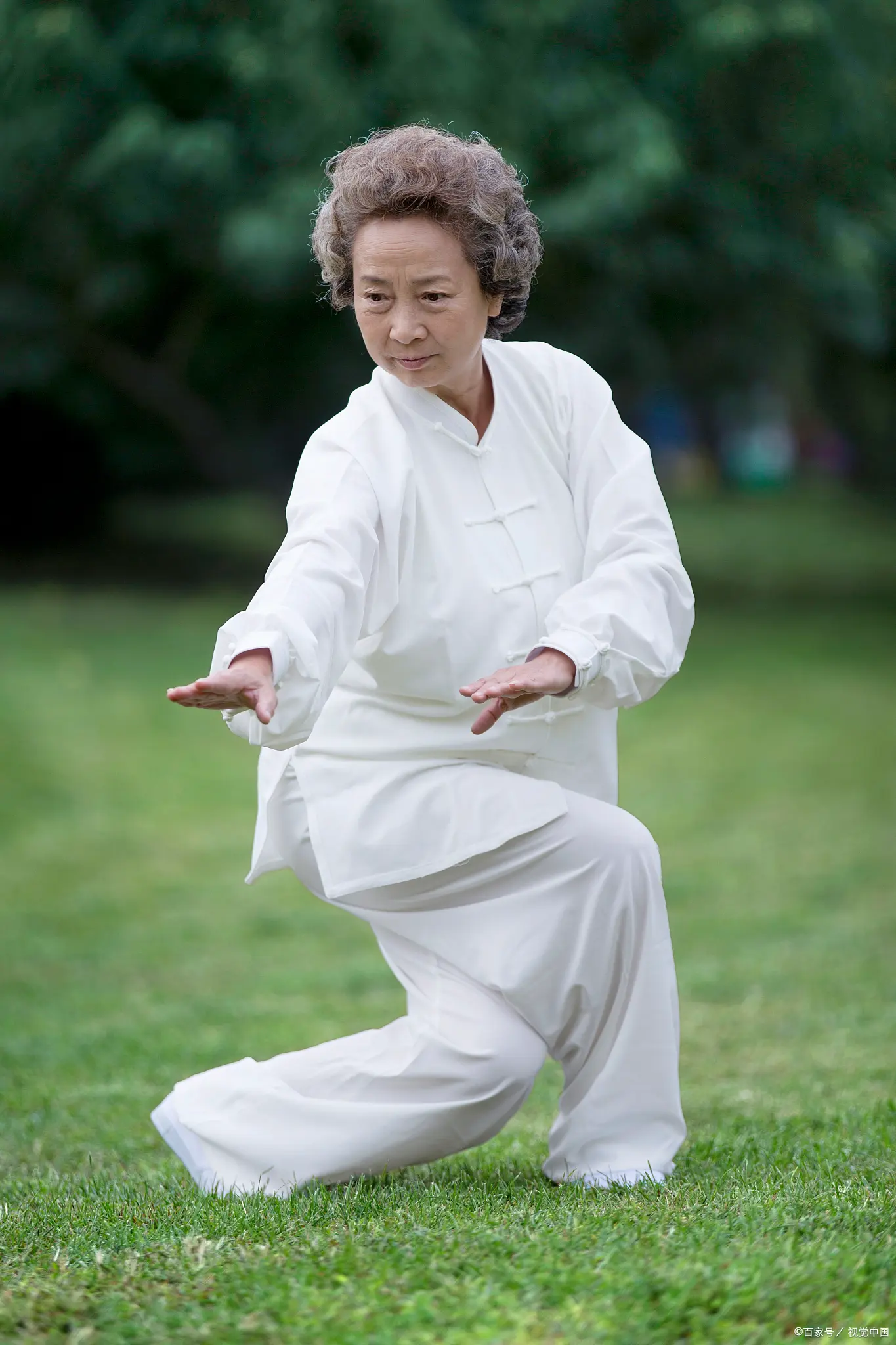
From a biomechanics perspective reviewed by Dr. Jing Li, PhD , Tai Chi Walking places minimal vertical impact on the knee joint. Unlike running, which involves airborne phases and abrupt loading, Tai Chi Walking maintains continuous ground contact and slow weight transfer.
For a biomechanical breakdown of Tai Chi Walking compared with Nordic and Japanese interval walking, read our full walking impact comparison guide .
| Movement Type | Impact (x Body Weight) | Knee Stress Type |
|---|---|---|
| Tai Chi Walking | 1.1 – 1.3x | Low (Controlled Load) |
| Normal Walking | 1.5 – 2.0x | Moderate (Momentum) |
| Running / Jogging | 3.0 – 5.0x | High (Impact Shock) |
Key biomechanical characteristics:
- No jumping or pounding
- Gradual weight shifting
- Controlled knee flexion
- Even force distribution through the foot
This results in lower peak joint stress and improved joint lubrication through movement — a critical factor for individuals with early-stage osteoarthritis.
Because the impact is so low (1.2x body weight), you can practice longer and more frequently, which is the key secret to [ Tai Chi Walking for Weight Loss ].
The “Spiral Force” Mechanism Explained Simply
One defining feature of Chen-style Tai Chi is spiral force ( silk reeling ) . Rather than isolating the knee, movement originates from the hips and torso, with the knee following naturally.
Biomechanically, this creates:
- Co-contraction of quadriceps and hamstrings
- Reduced patellar tracking stress
- Improved neuromuscular control
Dr. Jing Li notes that this muscle coordination helps stabilize the knee dynamically, rather than relying on passive joint structures alone.
What Medical Research Says About Tai Chi and Knee Health
Tai Chi for Knee Osteoarthritis: What Studies Show
Medical research increasingly supports Tai Chi as a safe intervention for knee conditions.
- The American College of Rheumatology (ACR) recommends Tai Chi as a non-pharmacological therapy for knee osteoarthritis.
- A JAMA Network Open study reported significant pain reduction and improved physical function after 12 weeks of Tai Chi practice.
- Other studies show improvements in balance, proprioception, and lower-limb strength.
Importantly, these benefits were achieved without increased injury rates .
What Tai Chi Does Not Do to Your Knees
Tai Chi Walking does not :
- Grind down cartilage
- Cause repetitive impact trauma
- Force the knee into extreme ranges when practiced correctly
Most reported knee pain during Tai Chi practice stems from incorrect technique, not inherent danger.
The 3-Minute Self-Assessment: Should You Practice Tai Chi Walking?
⚠️ Three Questions You Must Answer First
- Is your knee currently swollen or red? (Active inflammation = Rest)
- History of severe injury? (Meniscus/ACL tears = Consult doctor)
- Is your BMI significantly above average? (Requires higher stances)
3 Simple Functional Tests
- One-leg stand (30s): Tests stability.
- Controlled squat: Checks alignment.
- Stair test: Reveals cartilage sensitivity.
Pain, sharp discomfort, or instability during these tests signals the need for caution.
Pain Signals Explained: The Traffic-Light System
Understanding these signals prevents injury. Listen to your body:
🟢
Green Light: Mild muscle soreness (thighs/glutes) that fades within an hour. Action: Safe to continue.
🟡
Yellow Light: Joint ache lasting several hours. Action: Reduce depth (stance height) or duration.
🔴
Red Light: Sharp, stabbing, or needle-like pain inside the joint. Action: STOP immediately. Check alignment.
How Tai Chi Walking Protects Knees When Done Correctly
The Golden Alignment Rule: “Three Points in One Line”
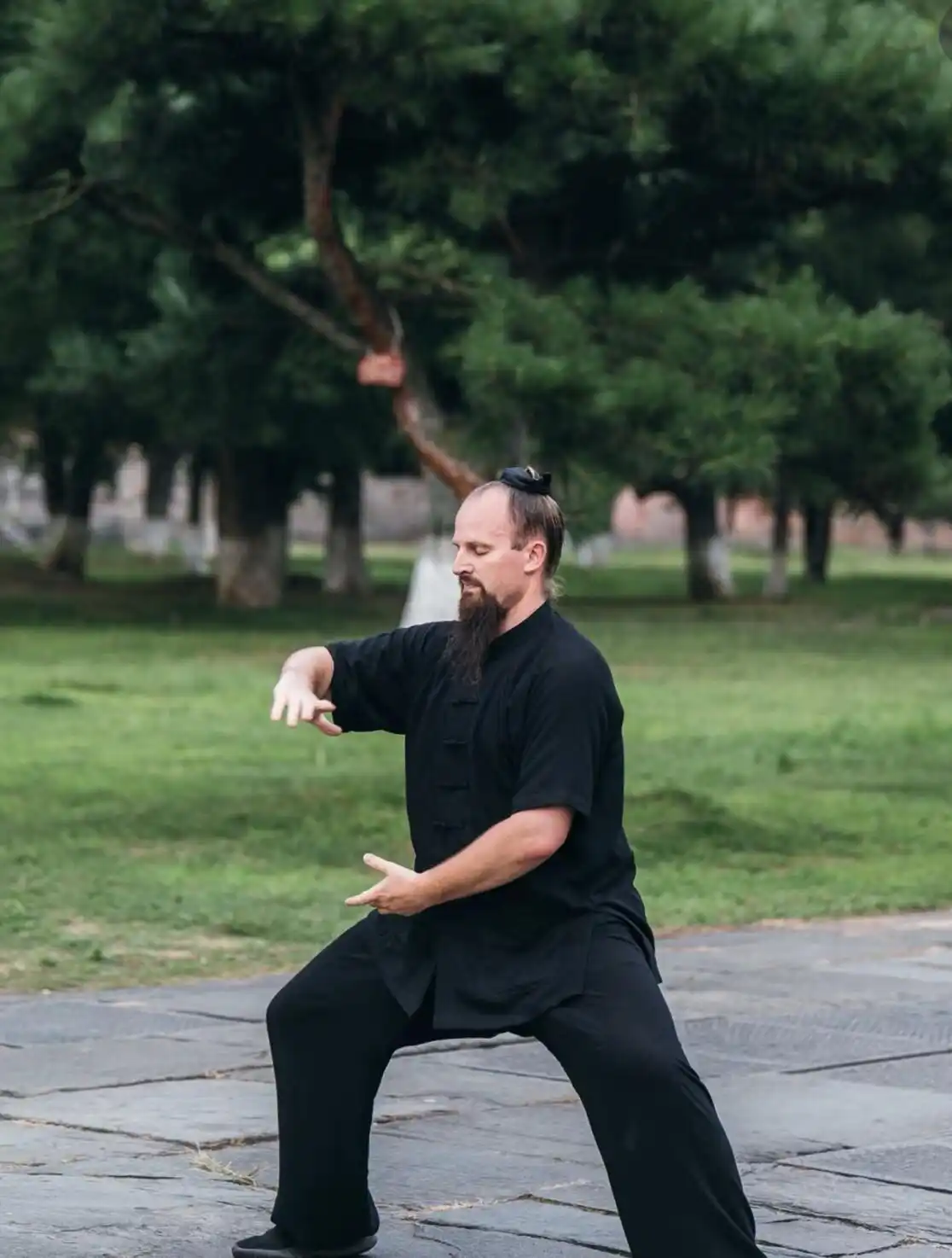
In Chen-style teaching, proper alignment follows a simple rule: nose , knee , and toe move in the same direction .
This alignment:
- Prevents inward knee collapse
- Reduces shear force on the meniscus
- Maintains patellar tracking
Why the Hip Leads and the Knee Follows
Master Mingde Chen often describes the hip ( kua ) as a door hinge , with the knee acting as the door panel. When movement begins at the hip, the knee moves naturally and safely.
Twisting the knee directly under load is a common mistake that increases injury risk.
High Stance vs. Low Stance: Which Is Safer?
Contrary to popular belief, lower is not better for knee health.
For most beginners and older adults:
- Knee angle around 120–135 degrees
- Moderate depth with upright posture
- Emphasis on control, not endurance
Low stances are advanced skills and not required for health benefits .
Common Mistakes That Cause Knee Pain (Not Tai Chi Itself)
The “Screw Effect”: Knee Collapse Explained
When the knee collapses inward while bearing weight, it creates a twisting force similar to “screwing” the joint. Over time, this stresses the meniscus and cartilage. Many generic fitness apps ignore these alignment rules. See our community discussion on [ why some apps like Mad Muscles can be risky for beginners ].
Overtraining and Ego-Based Practice
Practicing too long, too low, or copying advanced practitioners often leads to discomfort. Tai Chi rewards patience, not intensity.
A Knee-Friendly Tai Chi Walking Progression Plan
Stage 1: Stability Before Movement (0–3 Months)
- High-stance Tai Chi Walking
- Wall-supported squats
- Heel raises for ankle stability
Stage 2: Controlled Weight Shifting (3–6 Months)
- Cloud Hands in high stance
- Modified single-leg balance
- Slow, deliberate transitions
Progression should always follow comfort, not ambition.
Final Reassurance and Safe Next Step
Tai Chi Walking is not harmful to the knees when practiced with proper alignment, appropriate depth, and respect for individual limits.
This article reflects both traditional Chen-style Tai Chi lineage knowledge and modern biomechanical review , offering a balanced, evidence-based perspective.
If your goal is to move safely, reduce joint stress, and rebuild confidence in motion, Tai Chi Walking can be one of the most knee-friendly practices available.
Your knees are ready. Now learn the proper technique:
→ Start the Complete Tai Chi Walking Guide
Or if you’re a senior: Tai Chi Walking for Seniors & Fall Prevention →
FAQ
- Is Tai Chi Walking safe for knees?
Yes. Tai Chi Walking is safe for knees when practiced with proper alignment and appropriate intensity. Is Tai Chi Walking safe for knees? From a biomechanical perspective, it is a low-impact exercise that minimizes ground reaction force and reduces stress on knee cartilage compared to running or jumping activities.
- Does Tai Chi Walking damage knee joints?
No. Tai Chi Walking does not damage knee joints when performed correctly. Does Tai Chi Walking damage knee joints? Research and clinical recommendations show that slow, controlled weight shifting in Tai Chi improves joint stability rather than causing cartilage wear or meniscus damage.
- Can Tai Chi Walking cause knee pain?
Yes — but only if done incorrectly. Can Tai Chi Walking cause knee pain? Knee pain usually results from poor alignment, excessive depth, or inward knee collapse, not from Tai Chi Walking itself. Proper technique significantly reduces this risk.
- Is Tai Chi Walking good for knee osteoarthritis?
Yes. Tai Chi Walking is recommended for people with knee osteoarthritis by major medical organizations. Is Tai Chi Walking good for knee osteoarthritis? Studies show it can reduce pain, improve balance, and enhance joint function when practiced at a suitable intensity.
- Is Tai Chi Walking better than running for knee health?
Yes. Tai Chi Walking is significantly more knee-friendly than running. Is Tai Chi Walking better than running for knee health? Running creates 3–5 times body-weight impact on the knees, while Tai Chi Walking produces much lower joint loading with controlled movement.
- Is Tai Chi Walking safe for seniors with knee problems?
Yes, in most cases. Is Tai Chi Walking safe for seniors with knee problems? When practiced in a higher stance and without twisting, Tai Chi Walking helps seniors maintain mobility and joint stability with minimal injury risk.
- Is low stance Tai Chi Walking bad for knees?
Yes, for most beginners. Is low stance Tai Chi Walking bad for knees? Deep knee bending increases joint pressure and is unnecessary for health benefits. A higher stance is safer and more effective for knee protection.
- Is Tai Chi Walking safe if you are overweight?
Yes, with modifications. Is Tai Chi Walking safe if you are overweight? Practicing in a higher stance and reducing session duration helps limit knee joint stress while maintaining the benefits of Tai Chi Walking.
- Should I consult a doctor before practicing Tai Chi Walking for knee pain?
Yes, if you have existing knee conditions. Should you consult a doctor before practicing Tai Chi Walking for knee pain? Medical consultation is recommended for individuals with severe osteoarthritis, recent surgery, or persistent inflammation.
- Is Tai Chi Walking a knee-friendly exercise?
Yes. Tai Chi Walking is considered a knee-friendly exercise by both traditional instructors and modern biomechanics experts. Is Tai Chi Walking a knee-friendly exercise? Its slow pace, controlled alignment, and low-impact nature make it suitable for long-term joint health.
- Does Tai Chi Walking help with knee arthritis?
Yes. Tai Chi Walking can help reduce knee arthritis symptoms by improving joint alignment, muscle support, and movement control without adding impact.
Arthritis pain often increases when the knee joint experiences uneven loading or instability. Tai Chi Walking addresses these factors by:
keeping the knee aligned over the foot
transferring weight slowly and evenly
activating muscles around the joint continuously
avoiding sudden compressive forces
Because movement stays smooth and low-impact, many people with knee arthritis can practice comfortably even when higher-intensity exercises are difficult.
Clinical studies on Tai Chi for arthritis show improvements in pain, stiffness, and physical function over 8–12 weeks of regular practice. Tai Chi Walking uses the same controlled stepping mechanics in a simplified, repetitive form, making it especially suitable for joint-sensitive individuals.
👉 See stepping mechanics: what Tai Chi Walking is and how it works
- How many times a week should I practice Tai Chi Walking for knee pain relief?
For knee pain relief, most therapeutic Tai Chi programs recommend practicing 3–5 times per week for 20–30 minutes per session.
This frequency provides enough repetition to retrain gait and joint alignment while allowing tissues around the knee to adapt gradually.
General guidance:
1–2×/week: maintenance or gentle mobility
3–5×/week: pain-reduction and functional improvement
daily short practice: optimal for motor learning
Research on Tai Chi for knee pain shows that practicing fewer than three times weekly often produces limited improvement, while practicing more than once per day does not significantly increase benefit.
Consistency matters more than duration. Short, regular sessions usually help the knee more than occasional long sessions.
👉 Home routine: Tai Chi Indoor Walking practice guide
- Can I practice Tai Chi Walking during knee replacement recovery?
Yes — but only with medical clearance and stage-appropriate modification.
After knee replacement surgery, rehabilitation typically progresses from basic mobility to controlled walking mechanics. Tai Chi Walking is often introduced in later recovery because it trains:
balanced weight acceptance
controlled step placement
joint alignment awareness
confidence during walking
Many clinicians consider gentle Tai Chi stepping appropriate around 6–12 weeks after surgery, once walking without assistive support is stable. However, timing varies depending on healing, swelling, and strength.
During recovery practice should be modified:
shorter steps
higher stance
slow transfers
no deep knee bending
pain-free range only
Always follow your surgeon or physiotherapist’s guidance. Tai Chi Walking should support recovery — never replace prescribed rehabilitation.
⚠️ Not medical advice. This article is for educational purposes only. Always consult a qualified healthcare provider before starting any exercise or wellness program.