Tai Chi for Beginners: Where to Start, What to Practice First, and Your First Week
New to Tai Chi? Start here. Learn what Tai Chi actually is, what to practice first, how to build your first week, and how to avoid the beginner mistakes that make people quit too early.
Most beginners are not confused about whether Tai Chi looks beautiful.
They are confused about where to start without wasting months.
That confusion is reasonable, because Tai Chi is often introduced in one of two unhelpful ways:
- as vague wellness poetry
- as a long form to memorize before you understand anything
This page takes a better route.
Think of it as your practical starting roadmap:
- what Tai Chi actually is
- what to practice first
- what not to worry about yet
- how to build your first week
- how to avoid the beginner mistakes that make people quit
The main thing to understand is this:
you do not start Tai Chi by trying to look advanced.
You start by learning how to stand, breathe, shift weight, and move without fighting yourself. This guide is for complete beginners who want to start Tai Chi at home, safely and without confusion.
If Qigong sounds more approachable than Tai Chi, our Qigong for Beginners guide covers the gentlest entry point for internal practice.
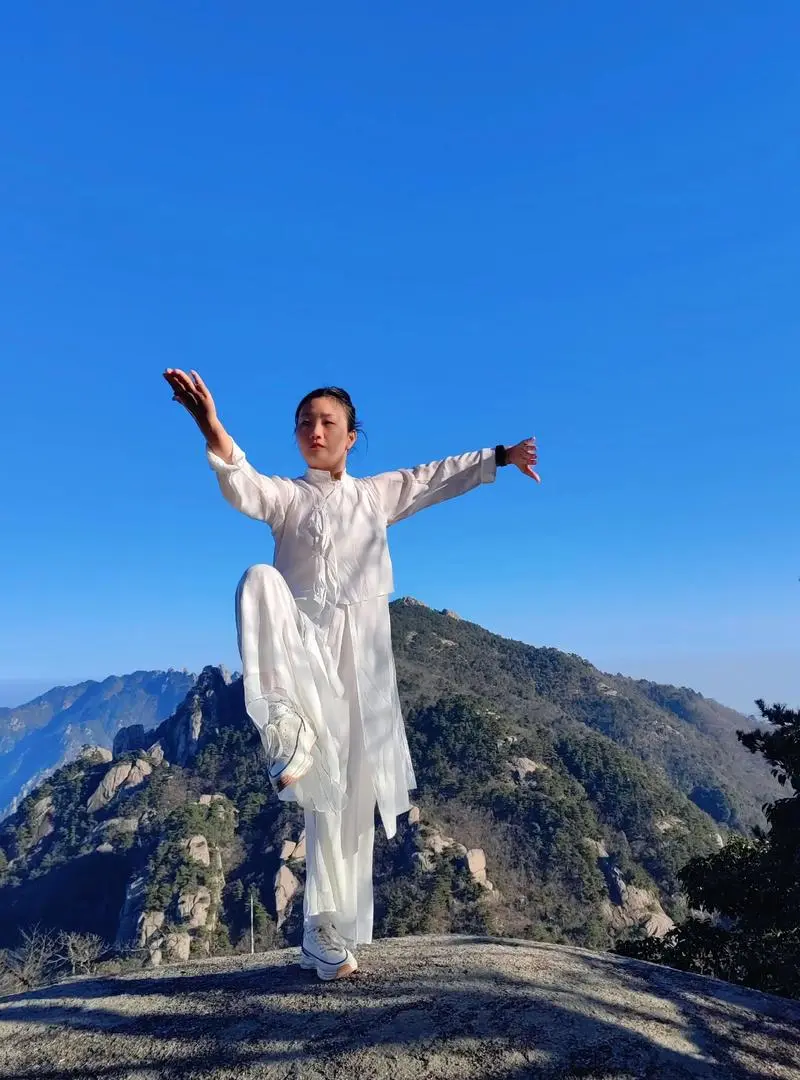
Can I start Tai Chi today?
Yes. You only need:
- 5 square feet of space — about 1.5 by 2 meters of clear, flat floor
- Loose clothing — nothing that restricts your arms or legs
- 5–7 minutes — that is enough for a meaningful first session
- No experience — you do not need to know anything beforehand
Tai Chi is one of the most accessible movement practices available. You do not need a studio, equipment, or prior experience to begin. The movements start from where you already are — standing, breathing, and shifting weight.
What Tai Chi actually is
Tai Chi is a Chinese movement system that combines:
- posture
- breathing
- weight transfer
- focused attention
It can be practiced as martial art, moving meditation, health method, or all three together.
For a beginner, the most useful thing to know is that Tai Chi is not “just slow exercise.” The slowness is there so you can feel:
- where your weight actually is
- where you tense unnecessarily
- whether your movement is connected or fragmented
That is why Tai Chi can feel simple from the outside and surprisingly demanding from the inside.
What to practice first
Beginners often think the first step is choosing a style or memorizing a full sequence.
Usually it is not.
The first step is learning three foundations:
1. Standing
You need a reference posture. On this site, that starts with Wuji.
2. Breathing
You need a way to stop turning practice into another form of strain.
3. Walking and weight shift
You need movement simple enough to repeat without losing structure. That is why Tai Chi Walking is one of the best starting points.
What your first week should look like
Do not try to do everything.
A good first week can be this:
| Day | Focus | Duration |
|---|---|---|
| Day 1 | Stand in Wuji — feel your weight settle into the feet | 5 min |
| Day 2 | Stand in Wuji + Tai Chi Walking — shift weight slowly | 7 min |
| Day 3 | Walk + breathe — match your exhale to the step | 7 min |
| Day 4 | Walk + 1 movement repeat — repeat Commencing Form slowly | 8 min |
| Day 5 | Walk + breathe + movement — short flow | 8 min |
| Day 6 | Repeat favorite sequence from previous days | 8 min |
| Day 7 | Walk + 1 movement repeat — focus on continuous, relaxed flow | 10 min |
That is enough to begin building:
- balance
- calm
- body awareness
- routine consistency
Your first month
| Week | Focus | Session Length |
|---|---|---|
| Week 1 | Standing + breathing | 5–7 min |
| Week 2 | Walking + weight shift | 7–10 min |
| Week 3 | Add 4 basic movements — repeat each slowly | 10–12 min |
| Week 4 | Mini routine — link movements into a short continuous flow | 10–15 min |
Expected results: the first three months
| Timeframe | What to Expect |
|---|---|
| Week 1 | Shoulders relax, breathing deepens |
| Week 2 | Balance improves, less morning stiffness |
| Week 4 | Breathing feels natural during movement |
| Month 2 | Weight transfer becomes smoother, posture improves |
| Month 3 | Movement confidence builds, routine feels automatic |
Health Benefits of Tai Chi for Beginners
Most beginners ask the same question early: what will Tai Chi actually do for me?
Research over the past two decades has built a clear picture. Here are the benefits best supported by clinical evidence and most relevant to someone starting out:
Balance and fall prevention. Systematic reviews consistently show that Tai Chi reduces fall risk by improving lower-body strength and proprioception — your body’s ability to sense where it is in space. A 2023 meta-analysis of over 50 trials found fall reductions of 30–43% in older adults who practiced regularly. → Tai Chi for Balance & Fall Prevention | NCCIH — Tai Chi for health
Joint comfort and arthritis-friendly movement. Multiple studies, including Cochrane reviews, indicate that Tai Chi reduces pain and improves physical function in people with knee osteoarthritis and rheumatoid arthritis. The slow, controlled range of motion strengthens supporting muscles without pounding the joints. → Tai Chi for Chronic Conditions & Arthritis | Cochrane review — Tai Chi for osteoarthritis
Stress reduction, anxiety relief, and better sleep. Clinical trials have found that regular Tai Chi practice lowers cortisol levels, reduces symptoms of generalized anxiety, and improves sleep onset and quality. The combination of rhythmic breathing and focused attention appears to regulate the autonomic nervous system. → Tai Chi for Stress Relief · Tai Chi for Better Sleep · Tai Chi for Anxiety | NHS — Tai Chi for health
Gentle cardiovascular conditioning and quality of life. Although the movements are slow, Tai Chi elevates heart rate to moderate-intensity levels. Participants in longitudinal studies consistently report improved energy, mood, and daily functioning. → Tai Chi for Chronic Conditions | Tai Chi Health Benefits Hub
Evidence at a Glance: What the Studies Show
| Benefit | Key Finding | Study Type | Source |
|---|---|---|---|
| Fall Prevention | 30–43% risk reduction in older adults | Meta-analysis (50+ trials, 2023) | NCCIH |
| Knee Osteoarthritis | Reduced pain, improved physical function | Cochrane Systematic Review | Cochrane |
| Stress & Anxiety | Lower cortisol, improved HRV | Multiple RCTs | NHS |
| Weight Management | 3.3 cm waist reduction in 12 weeks | C-RCT (n=374) | PubMed |
| Bone Density | No BMD loss during weight loss | 12-week RCT | PubMed |
Tai Chi for Beginners Over 50 and 60
Tai Chi is one of the most prescribed exercises for adults over 50 and 60 — and for good reason. It builds the three things that decline fastest with age: balance, leg strength, and body awareness.
Start safely. Practice next to a wall, counter, or sturdy chair. If standing is difficult, begin with seated Tai Chi — the upper-body movements and breathing still deliver real benefits. Many Tai Chi for seniors walking programs offer chair-based options.
What to focus on. Balance work and fall prevention are the most evidence-backed reasons to start. A 2023 meta-analysis found fall reductions of 30–43% in older adults who practiced regularly. Tai Chi Walking is the ideal starting movement — low-impact, natural, and immediately accessible.
No special equipment needed. Loose clothing and flat shoes are all you need. Free resources — including our beginner eBook — make it easy to start at home without spending anything.
If you have chronic conditions. Tai Chi adapts to arthritis, joint pain, and chronic conditions better than almost any other exercise. Keep stances high, avoid deep knee bends, and listen to your body.
Who Tai Chi for Beginners Is Perfect For
Tai Chi adapts to a wide range of bodies, ages, and health goals. Here is how different beginners can approach it:
For seniors and older adults. Tai Chi is one of the most recommended fall-prevention exercises worldwide. Chair-based or wall-supported versions make it accessible even with limited mobility. Start with 5–10 minutes of seated movement and progress to standing when ready.
For office workers with stiff neck, shoulders, and back. A short 5–10 minute midday practice can reverse the postural strain of prolonged sitting. Focus on shoulder release, spinal rotation, and weight-shifting to break the tension cycle.
For people with arthritis, knee pain, or joint sensitivity. Keep stances high (minimal knee bend) and avoid deep twisting. Many practitioners with chronic joint conditions benefit from a seated or chair-based version of the basic movements. → Tai Chi for Chronic Conditions
For those managing stress, anxiety, or sleep issues. Evening practice works particularly well. Combine slow walking with relaxed breathing to shift the nervous system toward a restorative state. → Tai Chi for Stress · Tai Chi for Sleep · Tai Chi for Anxiety
For women. Tai Chi addresses several health priorities specific to women — bone density maintenance, balance through menopause, stress management, and mental health support. The low-impact nature makes it sustainable through pregnancy, postpartum recovery, and beyond. Many women also find the stress relief and sleep quality benefits especially valuable during hormonal transitions.
Tai Chi for Beginners to Lose Weight
Can slow movement really help with weight loss? Yes — but not in the way a high-intensity workout does.
How it works. Tai Chi for weight loss operates through three pathways: gentle caloric expenditure (Tai Chi Walking burns 280–350 kcal per hour), cortisol reduction (lower stress hormones mean less belly fat storage), and increased body awareness that often leads to better eating choices.
The most effective movement for weight goals. Tai Chi Walking is the single best starting point — it is sustainable enough to do daily and joint-friendly enough that you will not skip sessions due to soreness. The walking weight loss guide breaks down exactly how to structure it.
Expect gradual, sustainable results. Tai Chi does not produce dramatic short-term weight loss. Instead, it rewires the habits and hormonal patterns that make weight loss difficult — which is why many practitioners report it works better over 6 months than crash programs that fail in 3 weeks. → Full evidence review
How to Start Tai Chi for Beginners at Home
You do not need a studio, a uniform, or any special equipment. Here is what you need to begin a home practice:
Space. About 1.5 by 2 meters (5 by 7 feet) of clear, flat floor. Avoid slippery or heavily carpeted surfaces.
Clothing. Loose, comfortable clothing that does not restrict your arms or legs. Flat shoes with thin soles — or bare feet — give you the ground feel you need. Avoid thick cushioned running shoes.
Equipment. Optional but helpful: a phone or tablet to follow a video, a mirror to check your posture, and a timer.
Frequency and duration. Start with 5 to 15 minutes per session, 3 to 5 times per week. After 3 to 4 weeks, gradually increase to 20 to 30 minutes if it feels sustainable.
When to practice. Mornings work well for gentle awakening. Lunch breaks help reset posture and focus. Evening sessions support relaxation and better sleep.
7-Minute Tai Chi Routine for Beginners
This 7 minute flow uses four of the most accessible movements in Tai Chi. No memorization required — focus on feeling each shape rather than performing it perfectly.
1. 起势 — Commencing Form(Chen Style 18-Form #1)
| Goal | Relax shoulders, settle weight |
| Duration | 1 minute |
| Common Mistake | Lifting the shoulders, locking the elbows |
| Tip | Imagine floating. Movement comes from the back, not just the arms. |
Stand with feet shoulder-width apart, knees slightly bent, arms hanging naturally. Inhale slowly and raise both arms to shoulder height as if lifting a light balloon. Exhale and let the arms float back down.

2. 金刚捣碓 — Buddha’s Warrior Attendant Pounds Mortar(Chen Style 18-Form #2)
| Goal | Gather power in the Dantian (lower abdomen energy center), release downward |
| Duration | 1–2 minutes |
| Common Mistake | Forcing the stomp, rounding the back |
| Tip | Let the weight settle naturally. Keep the spine long. |
From Wuji stance, shift weight onto the right leg. Lift the left knee while the right hand rises to chest height, palm facing down, and the left hand rests at your side. Step forward with the left foot into a bow stance. Circle both arms — the right hand presses forward while the left hand pulls back to your hip. Shift weight back, lift the left knee again, and let the right fist settle into the left palm at waist height.

3. 懒扎衣 — Lazily Tying Robe(Chen Style 18-Form #3)
| Goal | Open the chest, relax the shoulders |
| Duration | 1–2 minutes |
| Common Mistake | Leading with the arm instead of the waist |
| Tip | Movement is led by the waist. Chest opens naturally — do not force the stretch. |
From the closing posture of the previous movement, shift weight onto the left leg. Turn the waist to the right as the right hand opens outward in a slow arc, palm facing upward, while the left hand presses downward to your side. Settle into a right bow stance as the right arm extends — as if tying a robe loosely across your body.

4. 六封四闭 — Six Sealings Four Closings(Chen Style 18-Form #4)
| Goal | Gather energy inward, release smoothly |
| Duration | 1–2 minutes |
| Common Mistake | Hands moving independently, losing the spine |
| Tip | The hands move as one unit. Keep the knees tracking over the toes. |
From the open posture, shift weight back onto the left leg. Circle both arms downward and across the body — the right hand traces a closing arc as the left follows. Settle into a left bow stance with both hands pressing forward at chest height, palms facing outward.

Safety Tips for Tai Chi Beginners
Tai Chi is one of the safest movement practices available, but a few precautions help you practice wisely:
Consult a doctor first if: you have uncontrolled cardiovascular conditions, recent joint replacement or surgery, severe osteoporosis, or significant balance disorders. Tai Chi is gentle, but individual conditions vary.
Stop or modify if you feel: sharp joint pain, dizziness, chest tightness, or shortness of breath. Reduce your range of motion, raise your stance (less knee bend), or switch to a seated version.
Knee safety: Keep your knees aligned with your toes at all times. Do not let the knee collapse inward. Avoid twisting the knee while bearing weight — turn with the whole body instead.
Seniors and those with limited mobility: Practice next to a wall, counter, or sturdy chair for support until your balance improves. Seated Tai Chi is a valid and effective starting point.
Tai Chi Styles for Beginners
Style matters, but less than people think. What matters more is whether the first material is teachable and repeatable. That said, knowing the landscape helps.
The five major styles at a glance
| Style | Feel for beginners | Best if you want |
|---|---|---|
| Yang Style | Large, slow, open movements — the most accessible entry | A gentle, widely taught starting point with plenty of resources |
| Chen Style | Alternates slow and explosive movement; more coordination early | Internal power and authentic traditional practice |
| Sun Style | Shorter forms with agile stepping; joint-friendly | A compact, knee-friendly form with unique footwork |
| Wu Style | Leaning forward posture; deep sensitivity work | A different body mechanic and focused internal sensitivity |
| Wu Hao Style | Compact frame with strict structural demands | Refined, precise practice (less commonly taught to beginners) |
How to choose a teacher or learning material
Look for these qualities whether you choose online or in-person instruction:
- Can the teacher explain movements in simple, physical terms — not just metaphor?
- Do they encourage you to adapt based on your body, or demand rigid imitation?
- Do they allow you to try different styles before committing?
- Is there a structured progression for beginners, not just a full-form sequence?
Online versus in-person
Both paths work for beginners. Online learning (video courses, guided content) is excellent for building familiarity with the movements and establishing a home routine. In-person instruction becomes more valuable when you want feedback on alignment and internal coordination.
Style matters. But your first month of consistent practice matters more than which style label you choose.
Free Tai Chi for Beginners PDF Guide
A written guide you can keep on your phone or print out is often the most practical way to stay consistent in the first month.
Download our free eBook. Understanding Qi: A Beginner’s Guide to Tai Chi Energy is a PDF guide covering the foundational concepts — Wuji stance, breathing methods, and the principles that make Tai Chi work.
What you get in the PDF:
- Illustrated Wuji standing instructions
- Basic breathing patterns
- The 5 core principles of Tai Chi movement
- A 4-week starter plan
Other free resources. The full Learn Tai Chi path on this site is completely free. For self-guided practice, the Learn Tai Chi by Yourself guide covers how to build a home routine without a teacher.
Common beginner mistakes
Starting with a long form too early
If the sequence is longer than your attention and structure can support, you end up rehearsing confusion.
Trying to imitate appearance
A beginner who tries to “look like Tai Chi” often becomes stiffer, not better.
Breathing too hard
Forced breathing usually makes the body noisier instead of calmer.
Changing methods too often
Internal practice rewards depth of repetition, not novelty.
What beginners usually feel first
The first useful changes are usually:
- better weight awareness
- lower shoulder tension
- more stable turning
- calmer breathing
- less rushing
These are not side effects. They are the beginning of real practice.
If you only do one thing after reading this
Do this:
- stand in Wuji
- breathe without forcing
- practice Tai Chi Walking for a few minutes
That is a better beginning than trying to master ten movements badly.
Key Takeaways
Start Tai Chi with three foundations: standing (Wuji), breathing without forcing, and Tai Chi Walking for weight shift. A 5-7 minute daily session is enough to begin — no equipment, no studio, no prior experience needed. Most beginners notice calmer breathing and less shoulder tension within the first week, with balance improvements in 2-4 weeks.
| First Week Progression | Duration | Focus |
|---|---|---|
| Day 1–2 | 5 min | Stand in Wuji, feel weight settle |
| Day 3–4 | 7 min | Add Tai Chi Walking + breath |
| Day 5–7 | 8–10 min | Walk + 1 movement repeat, continuous flow |
Frequently Asked Questions
Do I need to be flexible to start Tai Chi?
No. Tai Chi does not require flexibility, strength, or prior fitness. The movements start from where your body already is — standing, breathing, and shifting weight (NCCIH). Range of motion improves naturally with practice. If standing is difficult, seated Tai Chi is equally valid.
How long should a beginner practice each day?
5–15 minutes is enough for the first month. Three to five sessions per week produce measurable improvement. Consistency matters more than session length — a daily 7-minute practice builds skill faster than an hour once a week (NHS).
Can I learn Tai Chi at home without a teacher?
Yes. The foundational movements — Wuji standing, Tai Chi Walking, basic breathing — are teachable through written and video guidance. This site’s Learn Tai Chi path is entirely free. In-person feedback becomes valuable when you refine alignment, but the first month of home practice builds a strong foundation.
What style of Tai Chi is best for beginners?
Yang Style is the most commonly recommended starting point due to its large, slow, open movements and wide availability of learning resources. Chen Style (taught on this site) is excellent if you want authentic traditional practice with a balance of slow and expressive movement. The style matters less than consistent practice in the first month.
Is Tai Chi safe for seniors and people with joint conditions?
Yes — and it is one of the most recommended exercises for older adults. A 2023 meta-analysis found Tai Chi reduces fall risk by 30–43% (NCCIH). Practice next to a wall or chair for support, keep stances high (minimal knee bend), and focus on Tai Chi Walking as a starting movement. For chronic conditions, see our guide on Tai Chi for Chronic Conditions.
When will I start seeing results?
| Timeframe | What to Expect |
|---|---|
| Week 1 | Shoulders relax, breathing deepens |
| Week 2 | Balance improves, less morning stiffness |
| Month 2 | Weight transfer smoother, posture improves |
| Month 3 | Movement confidence builds, routine feels automatic (PubMed RCT) |
What to read next
Whether you are exploring Wuji stance for skeletal alignment, Tai Chi walking for dynamic balance training, or Qigong for stress reduction — this Hub provides a structured 5-stage journey. Each resource below directly bridges traditional Wudang internal mechanics with empirical insights from 210+ peer-reviewed studies. For a complete, self-paced curriculum with milestone checkpoints, explore our structured programs.
Your Learning Path
Everything you need to start and sustain a Tai Chi practice, organized by your next step.
Learn Tai Chi Step by Step
A structured 5-stage journey from Wuji to full practice.
Read Guide →Tai Chi Walking Guide
Low-impact walking practice rooted in Tai Chi mechanics.
Read Guide →Wuji Standing Meditation
The foundational stance — formless, undivided potential.
Read Guide →Zhan Zhuang (Standing Post)
Build structure and root through static standing practice.
Read Guide →Qi Gong for Beginners
Energy cultivation exercises to complement your practice.
Read Guide →24-Step Simplified Form
The most widely practiced Tai Chi form worldwide.
Read Guide →Tai Chi for Balance & Fall Prevention
Start here if you want to improve your balance and prevent falls with Tai Chi.
Read Guide →Tai Chi for Stress Relief
Beginner-friendly approach to lowering stress through mindful movement.
Read Guide →Tai Chi for Better Sleep
Calmer nights start here — a gentle Tai Chi practice for sleep quality.
Read Guide →Tai Chi for Anxiety
Beginner-friendly guide to using Tai Chi for anxiety relief.
Read Guide →Tai Chi for Chronic Conditions
Start here if you are managing arthritis, heart health, or chronic pain with Tai Chi.
Read Guide →CDC & Clinical Evidence
What the CDC and major health organizations say about Tai Chi for beginners.
Read Guide →Tai Chi for Beginners Over 50 & 60
A decade-by-decade guide to lifelong flow — tailored for adults over 50 and 60.
Read Guide →Frequently Asked Questions
The questions beginners ask most about starting Tai Chi.
How long does it take to learn Tai Chi basics?
How long before I start feeling the benefits of Tai Chi?
Can I learn Tai Chi by myself at home?
Is Tai Chi good for weight loss?
Is Tai Chi suitable if I have bad knees or arthritis?
How often should beginners practice Tai Chi?
Do I need to memorize a long form to get benefits?
How much space do I need to practice Tai Chi at home?
What is the best time of day to practice Tai Chi?
Is Tai Chi safe for seniors and older adults?
Can Tai Chi help with anxiety and sleep problems?
What should I wear for Tai Chi practice?
Do I need a teacher or can I learn from videos?
Is Tai Chi enough exercise on its own?
What is the difference between Tai Chi and Qigong?
How do I know if I am doing Tai Chi correctly?
What is the best tai chi style for beginners?
Is tai chi ok if you have osteoporosis?
What does the Catholic Church say about tai chi?
Does 7 minutes of tai chi really work?
What are common tai chi mistakes?
Which is better for seniors, yoga or tai chi?
What happens if you do tai chi every day?
Your First Step Is Simple
Begin with Wuji stance for 5 minutes today. No equipment. No experience needed.
Get Weekly Beginner Tips
New to Tai Chi? Get one actionable tip each week plus our free eBook.
No spam. Unsubscribe anytime.