Tai Chi Glossary > Ba Fa (八法)
Ba Fa (八法)
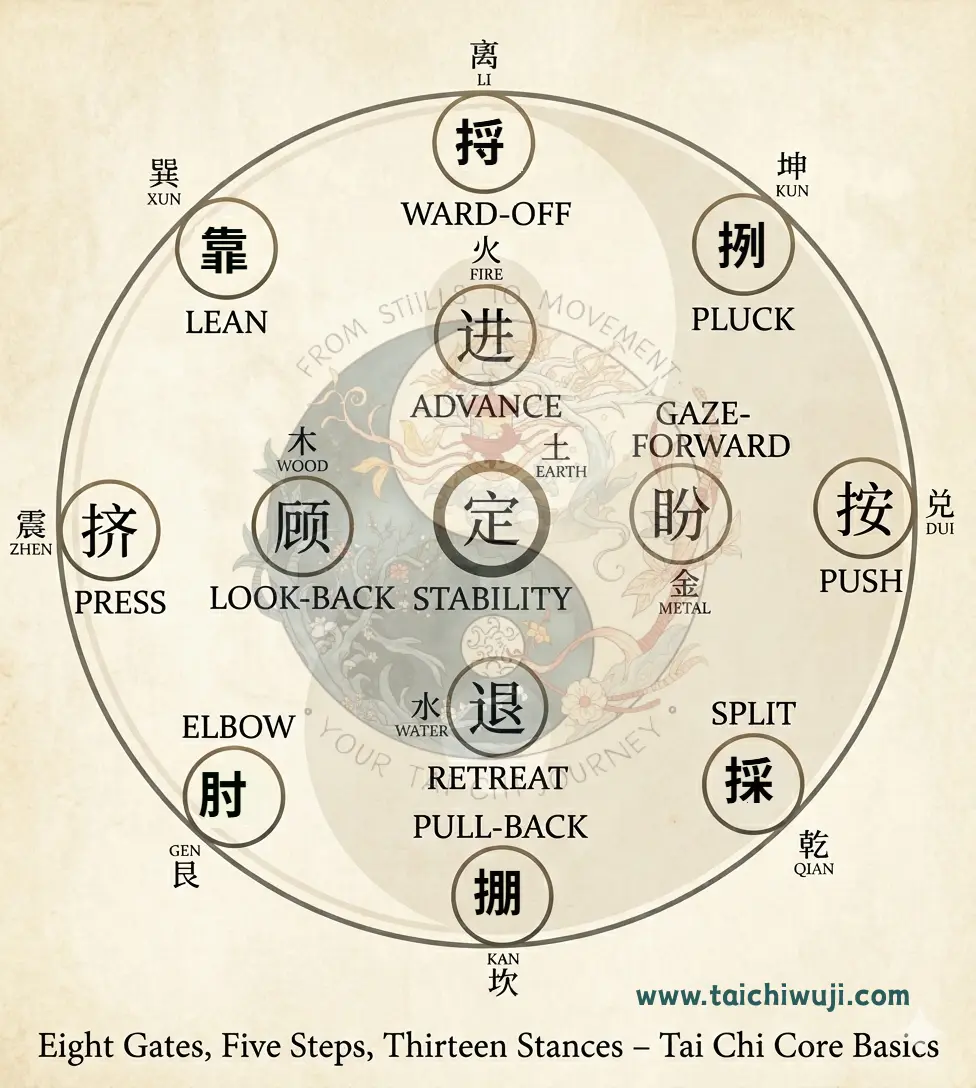
Definition: Ba Fa (八法) are the eight foundational methods of tai chi chuan—Peng, Lu, Ji, An, Cai, Lie, Zhou, Kao—representing the complete set of energetic expressions from which all tai chi techniques derive.
Understanding Ba Fa is understanding the grammar of tai chi. Just as all sentences in a language are built from a finite set of grammatical structures, every technique, application, and movement in tai chi chuan can be traced back to one or more of these eight methods. They are not merely a list of techniques—they are categories of jing (劲), each with a distinct energetic quality, direction, and principle of application.
In simple terms: The 8 ways to use your hands and the 5 ways to move your feet.
The Meaning of Ba Fa (八法)
| Translation | Context / Use Case | Nuance & Feel |
|---|---|---|
| The Eight Methods | Official or Academic | Formal, balanced, and standard. |
| The Eight Techniques | Practical Instruction | Action-oriented and easy to grasp. |
| The Eight Energies | Internal Theory / Push Hands | Advanced; emphasizes Jing over posture. |
| The Eight Gates | Cosmological / Directional | Deeply rooted in I Ching and Bagua theory. |
Ba (八) means “eight.” Fa (法) means “method,” “principle,” or “way of doing.” Together, Ba Fa translates as “ the eight methods “ — though in deeper usage, fa carries the sense of fundamental law or governing principle rather than mere technique.
The eight methods are traditionally associated with the eight trigrams of the I Ching (易经), linking tai chi’s technical framework to the cosmological structure of classical Chinese thought. Each method corresponds to a trigram, a cardinal or intercardinal direction, and a quality of force:
The first four—Peng, Lu, Ji, An—are considered the primary methods and appear together in the foundational sequence Grasp Sparrow’s Tail (揽雀尾), which is present in virtually every tai chi style. The second four—Cai, Lie, Zhou, Kao—are the supplementary methods, sometimes called the “four corners.”
The Eight Methods in Practice
Peng (掤) — Ward Off
Peng is the most fundamental of the eight methods and in many ways underlies all the others. It is an outward-expanding, buoyant force—like a balloon that yields to pressure without collapsing. In application, Peng intercepts and redirects incoming force by maintaining structural integrity and an expansive quality throughout the body. Without Peng as a foundation, the other methods lose their structural basis.
Lu (捋) — Roll Back
Lu is the yielding complement to Peng. Where Peng expands outward, Lu draws inward and redirects—following the opponent’s force, borrowing its momentum, and guiding it past the centerline. Lu is the clearest expression of the tai chi principle of using softness to overcome hardness.
Ji (擠) — Press
Ji is a compact, direct, forward-issuing force, typically applied with the forearm or back of the wrist against the opponent’s body. It closes the gap opened by Lu and delivers force along a straight line. In push hands , Ji often follows Lu as part of the four-method cycle.
An (按) — Push
An is a downward-and-forward settling force, applied with the palms. It is not a push in the conventional sense but a simultaneous downward seal and forward press that uproots the opponent’s structure by addressing their root before issuing forward force.
Cai (採) — Pluck
Cai involves seizing and controlling a limb—typically the wrist or elbow—and using a sudden downward or rotational pull to uproot and destabilize. It corresponds to the Cai entry in this glossary and is among the most direct expressions of listening jing in application.
Lie (挒) — Split
Lie applies force in two opposing directions simultaneously, splitting the opponent’s structure. A classic example is pulling one hand toward you while pushing the other away, creating a rotational destabilization that is difficult to resist. Lie corresponds to the Lie glossary entry.
Zhou (肘) — Elbow
Zhou uses the elbow as the primary striking or controlling surface. At close range where the hands cannot generate effective force, the elbow becomes the natural tool. Zhou techniques tend to be powerful and difficult to deflect due to the elbow’s structural solidity.
Kao (靠) — Lean / Body Strike
Kao uses the shoulder, back, hip, or any part of the body to strike or unbalance at very close range. It is the most physically direct of the eight methods and typically appears when hand techniques have been neutralized or the distance has collapsed entirely. Kao corresponds to the Kao glossary entry.
Ba Fa and the Five Steps
Ba Fa is traditionally paired with Wu Bu (五步), the Five Steps , to form the thirteen postures (十三势) of tai chi—the complete technical and strategic framework of the art. The eight methods govern what the hands and body do; the five steps govern how the feet move and position. Together they cover every possible situation in push hands and combat application.
This pairing reflects the cosmological structure underlying tai chi theory: eight trigrams (Ba Fa) plus five phases (Wu Bu, corresponding to the Five Elements ) equals thirteen—a number that recurs throughout classical tai chi literature.
Watch the full form in motion in our video guide below.
Common Misconceptions
-
“Ba Fa are eight separate techniques.” They are energetic categories, not fixed movements. Peng, for example, is not a specific hand position but a quality of force that can be expressed through dozens of different movements. A practitioner may express Peng through a ward-off gesture, a shoulder contact, or even a leg deflection—the movement changes; the energetic quality does not.
-
“The four corners are less important.” Cai, Lie, Zhou, and Kao are essential in close-range application and appear throughout all tai chi forms. The designation “four corners” refers to their trigram directions, not their importance. Practitioners who neglect the second four methods have an incomplete game in push hands.
-
“Understanding Ba Fa is enough.” Knowing the names and definitions of the eight methods is the beginning of understanding, not the end. Each method requires years of dedicated push hands practice to develop the sensitivity and timing needed for its correct application.
-
Cai (採) — the plucking method of the eight
-
Ji (擠) — the pressing method of the eight
-
Kao (靠) — the body-strike method of the eight
-
Lie (挒) — the splitting method of the eight
-
Lu (捋) — the roll-back method of the eight
-
An (按) — the push-down method of the eight
-
Grasp Sparrow’s Tail — the foundational sequence containing the first four methods
-
Five Steps — the footwork complement to Ba Fa forming the thirteen postures
-
Push Hands — the primary training context for Ba Fa application
-
Jing (劲) — the trained force quality expressed through each of the eight methods
-
Eight Gates — the spatial/directional framework associated with Ba Fa
Have questions about Ba Fa in practice? Our forum thread — [Masterclass] The Ultimate 62-Step Guide to Tai Chi’s 8 Methods & 5 Steps (Ba Fa Wu Bu) with Detailed Explanations — covers this and many more topics answered by experienced practitioners.
Related Glossary Terms
Explore connected concepts in the Tai Chi knowledge graph.
Community & Questions
Discussions from practitioners about Ba Fa.
Further Reading & Practical Guides
In-depth articles featuring Ba Fa.
The Last Gatekeeper: Chen Boxiang and the Hidden Lineage of Small Frame Taijiquan
Chen Boxiang (1944–2026), 18th-generation Chen clan descendant and 10th-generation inheritor of Chen Style Taijiquan, was the defining figure of Small Frame (Xiao Jia). This article traces his life from the Cultural Revolution's quiet defiance to his overseas teaching in 1995 — exploring why Small Frame is the most hidden, most demanding, and most authentic branch of Taijiquan, and what happens after its last gatekeeper departs.
The 8 Techniques of Tai Chi: Discover Peng, Lu, Ji, An and Unlock Internal Power
Go beyond the form. Learn the Tai Chi 8 techniques (Peng, Lu, Ji, An). This guide reveals the martial applications and internal energies that make Tai Chi a profound internal art.