Tai Chi Glossary > Five Elements (五行)
Five Elements (五行)
Definition: The Five Elements (五行)—Wood, Fire, Earth, Metal, Water—are a classical Chinese framework describing the cyclical transformation of energy, applied in tai chi, qigong, and traditional Chinese medicine to understand movement, health, and strategy.
The Five Elements are not elements in the Western chemical sense—they are not substances but phases of transformation, describing how energy moves through cycles of growth, consolidation, and change. In tai chi chuan and qigong , this framework provides both a map of the body’s internal energy landscape and a strategic model for understanding how forces interact and transform in practice.
The Meaning of Wu Xing (五行)
Wu (五) means “five.” Xing (行) is the more revealing character: it means “to walk,” “to move,” or “to proceed.” The compound Wu Xing is therefore more accurately translated as “ five movements “ or “ five phases “ than “five elements”—a translation that has persisted in English despite its misleading static connotation.
The five phases and their primary associations are:
| Phase | Chinese | Season | Direction | Organ Pair | Quality |
|---|---|---|---|---|---|
| Wood | 木 (Mù) | Spring | East | Liver / Gallbladder | Growth, expansion |
| Fire | 火 (Huǒ) | Summer | South | Heart / Small Intestine | Transformation, radiance |
| Earth | 土 (Tǔ) | Late Summer | Center | Spleen / Stomach | Stability, nourishment |
| Metal | 金 (Jīn) | Autumn | West | Lung / Large Intestine | Contraction, refinement |
| Water | 水 (Shuǐ) | Winter | North | Kidney / Bladder | Stillness, storage |
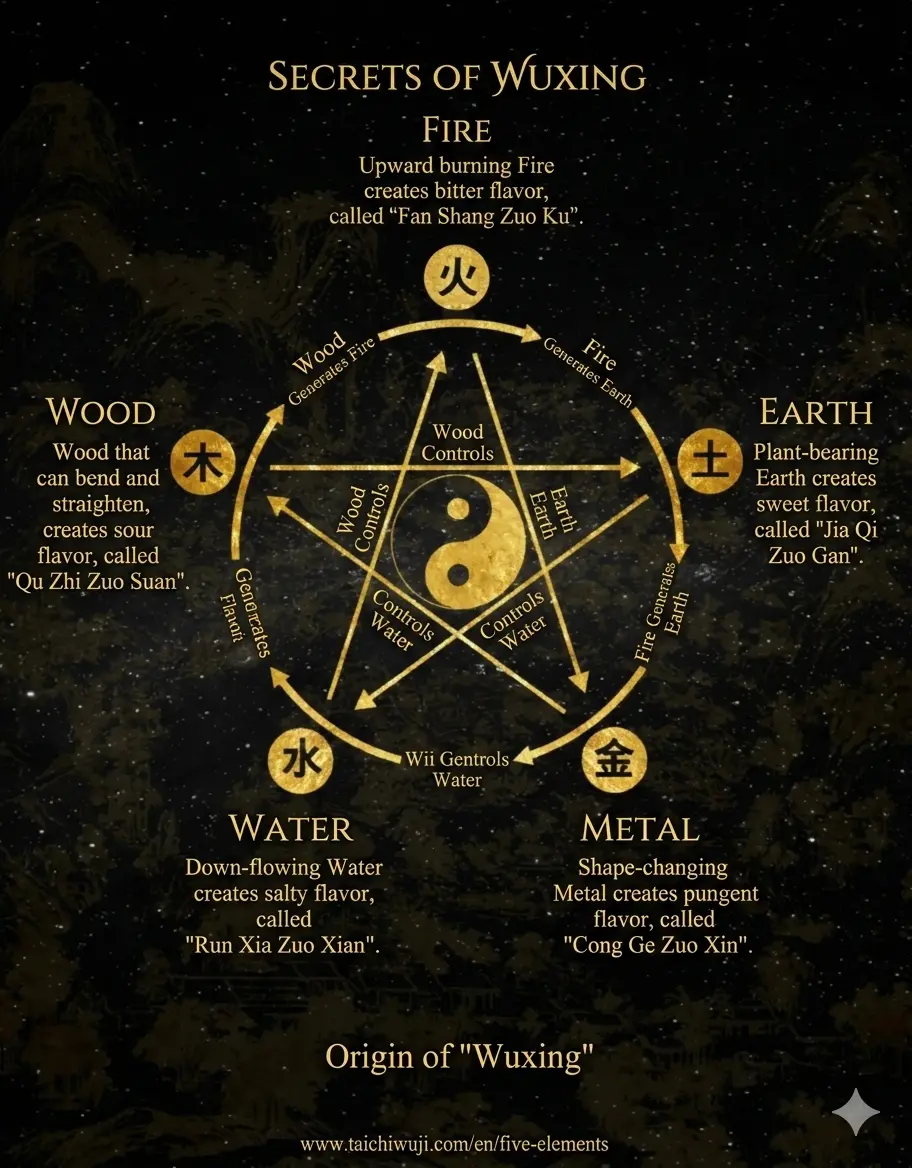
Two cycles govern the relationships between phases. The Generating Cycle (相生, shēng) describes how each phase gives rise to the next: Wood feeds Fire; Fire produces Earth (ash); Earth yields Metal; Metal holds Water; Water nourishes Wood.
The Controlling Cycle (相克, kè) describes how each phase restrains another: Wood parts Earth; Earth absorbs Water; Water quenches Fire; Fire melts Metal; Metal cuts Wood. These cycles are not merely theoretical—they are used in traditional Chinese medicine to diagnose imbalance and in qigong to guide therapeutic practice.
Five Elements in Tai Chi Practice
In tai chi chuan , the Five Elements framework appears most directly in the Five Steps (五步, Wǔ Bù)—the five footwork directions that complement the Ba Fa (eight methods) to form the thirteen postures (十三势). Each step corresponds to a phase:
- Advance (进步) — Metal
- Retreat (退步) — Wood
- Look Left (左顾) — Water
- Look Right (右盼) — Fire
- Central Equilibrium (中定) — Earth
Central Equilibrium (中定) corresponds to Earth—the stabilizing center from which all movement originates and to which it returns. This is not coincidental: Earth is the phase of rootedness, nourishment, and balance, making it the natural cosmological analog of the central principle in tai chi movement.
The Five Elements also inform the strategic logic of push hands and application. Understanding when to advance (Metal cutting) and when to yield (Water flowing) reflects the same intelligence as the Controlling Cycle—meeting force with its corresponding counter-phase rather than opposing it directly.
Five Elements in Qigong and Health Practice
In qigong practice, the Five Elements framework is most directly applied through organ-specific breathing and visualization exercises. Each organ system is associated with a phase, a color, a sound, and an emotional quality.
The Liu Zi Jue (六字诀), or Six Healing Sounds, is one of the most systematic qigong practices built on Five Elements organ theory—each of the six sounds targets a specific organ and its associated phase. The emotional correlates of each phase are particularly significant in therapeutic qigong:
- Wood — anger and frustration (Liver)
- Fire — joy and over-excitement (Heart)
- Earth — worry and overthinking (Spleen)
- Metal — grief and sadness (Lung)
- Water — fear (Kidney)
Persistent emotional states are understood to create imbalance in the corresponding organ system, while qigong practice that addresses the relevant phase can restore equilibrium. This bidirectional relationship—emotions affecting organs, organs affecting emotions—is one of the most clinically relevant aspects of Five Elements theory in modern therapeutic qigong contexts.
The Dan Tian relates to this framework through the Kidney-Water relationship: the Lower Dan Tian is located in the region associated with Kidney qi, which stores the fundamental vital essence (精, jing) inherited from birth. Preserving and replenishing this Water-phase energy is a central goal of longevity-oriented qigong practice.
Five Elements and the Seasons
Classical qigong assigns specific practices to each season based on Five Elements correspondence. Spring practice emphasizes Liver-Wood exercises—gentle stretching and expansion. Winter practice emphasizes Kidney-Water cultivation—stillness, zhan zhuang , and internal storage. This seasonal attunement reflects the broader Five Elements principle that human health is maintained by harmonizing with natural cycles rather than working against them.
Five Elements and Yin-Yang Theory
The Five Elements framework operates alongside rather than independently of yin and yang theory. Yin-yang describes the binary polarity underlying all phenomena; Five Elements describes the fivefold cycle of transformation within that polarity.
In practice, the two frameworks are used together: yin-yang analysis identifies the direction of imbalance, while Five Elements analysis identifies which phase or organ system is involved and which intervention—dietary, movement-based, or meditative—is most appropriate.
Common Misconceptions
“The Five Elements are a primitive pre-scientific theory.”
The framework is not a theory of chemistry or physics but a systems model of cyclical transformation. Its clinical utility in traditional Chinese medicine has been documented over two millennia of application, and its structural logic—particularly the generating and controlling cycles—maps onto modern systems thinking in ways that continue to generate research interest.
“Practitioners need to memorize all the correspondences.”
Beginning practitioners benefit most from understanding the basic generating and controlling cycles and the organ-emotion relationships. The full correspondence table is a reference tool for advanced study, not a prerequisite for effective practice.
“Five Elements only applies to health, not martial practice.”
As the Five Steps correspondence shows, the framework is embedded in the technical and strategic structure of tai chi from the beginning. Understanding Five Elements deepens tactical understanding of when to press, when to yield, and when to hold the center.
- Ba Fa — the eight methods that pair with Five Steps to form the thirteen postures
- Five Steps — the footwork system directly mapped onto the five phases
- Central Equilibrium — the Earth-phase center of tai chi structure
- Yin and Yang — the complementary polarity framework used alongside Five Elements
- Qigong — practice tradition in which Five Elements guides health and organ cultivation
- Liu Zi Jue — Six Healing Sounds practice built on Five Elements organ theory
- Dan Tian — lower energy center associated with the Kidney-Water phase
- Zhan Zhuang — standing practice suited to Water-phase cultivation in winter
- I Ching — classical text whose eight trigrams complement the Five Elements framework
- Tai Chi Chuan — martial art whose thirteen postures are structured by Five Elements and Ba Fa
Have questions about Five Elements in practice? Our forum thread — Qigong FAQ: Everything Beginners Ask — Answered by Senior Practitioners — covers this and many more topics answered by experienced practitioners.
Related Glossary Terms
Explore connected concepts in the Tai Chi knowledge graph.
Often Discussed Together
These concepts co-occur frequently across our articles and discussions.
Further Reading & Practical Guides
In-depth articles featuring Five Elements.
Qigong for Autumn: A Seasonal Practice Guide for the Transition into Fall
When the season turns, qigong turns with it. This guide explains how to adapt your practice from summer expansion to autumn gathering — the Sī sound, the Lung's Metal breath, and a 15–20 minute daily protocol from 立秋 to 秋分.
The Wudang Combat System: How Softness Conquers Hardness
Discover the实战 (combat) secrets of Wudang Kung Fu. Learn how Tai Chi, Xingyi & Bagua use softness, redirection, and spiral power for effective self-defense. Demystify internal martial arts with Tai Chi Wuji.
The 3 Internal Martial Arts: A Complete Guide to Xingyi, Bagua & Taiji
Discover the 3 core Internal Martial Arts: Xingyi Quan's power, Bagua Zhang's circles & Taiji Quan's flow. This complete guide compares their benefits for combat, health & mindfulness. Learn which one is right for you and how to start your journey today.