What Gets Lost When Tai Chi Goes Global — And Where It Still Lives
Key Takeaways
- Tai Chi's global spread has prioritized health applications over martial roots — most Western students never learn combat applications
- The "therapeutic Tai Chi" industry has removed push hands, Fa Jin, and martial interpretation from standard curricula
- Cultural context is also lost: Tai Chi was originally taught within master-student relationships lasting decades, not 6-week courses
- Awareness of what's lost allows practitioners to intentionally reclaim depth: seek lineage teachers, practice push hands, study the classics
A Conversation That Stopped Me
I recently reached out to David Roth-Lindberg , a Tai Chi teacher with over 40 years of experience in Sweden. I asked him a simple question: Is there really a difference between how Tai Chi is understood in the West versus in China?
His reply stopped me :
“I would suggest style based thinking is more prevalent in the west. In China, the ‘styles’ are obvious family names… But how Tai Chi is taught in the west and China is still very similar, focusing on form and how the visual ‘look’ of the postures, more than on the underlying principles.
So, in practice, both in China and the west, I would suggest you are correct, teaching Tai Chi principle based in a way that transcends style and school is very much absent.”
One line hit me hardest :
“Most people are just not interested in digging deeper and exploring the depth of the art.”
That sentence stayed with me. Because David isn’t describing a Western problem. He’s describing the problem — one that exists in China just as much as anywhere else.
What Has Been Deemphasized in Modern Tai Chi
If David is right — and I believe he is — then the real question becomes: What exactly has shifted as Tai Chi moved from closed-door transmission to mass practice?
In China, this isn’t just talk among practitioners. It’s documented in academic papers, official publications, and the testimonies of lineage holders.
Here’s what the evidence points to:
Martial application
Traditional Tai Chi was built around combat. Movements like Yan Shou Hong Chui (Hidden Thrust Punch) in Chen-style Lao Jia were never just postures — they were part of a fighting system requiring years of push-hands practice to master.
The 2024 Competition Rules for Tai Chi, published by China’s General Administration of Sport, explicitly require movements to be “smooth, rhythmic, and without obvious signs of force.” Explosive power (fa jin), stomping (zhen jiao), and spiral twisting (chan si jin) — all essential to traditional training — are systematically de-emphasized in competition routines.
Internal training
Traditional Tai Chi was never just about moving the body — it was about moving qi. This required standing meditation (zhan zhuang), breath regulation, and energy guidance. Chen-style lineage holder Chen Qingzhou documented these methods in A Compendium of Chen-style Tai Chi Kungfu (2003).
His warning: “A fist without internal kungfu is merely an empty form — a body without a soul.” Modern simplified routines have largely moved away from these foundational practices.
Philosophical depth
Traditional Tai Chi carried a complete philosophical system: Yin-Yang logic, Confucian balance, Chinese medicine’s energy pathways. Beijing Sport University’s motion-capture research confirms that traditional movement rhythms align with the body’s natural energy cycles. Much modern teaching, by contrast, focuses primarily on “how” and less on “why.”
Lineage transmission
Traditional Tai Chi was passed down through master-disciple relationships — “oral teaching and personal demonstration.” It was understood that the art required years to refine. Simplified routines, designed for mass transmission — books, videos, group practice — operate on a different model.
As representatives of five traditional schools in Hunan put it: “Traditional routines are the roots; new routines are the branches. Without roots, branches cannot grow into a forest.”
Training systems
Traditional training included standing meditation, single-movement repetition, push hands, and sanshou (free fighting). In many modern settings, this has been condensed to focus primarily on the form.
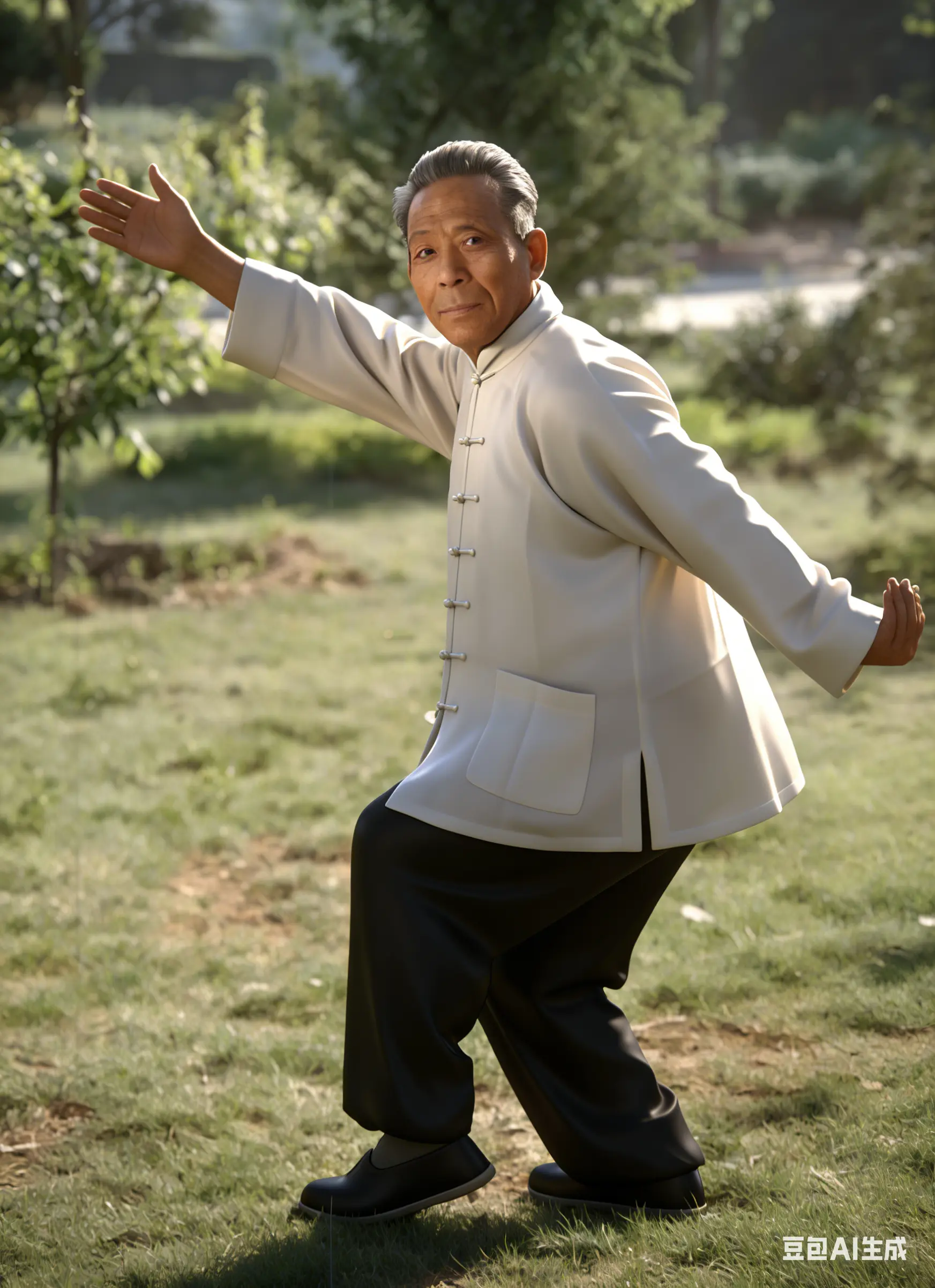
Wang Peisheng (1919–2004), Wu-style Tai Chi master, performing “Step Back and Mount Tiger.” He advanced Yang Chengfu’s principle of “using mind instead of force,” emphasizing that Tai Chi “completely relies on mind to achieve skill.” This posture embodies martial intent without muscular tension — a vanishing quality in modern Tai Chi.
A Gradual Shift, Not a Simple Loss
What’s interesting is that this wasn’t a sudden disappearance. It was a gradual reprioritization, shaped by changing contexts and goals.
Key turning points include:
- 1956 : The 24-form simplified Tai Chi was created by China’s Sports Commission. The stated principle: “easy to learn, easy to practice, focus on health.” Explosive movements, stomping, and jumps were not included.
- 1989 : The 42-form competition routine was standardized by the National Sports Commission’s Wushu Research Institute, with an emphasis on “standardization, performance orientation, unified scoring.”
- 2024 : The official Tai Chi Competition Rules state in Article 3.2: “Movements must be连贯, rhythmic, and without obvious signs of force.” Movements like stomping and fa jin are not part of the scoring criteria.
The martial elements of Tai Chi were not entirely forgotten — but they became less central as other priorities (accessibility, standardization, health promotion) moved to the forefront.
As one official source notes: “This routine is designed for competition. It does not include the explosive movements of original styles.”
The data suggests a shift in practice patterns as well. Many practitioners today never encounter push hands at all. The word “martial” in competition contexts refers more to heritage than to training methodology.
Where the Older Approaches Still Persist
If you only encountered Tai Chi through modern performance-oriented versions, you might assume the martial side had disappeared entirely. It hasn’t.
It’s just become less visible.
Among the traditions I’ve observed, several lineages — including Chen, Sun, Wu (Yuxiang), Zhaobao, and He — still preserve significant elements of the complete training system: form, push hands, and in some cases, sanshou. They represent living threads where principles remain central.
| Style | Core Feature | Lineage Holder | Where to Find |
|---|---|---|---|
| Chen | Fa jin, spiral power, explosive punches | Chen Zhenglei (National Intangible Cultural Heritage bearer) | Henan; online via Bilibili, Douyin |
| Sun | Living step, combat footwork | Sun Jianyun (passed; taught Zhang Dahui) | Hebei; Jinan, Qingdao |
| Wu (Yuxiang) | Short-range, compact, “hidden jin” | Li Shengduan | Hebei; YouTube channel |
| Zhaobao | Circular neutralization, “24 methods” | Dong Yonggui | Henan; Douyin livestream |
| He | Three-stage push hands (quantifiable progression) | He Youlu | Henan; official Wushu Association videos |
These are not museum pieces. They are living systems where push hands is still practiced, where fa jin is still taught, and where martial application remains a reference point.
One example is here in Shandong — though you won’t find it online.
Cai Wenxiao is a Chen-style small-frame lineage holder in Dezhou. He teaches in a family school, by disciple transmission only. No videos. No public classes. Just a small number of students who found their way to him and demonstrated sustained commitment.
That’s where some of the older methods still reside.
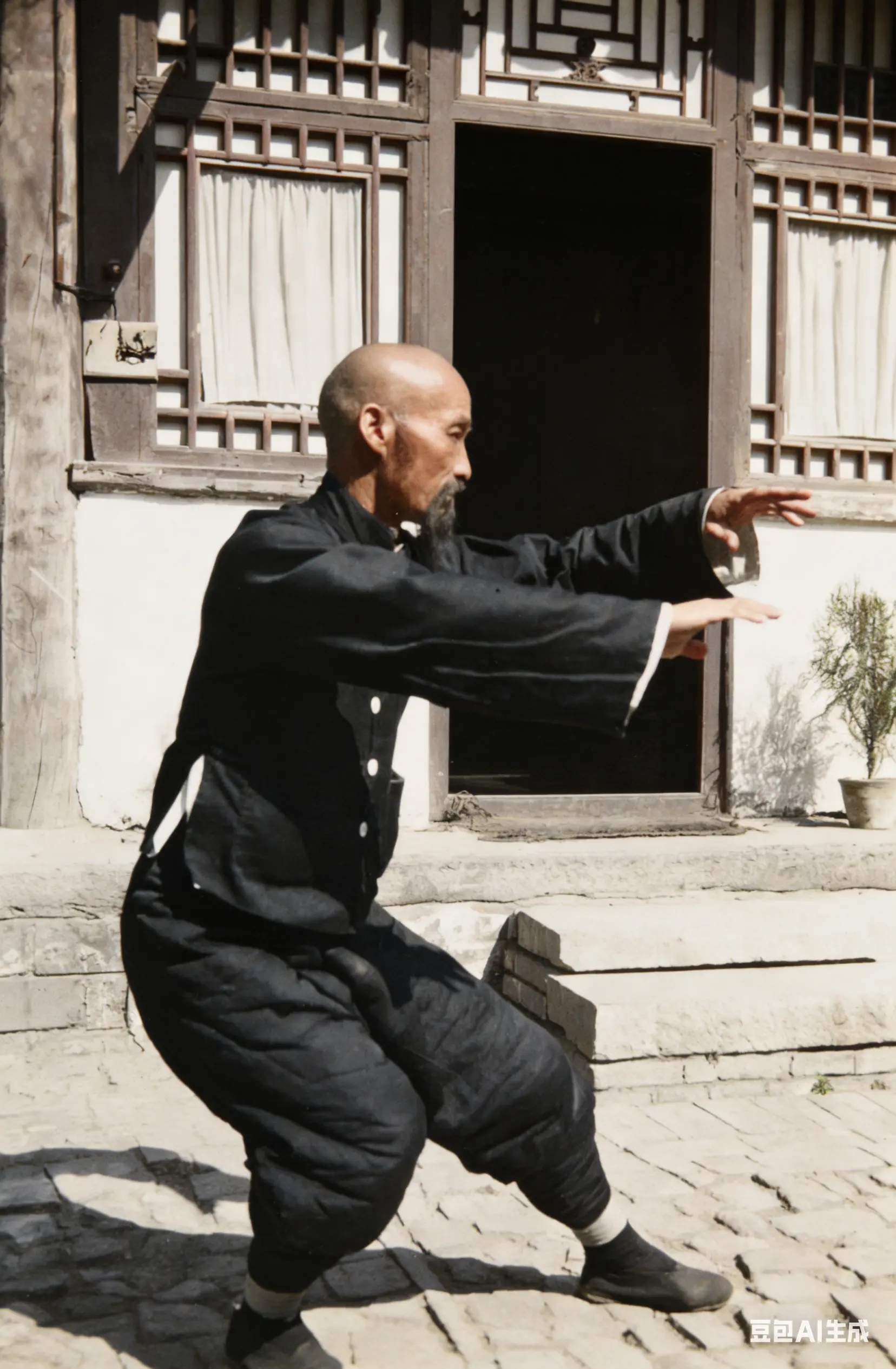
Sun Lutang (1860–1933), founder of Sun-style Tai Chi, photographed in the late 19th or early 20th century. This image is preserved in the University of Bristol’s Historical Photographs of China archive. Sun was known as the “Martial Saint” and synthesized Xingyi, Bagua, and Tai Chi into a unified internal system — a reminder of Tai Chi’s original martial depth.
Five Classical Combat Applications in Tai Chi
To understand what “martial” meant in traditional contexts, it helps to look at specific techniques. These are not performance movements. They are applications that were traditionally taught after years of foundational practice.
| Technique | Style | Mechanism | Target | Traditional Status |
|---|---|---|---|---|
| Yan Shou Hong Chui (Hidden Thrust Punch) | Chen | 0.09-second explosion, 50–70kg penetrating force | Chest, heart, ribs | Core training in sanshou |
| Zhi Dang Chui (Groin Thrust Punch) | Chen | Spiral drilling punch, upward trajectory | Groin, lower abdomen | Traditionally taught, later restricted in public forms |
| Chuan Xin Zhou (Penetrating Heart Elbow) | Chen/Sun | Close-range elbow strike, “three forces in one” | Sternum, heart area | Considered too dangerous for casual training |
| Jin Bu Ban Lan Chui (Step, Block, Punch) | Sun/Yang | Three-move combination | Chest, face, temples | Widely taught across styles |
| Shou Tou Shi (Beast Head Strike) | Chen | Defensive block + counter strike | Ribs, jaw | Practiced in various forms |
Chen Xin, in his classic Illustrated Explanation of Chen-style Taijiquan, referred to Yan Shou Hong Chui as “the first of the seven hammers.” Yang Chengfu described Jin Bu Ban Lan Chui as “the king of the five punches.”
These descriptions reflect a training context where martial application was part of the picture — not the only part, but a meaningful one.
A Possible Path Forward
The question is not whether older training methods can be “restored” in some pure form. They can’t — nor should they be, without adaptation to modern contexts.
But certain elements can be reintegrated, if there is interest.
A possible approach, based on traditional frameworks and informed by modern understanding:
| Stage | Focus | Practice | Observable Outcome |
|---|---|---|---|
| 1. Foundation | Body structure, relaxation | Standing meditation + silk reeling | Improved stability and ease of movement |
| 2. Refinement | Coordinated whole-body movement | Slow form practice with attention to internal connections | Greater smoothness and integration |
| 3. Validation | Interactive sensitivity | Progressive push hands practice | Ability to respond without pre-planned movement |
| 4. Integration | Spontaneous application | Context-dependent exploration | Deeper understanding of principles under pressure |
The key insight: push hands serves as a bridge between solo form and interactive understanding. Without some form of partner work, certain aspects of Tai Chi remain theoretical. With it, they become experiential.
Back to David — And an Open Question
David mentioned his teacher, Bill Dockins, who brought Tai Chi to Sweden in the late 1960s.
“Bill valued styles very differently, but still, he focused mainly on principles and synthesised movements and techniques from other styles into his own Yang Tai Chi. His teacher, who I also met, was very clear that there are no styles in Tai Chi.”
That orientation — principles over packaging — is rare in any context. But it still exists. In Chen village. In Zhaobao. In the basements of Dezhou, where a small-frame teacher works with a handful of students.
Perhaps the real question is not whether Tai Chi’s martial dimension still exists in some form. It does.
The question is : how do we choose to approach it?
David’s observation cuts deeper than he might realize. The shift away from principle-based teaching isn’t just a Western phenomenon or a Chinese one. It’s a modern one — the inevitable trade-off when any art moves from small-scale, intensive transmission to mass accessibility.
Knowing what shifted is the first step.
The next step is deciding what we want to carry forward.
Thanks to David Roth-Lindberg for the conversation that inspired this reflection. David writes about Tai Chi on his blog and can be found on X @RothLindberg .
For those interested in exploring further: the lineages mentioned above are accessible in various ways. Chen Zhenglei teaches online. Dong Yonggui streams on Douyin. And if you’re committed enough to travel to Dezhou, Cai Wenxiao’s door might open.
Master Mingde Chen
12th generation Chen-style inheritor with decades of teaching experience.
View all articles →