Tai Chi Glossary > Yin and Yang (阴阳)
Yin and Yang (阴阳)
Definition: Yin and Yang (阴阳): Complementary forces governing all change in Chinese philosophy and Tai Chi. Yin is receptive, dark, and contracting; Yang is active, bright, and expanding. Neither exists without the other — at the extreme of each, transformation into its opposite begins. In Tai Chi, expressed as Empty/Full weight shifting, Open/Close movement, and Inhale/Exhale breath.
In Chinese philosophy, Yin and Yang (阴阳, yīn yáng) describe the fundamental duality underlying all phenomena. They are not opposites in conflict but complementary phases of a single continuous cycle — like day and night, inhalation and exhalation, rest and action.
The concept originates in classical texts including the I Ching (易经) and the Huangdi Neijing (黄帝内经), where Yin and Yang are used to map the patterns of nature, health, and change. In Tai Chi, this ancient framework becomes a direct body practice.
The Four Properties of Yin and Yang
Classical Chinese philosophy identifies four defining characteristics that distinguish Yin-Yang theory from simple duality:
- Mutual Root (互根, hù gēn) : Yin and Yang define each other. There is no warmth without cold, no movement without stillness, no fullness without emptiness. Remove one, and the other ceases to have meaning.
- Wax and Wane (消长, xiāo zhǎng) : Yin and Yang are not fixed. When Yang grows, Yin recedes — and vice versa. This constant shift is the engine of all natural change: the arc of a day, the turn of seasons, the rhythm of effort and recovery.
- Transformation (转化, zhuǎn huà) : At the extreme of Yin, Yang is born. At the extreme of Yang, Yin returns. Night reaches its deepest point and dawn begins. This is why Tai Chi movements never terminate — they curve and return, each end becoming the next beginning.
- Divisibility (可分, kě fēn) : Every Yin contains the seed of Yang, and every Yang contains the seed of Yin. This is represented visually in the Taijitu (太极图) — the familiar symbol with a white dot in the dark half and a dark dot in the white half.
Yin and Yang in Tai Chi Practice
In Tai Chi, Yin-Yang theory is not metaphor — it is the structural logic of every movement. Three paired principles govern the practice:
Empty and Full (虚实, xū shí)
At any moment, one leg bears the body’s weight (Full, Shi — Yang) while the other remains light and ready (Empty, Xu — Yin). Correct Tai Chi practice requires 100% commitment to each shift: not 60/40, but complete transfer. The empty leg is not weak — it is potential, coiled and waiting.
Open and Close (开合, kāi hé)
Movements expand outward — arms extending, chest opening — in the Yang phase. They gather inward — arms drawing in, energy condensing — in the Yin phase. Power in Tai Chi is generated through this cycle: the closing phase stores, the opening phase releases.
Inhale and Exhale (呼吸, hū xī)
Breath is the most immediate expression of Yin-Yang in the body. Inhalation is Yin: drawing in, gathering, rising. Exhalation is Yang: releasing, extending, sinking. In classical Tai Chi, breath coordinates with movement — inhale with closing and rising, exhale with opening and descending.
Yin and Yang in the Body: The TCM Connection
Traditional Chinese Medicine (TCM) applies Yin-Yang theory directly to health. Each organ system has a relative Yin or Yang nature; illness is understood as imbalance between them rather than the presence of a pathogen alone.
In this framework, Tai Chi practice serves a dual function: as movement that develops martial skill, and as a health practice that regulates the body’s internal Yin-Yang balance. Excess Yang may manifest as inflammation, agitation, or heat; deficient Yin as dryness, fatigue, or restlessness. The slow, continuous, spiral movements of Tai Chi are specifically designed to address both without tipping into excess in either direction.
This is why Tai Chi is consistently associated with measurable health outcomes — improved balance, reduced blood pressure, lower cortisol — rather than just general fitness. It is calibrated movement, not random exercise.
Yin and Yang vs. Wuji: The Relationship
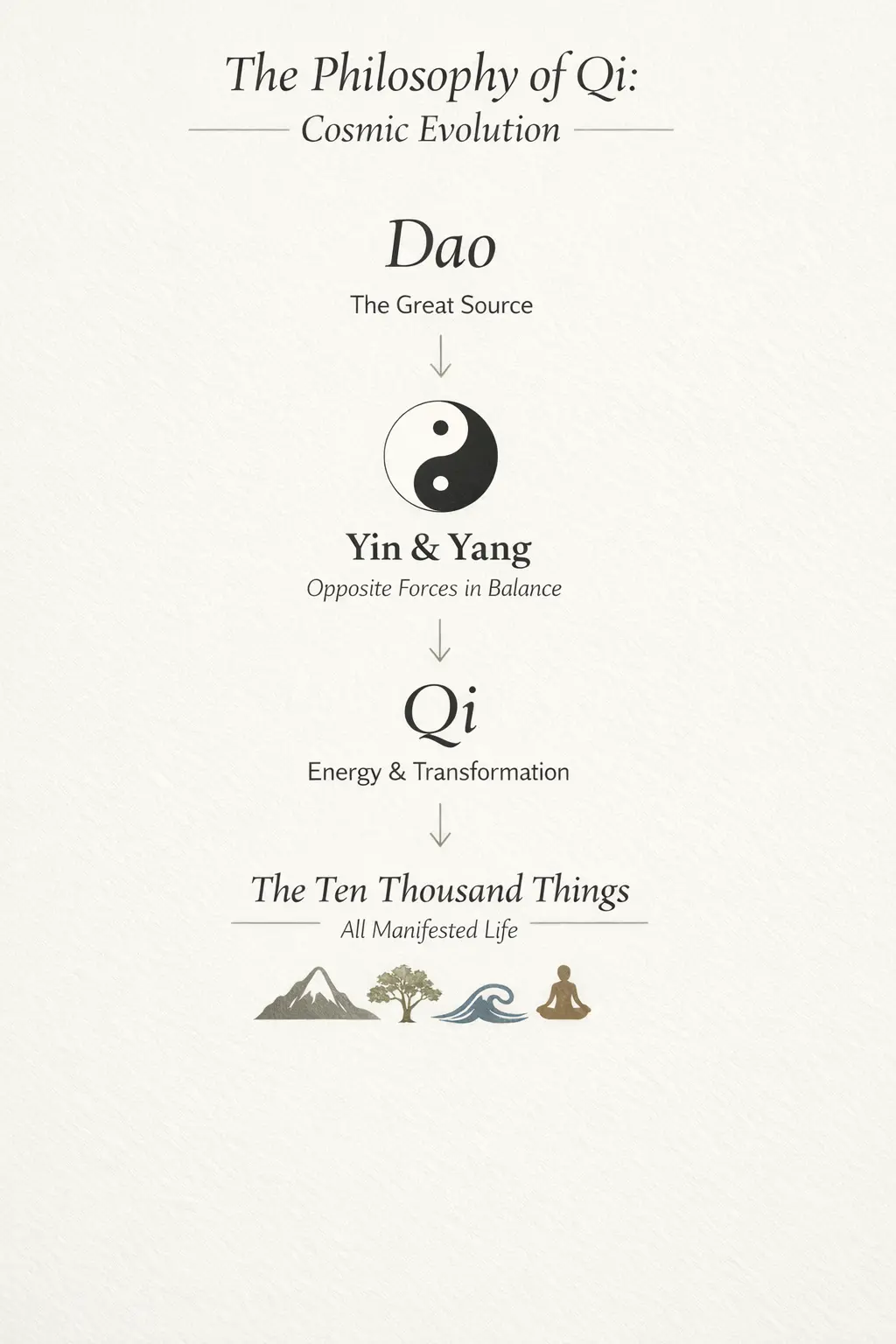
Yin and Yang do not arise from nothing. They emerge from Wuji (无极) — the undifferentiated state before any polarity exists. The classical formula states:
无极生太极,太极生两仪 “From Wuji, Taiji is born; from Taiji, the Two Polarities (Yin and Yang) arise.”
Understanding this sequence matters for practice: the Wuji stance that opens every Tai Chi form is not merely preparation. It is the deliberate return to the state before Yin and Yang — so that movement arises from genuine stillness, not just a pause between actions.
See also:
- Wuji (无极) — The undifferentiated state before Yin and Yang
- Taiji (太极) — The Supreme Ultimate from which Yin and Yang emerge
- Qi (气) — The vital energy whose flow Yin-Yang balance governs
- Zhan Zhuang (站桩) — Standing meditation as Wuji practice
Related Glossary Terms
Explore connected concepts in the Tai Chi knowledge graph.
Often Discussed Together
These concepts co-occur frequently across our articles and discussions.
Community & Questions
Discussions from practitioners about Yin-Yang.
A Modern R&B Song Called "TAI CHI" – How Pop Culture Sees Our Practice?
Is Tai Chi Chinese or Japanese? Debunking the Myth
[Masterclass] The Ultimate 24-Step Guide to Yang Style Tai Chi 24 Form with Animated Images
UNESCO Taijiquan turns 6 — has the inscription changed how the world sees Tai Chi?
What is Wuji Energy? Understanding the Foundation of Tai Chi
Further Reading & Practical Guides
In-depth articles featuring Yin-Yang.
Qigong for Autumn: A Seasonal Practice Guide for the Transition into Fall
When the season turns, qigong turns with it. This guide explains how to adapt your practice from summer expansion to autumn gathering — the Sī sound, the Lung's Metal breath, and a 15–20 minute daily protocol from 立秋 to 秋分.
Zhao Youbin Yang Style Tai Chi 85 Form: Complete Guide & Video Tutorial
Complete guide to Zhao Youbin's Yang Style Tai Chi 85 form. Learn the traditional long form with video breakdowns by section, full posture list with English names, and the Ten Essential Requirements.
What Gets Lost When Tai Chi Goes Global — And Where It Still Lives
A conversation with a 40-year Swedish practitioner reveals how Tai Chi's martial core was gradually deemphasized — and where Chen, Sun, Wu, Zhaobao, and He lineages still preserve it.
Tai Chi Research: 8 Scientific Discoveries About Tai Chi Health Benefits
Discover 8 major research trends in Tai Chi science, including studies on aging, brain health, chronic disease, and rehabilitation benefits.
Why Tai Chi Uses Circular Motion: The Deep Martial, Philosophical & Health Reasons
Discover why arc movement is the core secret of Tai Chi. We explain the martial science of Silkworm Reeling & Dantian rotation, the philosophy of Yin-Yang, and health benefits. Learn how curves generate true power.