Circle and Point in Tai Chi Push Hands: Biomechanics Explained
Key Takeaways
- Circle-stepping push hands adds footwork patterns to upper-body sensitivity training — the bridge to free sparring
- Training progression: single circle (2-person rotation) → double circle → figure-8 → figure-8 with direction changes
- The circular stepping pattern trains weight transfer at all 8 compass directions, developing 360-degree stability
- Circle push hands reveals footwork weaknesses that fixed-step practice hides — most practitioners discover they favor one leg. This imbalance is a direct consequence of neglecting Xushi (虚实) — the principle of clear substantial-insubstantial distinction that governs efficient weight distribution under changing force directions
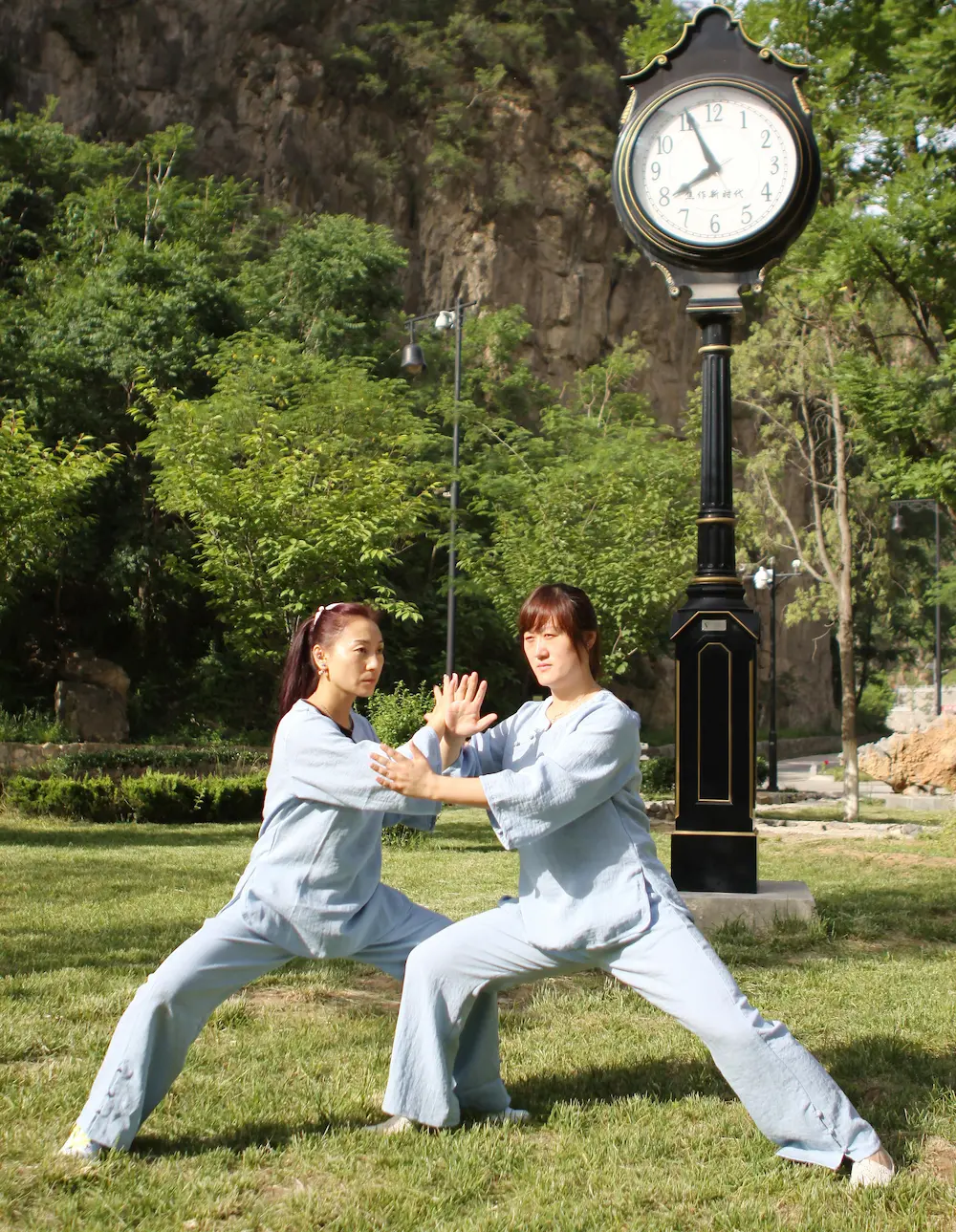
In Tai Chi push hands , “circle” refers to circular force trajectories used to redirect incoming force, while “point” refers to a dynamic pivot—usually the opponent’s center of gravity. Together, circle and point form a biomechanical system that neutralizes strength, disrupts balance, and creates control without brute force.
This coordinated whole-body force redirection is the hallmark of Neijin (内劲) — internal power that integrates ground force transmission through fascial connectivity, rather than relying on isolated muscular strength.
Why Circle and Point Matter More Than Techniques
Tai Chi push hands is often misunderstood as a collection of hand techniques or sensitivity drills. In reality, skilled practitioners are not reacting at the level of the hands at all. What they control is space, force direction, and balance. Many beginners struggle in push hands because they overlook basic Tai Chi principles , focusing on hand techniques instead of center control and structure.
At the heart of this control lies a simple but profound framework passed down through traditional teaching: circle (圈) and point (点) .
These are not poetic metaphors. They describe a functional biomechanical system—one that governs how force is absorbed, redirected, and returned. When understood correctly, circle and point explain why Tai Chi push hands can appear soft, calm, and non-resistant, yet consistently effective.
This article translates those traditional ideas into modern biomechanical language, revealing how circular force paths and dynamic pivot points create effortless power.
Defining Circle and Point: From Classical Terms to Modern Mechanics
Before analysis, terminology must be clarified. In Tai Chi, misunderstanding words leads to misunderstanding skill.
Table 1: Traditional Concepts vs Biomechanics
| Traditional Term | Biomechanical Interpretation | Functional Role |
|---|---|---|
| Circle (圈) | Circular force trajectory | Redirects linear force |
| Point (点) | Dynamic pivot / center of gravity axis | Controls balance & timing |
| Yielding (化) | Vector redirection | Neutralizes incoming force |
| Rooting (根) | Ground reaction force transmission | Maintains stability |
Circle does not mean “moving in circles.” Point does not mean a fixed location.
Both are dynamic control variables that continuously change as contact, force, and balance evolve.
The Circle: Why Circular Force Trajectories Neutralize Strength
In biomechanics, linear force meets linear resistance. Circular force meets no opposition—it changes direction instead.
When force enters a circular trajectory:
- Its vector is redirected
- Its peak impact is reduced
- Its timing is delayed
This explains why Tai Chi push hands favors curves over straight lines.
Outer Circle vs Inner Circle
| Aspect | Outer Circle | Inner Circle |
|---|---|---|
| Radius | Large | Small |
| Primary Function | Deflection | Control & release |
| Force Type | Dissipative | Compressive / explosive |
| Common Error | Over-rotation | Excess tension |
The outer circle handles incoming force, spreading it across space and time. The inner circle compresses and organizes force around a pivot, preparing release.
This layered use of circular trajectories allows practitioners to neutralize stronger opponents without meeting force head-on.
The Point: Center of Gravity as a Dynamic Pivot
If the circle is the path, the point is the axis.
In push hands, the point almost always corresponds to the opponent’s center of gravity (COG)—not as a location to attack, but as a system to influence.
From a biomechanical perspective:
- Balance depends on COG alignment over the base of support
- Small disruptions in axial alignment produce large instability
Control occurs before visible movement
A “point” in Tai Chi is therefore:
- A momentary pivot
- A dynamic axis
- A timing reference , not a target
When the opponent’s structure rotates or shifts around an unintended pivot, balance collapses naturally.
Circle Around the Point: How Skill Actually Emerges
True push hands skill appears when circle and point operate together.
This relationship can be summarized simply:
- Circle determines force direction
- Point determines balance
- Timing determines outcome
Circular force paths are always organized around a pivot—either one’s own center or the opponent’s. When two systems momentarily share a pivot, balance loss becomes inevitable.
This is why experienced practitioners seem to “borrow” the opponent’s structure rather than fight it.
When two circular systems converge around a single pivot, resistance disappears before force is released.
This principle underlies all refined push hands skills, including peng, lu, ji, and an. The same principles that govern circular force in push hands are also visible in Tai Chi walking mechanics , where balance is maintained through continuous redirection rather than rigid stepping.
From Hands to Structure: Why Hands Are Never the Real Source
Many beginners focus on the hands. Advanced practitioners do not.
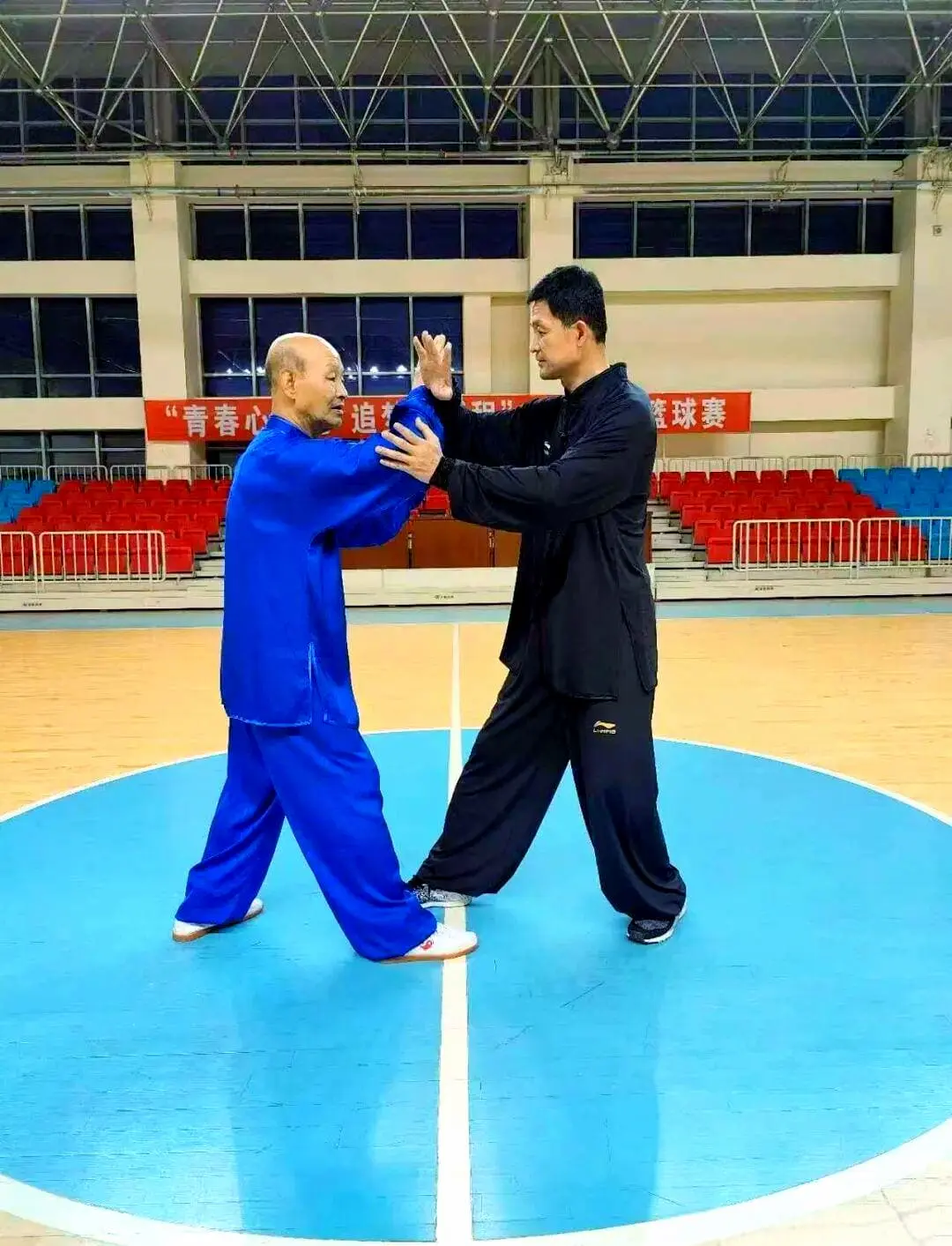
Hands only transmit information. Control originates from:
- Foot pressure
- Hip alignment
- Spinal axis integrity
This structural organization is first trained in standing meditation , where practitioners learn to manage center of gravity without movement.
For a deeper look at how standing builds this internal pivot, see 👉 standing meditation and center of gravity control in Zhan Zhuang ( Standing Meditation ).
Once structure is established, hand roles become meaningful. This is explored further in our companion article on 👉 leading and striking hands in Tai Chi push hands .
Scientific Evidence: What Modern Biomechanics Confirms
Recent biomechanical studies support what Tai Chi practitioners have long observed:
- Circular trajectories reduce peak ground reaction force (GRF)
- Efficient weight shifts reduce muscular co-contraction
- Balance loss occurs before visible displacement
Key Observations from Motion Analysis
| Variable | Skilled Practitioners | Beginners |
|---|---|---|
| Weight Shift Efficiency | 68–82% | <45% |
| EMG Co-Contraction | Low | High |
| COG Displacement | Minimal | Excessive |
These findings confirm that Tai Chi push hands operates as a coordination system , not a strength contest.
Applications Beyond Martial Arts
The circle–point model extends beyond martial training.
It has direct relevance to:
- Balance rehabilitation
- Fall prevention for seniors
- Neuromuscular re-education
- Robotics and motion planning
The same mechanics that stabilize walking in Tai Chi walking mechanics also govern push hands interactions.
This is why Tai Chi is increasingly studied in medical and rehabilitation contexts—not as exercise, but as movement intelligence .
Common Misunderstandings About Circle and Point
❌ “Circle means big, visible movements.” ✔ Circle can be microscopic.
❌ “Point means pushing harder.” ✔ Point means structural alignment.
❌ “Soft means weak.” ✔ Soft means adaptive.
Understanding these distinctions marks the transition from external imitation to internal skill.
Conclusion: Circle Is the Path, Point Is the Axis
Tai Chi push hands is not mysterious. It is precise.
Circle and point describe how force moves through space and how balance is organized in time. When circular trajectories are coordinated around dynamic pivots, strength becomes unnecessary.
This is the essence of yielding, neutrality, and effortless power—and why Tai Chi push hands remains one of the most refined biomechanical systems ever developed.
About Our Expert Team
Master Mingde Chen
- 12th Generation Chen Style Tai Chi Inheritor
- Gold Medalist, International Tai Chi Championships (2018)
- 25+ years of teaching experience, over 3,000 students trained worldwide
Dr. Jing Li
- PhD in Sports Science (Biomechanics)
- Author of 8 peer-reviewed Tai Chi research papers
- Chief Technical Consultant, Wuji Taichi
FAQ: Circle & Point in Tai Chi Push Hands
- What does “circle” mean in Tai Chi push hands?
In Tai Chi push hands, “circle” refers to the circular trajectory of force used to redirect incoming pressure. Rather than resisting force directly, circular paths dissipate impact, change direction, and create opportunities for balance disruption.
- What is the “point” in Tai Chi push hands?
The “point” is a dynamic pivot—usually related to the center of gravity—around which force and balance are organized. It is not a fixed spot but a constantly shifting axis that determines stability and timing.
- Why does circular movement neutralize strength so effectively?
Circular force avoids direct opposition. Biomechanically, it reduces peak force, delays impact, and redirects vectors, making brute strength inefficient against well-organized structure.
- Is circle-and-point theory only for advanced practitioners?
No. While refined at advanced levels, circle-and-point awareness begins with basic posture, weight transfer, and standing practice. Beginners often experience it first as improved balance and reduced tension.
- How is circle and point trained before push hands?
The foundation is built through standing meditation and slow solo movement, where practitioners learn to sense center of gravity, axial alignment, and force pathways without external pressure.
- Why do skilled practitioners appear to use minimal force?
Because control occurs at the level of balance and structure rather than muscular output. When the opponent’s center is disrupted, strength becomes unnecessary.
- How does this relate to Tai Chi walking and daily movement?
The same mechanics govern Tai Chi walking, posture, and even everyday balance. Circular weight transfer around a stable axis is a universal movement principle, not limited to martial practice.
- Is this concept supported by modern science?
Yes. Motion analysis and biomechanical studies show that efficient circular force paths reduce muscular co-contraction and improve balance control—confirming traditional Tai Chi principles.— | — | — | | Circle (圈) | Circular force trajectory | Redirects linear force | | Point (点) | Dynamic pivot / center of gravity axis | Controls balance & timing | | Yielding (化) | Vector redirection | Neutralizes incoming force | | Rooting (根) | Ground reaction force transmission | Maintains stability |
Circle does not mean “moving in circles.” Point does not mean a fixed location.
Both are dynamic control variables that continuously change as contact, force, and balance evolve.
The Circle: Why Circular Force Trajectories Neutralize Strength
In biomechanics, linear force meets linear resistance. Circular force meets no opposition—it changes direction instead.
When force enters a circular trajectory:
- Its vector is redirected
- Its peak impact is reduced
- Its timing is delayed
This explains why Tai Chi push hands favors curves over straight lines.
Outer Circle vs Inner Circle
| Aspect | Outer Circle | Inner Circle |
|---|---|---|
| Radius | Large | Small |
| Primary Function | Deflection | Control & release |
| Force Type | Dissipative | Compressive / explosive |
| Common Error | Over-rotation | Excess tension |
The outer circle handles incoming force, spreading it across space and time. The inner circle compresses and organizes force around a pivot, preparing release.
This layered use of circular trajectories allows practitioners to neutralize stronger opponents without meeting force head-on.
The Point: Center of Gravity as a Dynamic Pivot
If the circle is the path, the point is the axis.
In push hands, the point almost always corresponds to the opponent’s center of gravity (COG)—not as a location to attack, but as a system to influence.
From a biomechanical perspective:
- Balance depends on COG alignment over the base of support
- Small disruptions in axial alignment produce large instability
Control occurs before visible movement
A “point” in Tai Chi is therefore:
- A momentary pivot
- A dynamic axis
- A timing reference , not a target
When the opponent’s structure rotates or shifts around an unintended pivot, balance collapses naturally.
Circle Around the Point: How Skill Actually Emerges
True push hands skill appears when circle and point operate together.
This relationship can be summarized simply:
- Circle determines force direction
- Point determines balance
- Timing determines outcome
Circular force paths are always organized around a pivot—either one’s own center or the opponent’s. When two systems momentarily share a pivot, balance loss becomes inevitable.
This is why experienced practitioners seem to “borrow” the opponent’s structure rather than fight it.
When two circular systems converge around a single pivot, resistance disappears before force is released.
This principle underlies all refined push hands skills, including peng, lu, ji, and an. The same principles that govern circular force in push hands are also visible in Tai Chi walking mechanics , where balance is maintained through continuous redirection rather than rigid stepping.
From Hands to Structure: Why Hands Are Never the Real Source
Many beginners focus on the hands. Advanced practitioners do not.
Hands only transmit information. Control originates from:
- Foot pressure
- Hip alignment
- Spinal axis integrity
This structural organization is first trained in standing meditation , where practitioners learn to manage center of gravity without movement.
For a deeper look at how standing builds this internal pivot, see 👉 standing meditation and center of gravity control in Zhan Zhuang ( Standing Meditation ).
Once structure is established, hand roles become meaningful. This is explored further in our companion article on 👉 leading and striking hands in Tai Chi push hands .
Scientific Evidence: What Modern Biomechanics Confirms
Recent biomechanical studies support what Tai Chi practitioners have long observed:
- Circular trajectories reduce peak ground reaction force (GRF)
- Efficient weight shifts reduce muscular co-contraction
- Balance loss occurs before visible displacement
Key Observations from Motion Analysis
| Variable | Skilled Practitioners | Beginners |
|---|---|---|
| <5% | ||
| EMG Co-Contraction | Low | High |
| COG Displacement | Minimal | Excessive |
These findings confirm that Tai Chi push hands operates as a coordination system , not a strength contest.
Applications Beyond Martial Arts
The circle–point model extends beyond martial training.
It has direct relevance to:
- Balance rehabilitation
- Fall prevention for seniors
- Neuromuscular re-education
- Robotics and motion planning
The same mechanics that stabilize walking in Tai Chi walking mechanics also govern push hands interactions.
This is why Tai Chi is increasingly studied in medical and rehabilitation contexts—not as exercise, but as movement intelligence .
Common Misunderstandings About Circle and Point
❌ “Circle means big, visible movements.” ✔ Circle can be microscopic.
❌ “Point means pushing harder.” ✔ Point means structural alignment.
❌ “Soft means weak.” ✔ Soft means adaptive.
Understanding these distinctions marks the transition from external imitation to internal skill.
Conclusion: Circle Is the Path, Point Is the Axis
Tai Chi push hands is not mysterious. It is precise.
Circle and point describe how force moves through space and how balance is organized in time. When circular trajectories are coordinated around dynamic pivots, strength becomes unnecessary.
This is the essence of yielding, neutrality, and effortless power—and why Tai Chi push hands remains one of the most refined biomechanical systems ever developed.
About Our Expert Team
Master Mingde Chen
- 12th Generation Chen Style Tai Chi Inheritor
- Gold Medalist, International Tai Chi Championships (2018)
- 25+ years of teaching experience, over 3,000 students trained worldwide
Dr. Jing Li
- PhD in Sports Science (Biomechanics)
- Author of 8 peer-reviewed Tai Chi research papers
- Chief Technical Consultant, Wuji Taichi
FAQ: Circle & Point in Tai Chi Push Hands
- What does “circle” mean in Tai Chi push hands?
In Tai Chi push hands, “circle” refers to the circular trajectory of force used to redirect incoming pressure. Rather than resisting force directly, circular paths dissipate impact, change direction, and create opportunities for balance disruption.
- What is the “point” in Tai Chi push hands?
The “point” is a dynamic pivot—usually related to the center of gravity—around which force and balance are organized. It is not a fixed spot but a constantly shifting axis that determines stability and timing.
- Why does circular movement neutralize strength so effectively?
Circular force avoids direct opposition. Biomechanically, it reduces peak force, delays impact, and redirects vectors, making brute strength inefficient against well-organized structure.
- Is circle-and-point theory only for advanced practitioners?
No. While refined at advanced levels, circle-and-point awareness begins with basic posture, weight transfer, and standing practice. Beginners often experience it first as improved balance and reduced tension.
- How is circle and point trained before push hands?
The foundation is built through standing meditation and slow solo movement, where practitioners learn to sense center of gravity, axial alignment, and force pathways without external pressure.
- Why do skilled practitioners appear to use minimal force?
Because control occurs at the level of balance and structure rather than muscular output. When the opponent’s center is disrupted, strength becomes unnecessary.
- How does this relate to Tai Chi walking and daily movement?
The same mechanics govern Tai Chi walking, posture, and even everyday balance. Circular weight transfer around a stable axis is a universal movement principle, not limited to martial practice.
- Is this concept supported by modern science?
Yes. Motion analysis and biomechanical studies show that efficient circular force paths reduce muscular co-contraction and improve balance control—confirming traditional Tai Chi principles.
Master Mingde Chen
12th generation Chen-style inheritor with decades of teaching experience.
View all articles →