Leading & Striking Hands in Tai Chi: Combat Theory Meets Biomechanics
Key Takeaways
- Leading hands (引手) in Tai Chi uses light contact to guide the opponent's momentum past their center, creating openings
- The technique applies the principle of "four ounces deflect a thousand pounds" — redirecting force rather than meeting it
- 4 phases of leading: stick → follow → guide → issue — each requires progressively more refined tactile sensitivity
- Leading hands are the most difficult push hands skill to master because they require yielding before your fear reflex activates
From Traditional Combat Theory to Modern Biomechanics
This article integrates classical Tai Chi combat pedagogy with modern biomechanical and neuromuscular research, ensuring both lineage authenticity and scientific rigor.
A Visual-Semantic Beginning: What Really Happens When Two Hands Meet
Imagine a slow-motion push hands exchange.
One hand softly receives, redirects, and subtly reshapes the opponent’s force. The other remains quiet—until suddenly it isn’t.
There is no clash. No brute force. No visible preparation.
Yet balance is lost, structure collapses, and the outcome is decided in less than a second.
This is not accidental. Nor is it mystical.
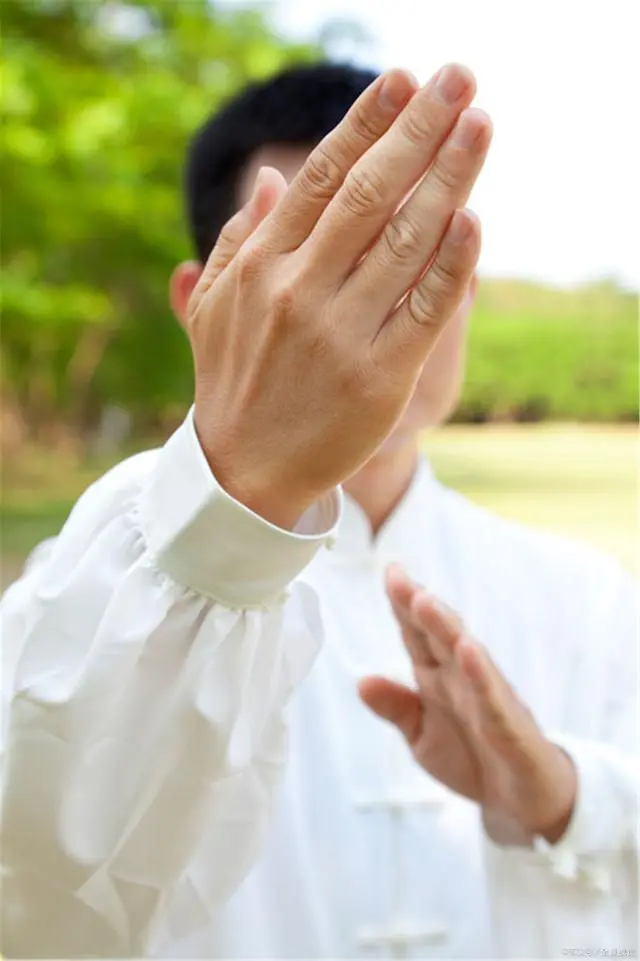
In traditional Tai Chi combat theory, this moment is governed by a precise division of labor between the two hands:
- The Leading Hand — responsible for guiding, neutralizing, and setting direction
- The Striking Hand — responsible for issuing power once conditions are created
Understanding this distinction is one of the most important—and most misunderstood—keys to real Tai Chi skill.
Why Tai Chi Requires Two Hands with Different Jobs
Many practitioners, especially in modern or health-focused Tai Chi, unconsciously use both hands the same way: both push, both resist, both issue force simultaneously.
From a Tai Chi combat perspective, this guarantees failure.
Classical principles such as she ji cong ren (舍己从人, “yielding to the opponent”) and yin jin luo kong (引进落空, “lead in and cause emptiness”) cannot be realized without functional differentiation between the hands.
Tai Chi does not treat the body as a collection of independent parts. It treats it as a coordinated system with sequential roles.
Just as walking requires one leg to support while the other steps, effective push hands requires one hand to lead while the other strikes.
For a deeper look at Tai Chi push hands mechanics , see our detailed breakdown of structured push hands training.
Terminology Matters: Translating 指导手 and 打击手 Correctly
In traditional Chinese Tai Chi pedagogy, practitioners distinguish between:
- 指导手 (Zhǐdǎo Shǒu) — literally “guiding hand”
- 打击手 (Dǎjī Shǒu) — “striking hand”
For international clarity and academic consistency, this article adopts the following standard terminology:
| Chinese Term | Recommended English | Academic Variant | Functional Meaning |
|---|---|---|---|
| 指导手 | Leading hand | Guiding limb | Guides force, controls direction and timing |
| 打击手 | Striking hand | Power limb | Issues force once conditions are created |
Why “leading” instead of “defending”? Because the leading hand is not passive. It actively shapes the interaction.
Why “striking” instead of “attacking”? Because the striking hand does not initiate conflict—it completes it.
This terminology aligns with usage found in biomechanics and Tai Chi push-hands research literature.
The spatial mechanics behind these hand roles—specifically the use of circular force paths and pivot points—are explored in our detailed analysis of circle and point in Tai Chi push hands .
The Traditional Logic: How Hand Roles Follow Body Rotation
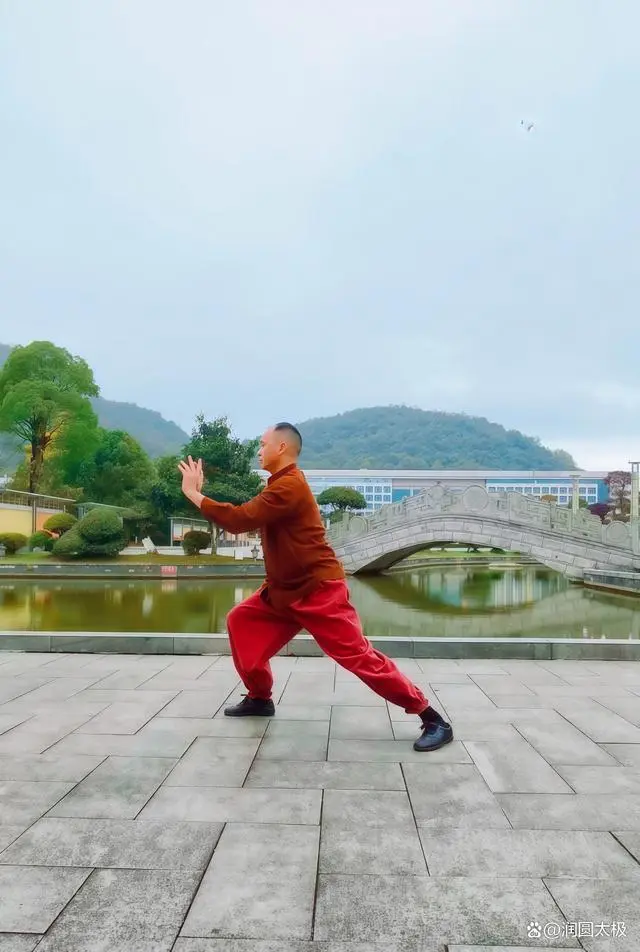
In classical Tai Chi forms and applications, hand roles are not fixed. They change dynamically with body rotation and vertical movement.
General rule:
- When the torso rotates left → left hand becomes the leading hand
- When the torso rotates right → right hand becomes the leading hand
Examples from traditional forms:
- Single Whip : rotation defines the leading hand
- Lazy About Tying Coat : rotation reverses hand roles
- Golden Rooster Stands on One Leg : rising hand strikes, sinking hand leads
This dynamic switching ensures continuous adaptability and prevents rigidity.
Tai Chi is never about “this hand always attacks.” It is about this hand leads now .
Biomechanics: What Science Reveals About Leading and Striking Hands
Modern biomechanics confirms what Tai Chi masters have transmitted for generations, especially when viewed through a scientific analysis of Tai Chi push hands .
1. Sequential Muscle Activation
Electromyography (sEMG) studies show:
- The leading hand activates muscles associated with stabilization and redirection
- The striking hand activates lower-limb and trunk-driven power chains
“Power originates in the feet, is governed by the waist, and expressed in the hands.”
2. Center of Gravity (COG) Control
Research using force platforms and motion capture demonstrates:
- Skilled practitioners lower and shift their center of gravity before issuing force
- The leading hand facilitates this shift
- The striking hand releases force only after structural alignment is achieved
| Parameter | Skilled Practitioners | Unskilled Practitioners |
|---|---|---|
| COG vertical fluctuation | −42% | High variability |
| Ground reaction force peak | Up to 1.8× body weight | Inconsistent |
| Strike timing | Delayed, precise | Simultaneous, inefficient |
Timing Is Everything: The 0.3-Second Rule
One of the most revealing findings from push-hands biomechanics research is temporal sequencing.
- Leading hand initiates contact and redirection
- Trunk rotation follows
- Striking hand activates approximately 0.3 seconds later
This delay is not hesitation. It is neuromuscular optimization.
Issuing force too early collapses structure. Issuing force too late misses opportunity.
Tai Chi’s brilliance lies in this narrow timing window.
Eight Energies Revisited: Not Techniques, but Expressions of Hand Roles
The Eight Energies (Peng, Lu, Ji, An, Cai, Lie, Zhou, Kao) are often taught as techniques.
In reality, they are outcomes of coordinated hand roles and body mechanics.
- Peng & Lu often manifest through the leading hand
- Ji & An emerge as the striking hand completes the sequence
- Zhou & Kao require seamless role switching at close range
To explore this further, see our guide on the Eight Energies of Tai Chi .
Common Errors That Prevent Real Skill
Across decades of teaching and research, three errors appear consistently:
Error 1: Both Hands Push Together
This eliminates guidance and turns Tai Chi into arm wrestling.
Error 2: Issuing Force Before Weight Transfer
Power without root collapses instantly.
Error 3: Arm Movement Without Waist Control
Hands move, body disconnects, force dies.
These mistakes are not stylistic—they are mechanical.
A Practical Training Framework: Building Hand Coordination
Step 1: Separate Roles
Practice slow push-hands where one hand only leads and never strikes.
Step 2: Delay the Strike
Introduce a deliberate pause between leading and striking actions.
Step 3: Integrate Through the Waist
Ensure all hand movement originates from kua and spinal rotation, as explained in how to tell if Tai Chi mechanics are correct .
This progression builds correct neuromuscular patterns instead of brute habit.
Beyond Tradition: Where Tai Chi Science Goes Next
Despite advances, significant gaps remain:
- No fMRI or EEG studies on listening–issuing transitions
- Little data comparing beginners vs experts
- No standardized “coordination efficiency index”
Future research combining wearable sensors and AI motion analysis may finally quantify what masters feel intuitively.
Tai Chi is poised to enter the era of precision movement science.
Conclusion: One Leads, One Strikes — Together They Win
The distinction between leading hand and striking hand is not optional. It is not stylistic. It is structural.
Without it:
- There is no yielding
- No timing
- No true Tai Chi skill
With it:
- Softness becomes effective
- Power becomes effortless
- Tradition meets verification
Tai Chi does not rely on mystery. It relies on coordination, timing, and understanding.
About Our Expert Team
Master Mingde Chen
- 12th Generation Chen Style Tai Chi Inheritor
- Gold Medalist, International Tai Chi Championships (2018)
- 25+ years of teaching experience, over 3,000 students trained worldwide
Dr. Jing Li
- PhD in Sports Science (Biomechanics)
- Author of 8 peer-reviewed Tai Chi research papers
- Chief Technical Consultant, Wuji Taichi
FAQ
- Can the leading hand also strike?
Yes—but not at the same moment. Roles change dynamically.
- Is the leading hand always lighter?
No. “Leading” refers to function, not force.
- Does this apply to solo form practice?
Absolutely. Form is where coordination is programmed.
- Is this concept unique to Chen style?
No. It exists across Tai Chi styles, though expressed differently.
Master Mingde Chen
12th generation Chen-style inheritor with decades of teaching experience.
View all articles →