Tai Chi Glossary > Qi (气)
Qi (气)
Definition: Qi (气) is the vital energy that flows through the body’s meridian network, cultivated through tai chi and qigong practice to support health, internal power, and the development of mind-body awareness.
Most people assume Qi means energy.
Some think it’s mystical. Others think it’s outdated.
Both views miss the point.
Qi is the most fundamental concept in Chinese medicine, Taoist philosophy, and internal martial arts—and also the most frequently misunderstood. In the West, it tends to get filed under one of two categories: mystical life force that defies explanation, or pre-scientific metaphor that modern medicine has superseded.
Neither is accurate.
Qi is a precise functional concept describing something real about how the body works. The debate is not whether it exists but how best to describe what it does.
New to internal practice? Start with Qigong for Beginners → before diving into the theory of Qi.
Part of the Understanding Qi series — follow this path to go from concept to practice:
- ★ Series Overview — complete guide + free PDF download
- What Is Qi — the foundational definition
- Qi vs Energy — why Qi is not simply “life force”
- The Philosophy of Qi — from cosmic origin to modern relevance
- Five Types of Qi — Yuan, Gu, Zong, Ying, and Wei Qi explained
- Why Science Struggles with Qi — and what we can learn from that
- How Qi Feels — a beginner’s guide to direct sensation
- Qi in Tai Chi Practice — from theory to embodiment
In Brief
- 气 (qì ): the character originally depicted steam rising from rice—something subtle, pervasive, and in constant motion
- In Chinese medicine, qi is the animating force of all physiological function—circulation, digestion, immunity, movement, thought
- In tai chi and qigong , qi is cultivated deliberately through movement, breath, and yi (intention)
- Qi flows through the body’s jingluo meridian network; where it flows freely, there is health; where it stagnates, dysfunction follows
- The classical hierarchy: yi (intention) leads qi; qi leads the body—not the reverse
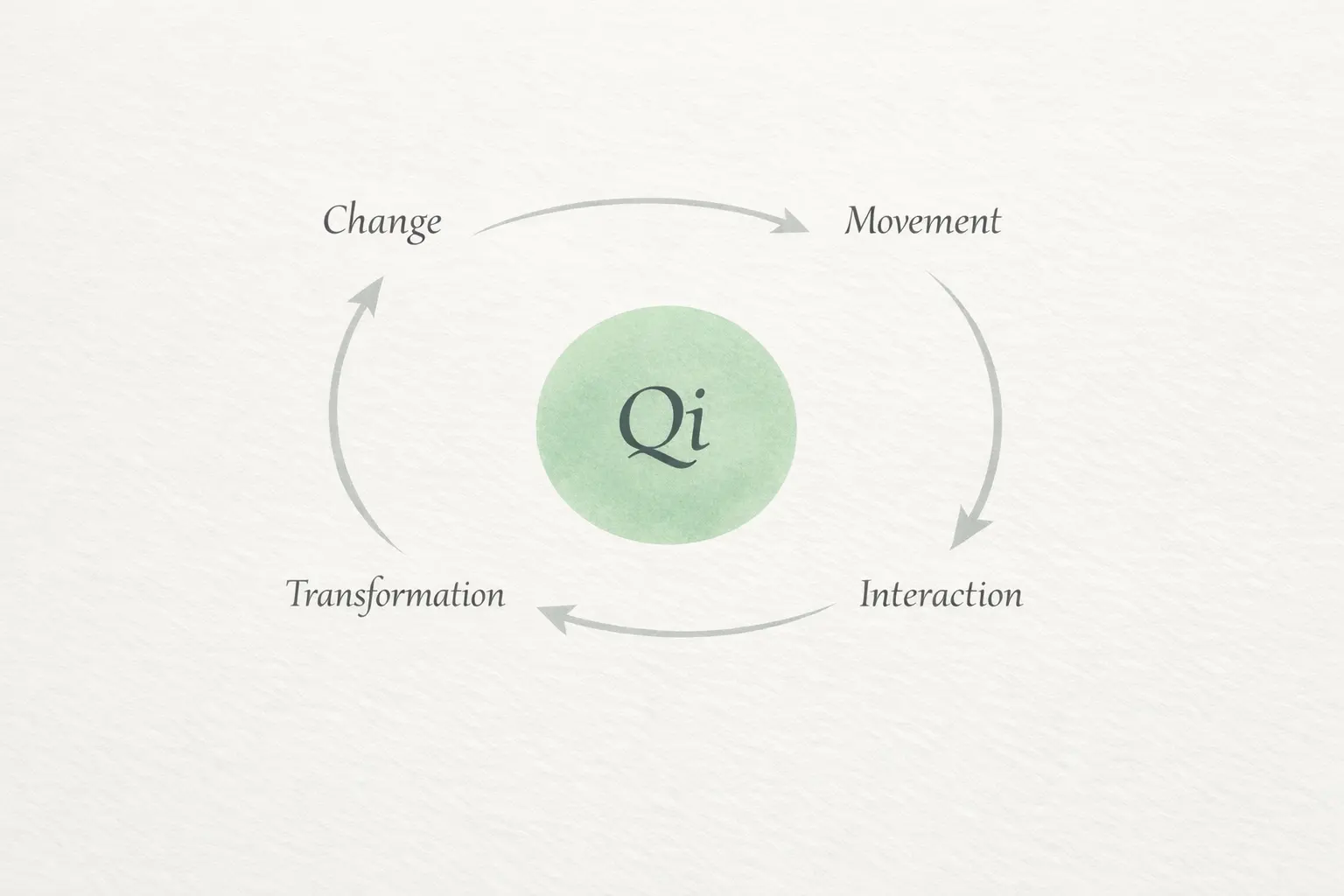
What the Character Reveals
The character 气 has evolved considerably over Chinese history, but its earliest forms depicted steam or vapor rising—something invisible yet unmistakably present, something that moves and transforms rather than sitting inert. Later forms combined this steam element with the character for rice (米), suggesting the vapor that rises during cooking: something that emerges from transformation, that nourishes, that cannot be held but can be directed.
This origin is not trivial. It tells you immediately that qi is not a substance in the Western sense—not a particle or a fluid with measurable weight and volume. It is more like a process, a quality of activity, a way that life expresses itself through living systems.
Where Western medicine tends to ask “what is this made of?”, Chinese medicine asks “how does this move, transform, and relate to everything else?”—and qi is the answer to that second question.
Qi in Chinese Medicine and Philosophy
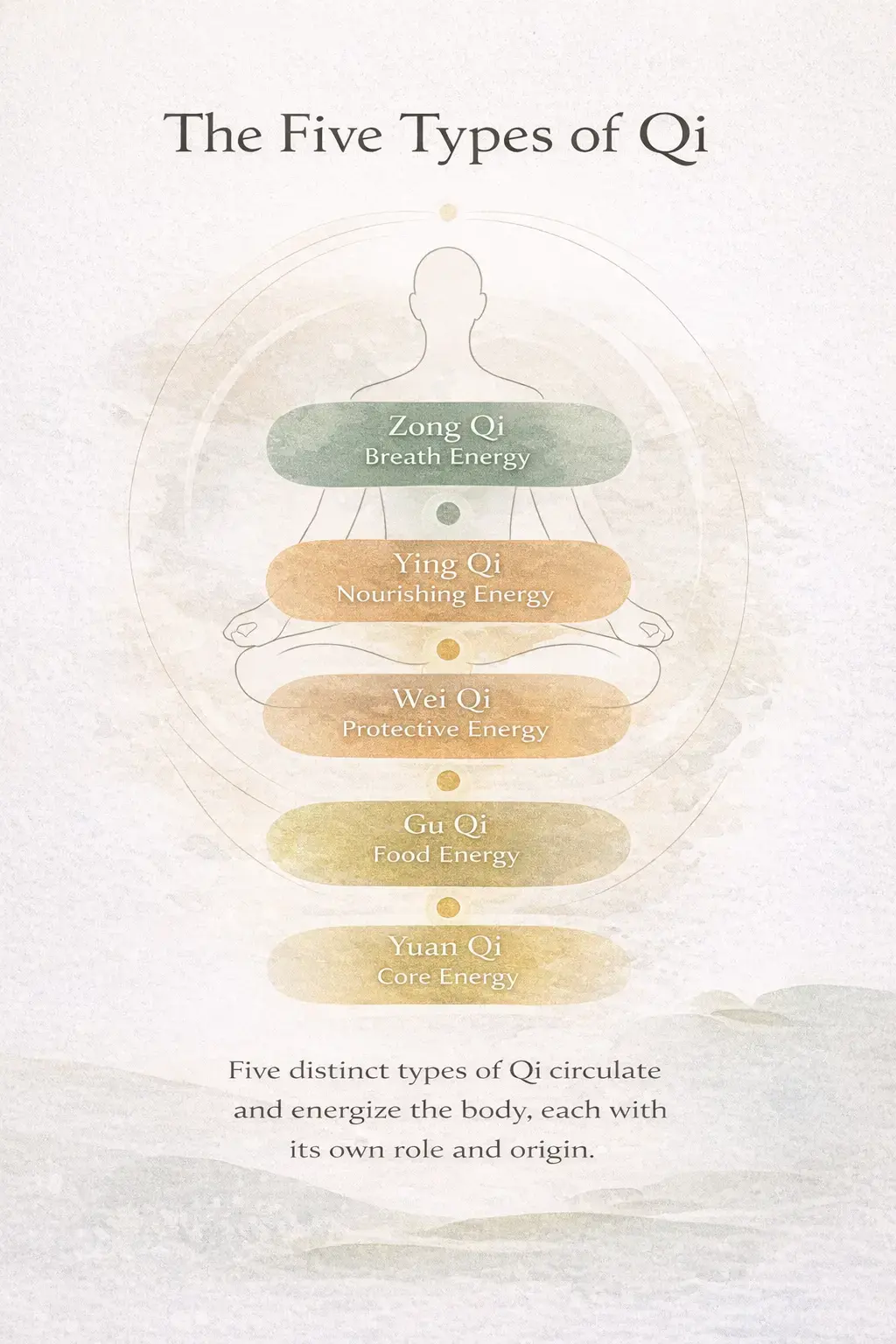
In traditional Chinese medicine (TCM), qi is not a single uniform substance but a family of related concepts describing different aspects of physiological function.
- Yuan Qi (元气, original qi) is the fundamental vitality inherited at birth, stored in the kidneys, and constituting the deepest layer of the body’s energetic reserve. It is finite—it depletes over a lifetime—which is why longevity-oriented qigong practices emphasize its preservation and replenishment.
- Gu Qi (谷气) is derived from food and digestion—the qi extracted from what we eat and drink. Together with air-qi (from breathing), it forms the basis of the qi that circulates through the meridians daily.
- Zong Qi (宗气, gathering qi) accumulates in the chest and governs the coordination of breathing and cardiac rhythm.
- Ying Qi (营气, nutritive qi) flows through the meridians nourishing the organs and tissues.
- Wei Qi (卫气, defensive qi) circulates at the body’s surface, protecting against external pathogens.
The following table summarizes the five major types of qi in traditional Chinese medicine and their relevance to qigong practice:
| Qi Type | Alternative Names | Core Function | Yin-Yang Attribute | Qigong Practice Connection |
|---|---|---|---|---|
| Yuan Qi (元气) | Original Qi, True Qi | Life’s fundamental driving force; promotes growth, development, activates organ function | Yin (foundational qi) | Yi focus on Dan Tian, return breath to origin, stillness practice to preserve root |
| Gu Qi (谷气) | Grain Qi, Food Qi | Provides post-natal nourishment and energy; material basis for other qi types | Neutral (post-natal foundation) | Regulate Spleen/Stomach, combine diet with practice, enhance energy transformation |
| Zong Qi (宗气) | Gathering Qi | Governs breathing, assists heart in blood circulation, affects voice and pulse strength | Yang (propelling qi) | Breath regulation training, deep breathing methods, sound guiding (e.g., Liu Zi Jue) |
| Ying Qi (营气) | Nutritive Qi, Constructive Qi | Transforms into blood, nourishes organs and tissues, maintains metabolism | Yin (nutritive qi) | Focus on meridians, seek movement within stillness, promote qi-blood harmony |
| Wei Qi (卫气) | Defensive Qi | Defends against pathogens, warms surface tissues, regulates sweat pores | Yang (protective qi) | Dynamic qigong (e.g., Baduanjin), consolidate surface yang, protect against wind-cold invasion |
How These Five Qi Types Work Together:
- Gu Qi is the source of all post-natal qi, transformed by the Spleen and Stomach from food and drink.
- Zong Qi is formed in the chest by combining Gu Qi with the clean air inhaled by the lungs — serving as the crucial link between breathing and heart-driven blood circulation.
- Ying Qi and Wei Qi both arise from further differentiation of Gu Qi. One is Yin, the other Yang; one moves inward, the other outward — together they maintain internal balance and external protection.
- Yuan Qi is the fundamental root, driving the entire qi transformation process, while constantly relying on Gu Qi for replenishment.
Qigong practice — through regulating body, breath, and mind — harmonizes the movement of these five qi types, leading to the state of “sufficient qi, robust blood, and clear spirit” that defines true health.
For most Tai Chi and Qigong practitioners, daily practice centers on two things: cultivating and regulating the True Qi (Internal Qi) that flows through the meridians, and preserving the foundational Original Qi that sustains vitality at its deepest level.
In Taoist philosophy, qi extends beyond the individual body to describe the animating principle of all phenomena. Heaven has qi. Earth has qi. The seasons are movements of qi. Human beings are configurations of qi that arise from and return to the larger field.
This macrocosmic dimension of qi is not just poetic—it grounds the classical instruction to harmonize practice with seasonal cycles, to face specific directions, to practice at specific times. The practitioner’s qi and the world’s qi are the same substance in different concentrations.
Qi and the Meridian Network
Qi does not float freely through the body—it flows along specific pathways. The jingluo (经络) meridian system is the map of these pathways: twelve primary meridians, each associated with a specific organ and one of the Five Elements phases, running bilaterally through the body in a continuous twenty-four-hour cycle.
The classical principle is stated directly in the Huangdi Neijing (黄帝内经, Yellow Emperor’s Classic): where qi flows freely, there is health; where qi stagnates or is blocked, there is pain and disease. This is not metaphor—it is the diagnostic and therapeutic logic of an entire medical tradition. Acupuncture, tuina massage, herbal medicine, dietary therapy, and movement practices including qigong and tai chi all aim, in their different ways, to restore free qi flow through the meridian network.
For practitioners, the most practically relevant meridian pathways are the Governing Vessel (督脉, Du Mai) running up the spine and over the crown, and the Conception Vessel (任脉, Ren Mai) running down the front centerline. Together they form the primary circuit of the Microcosmic Orbit—the first qi circulation pathway developed in advanced qigong and neigong practice.
Key points along these vessels— Bai Hui at the crown, Hui Yin at the perineum, Lao Gong in the palms—serve as focal points for intention during practice.
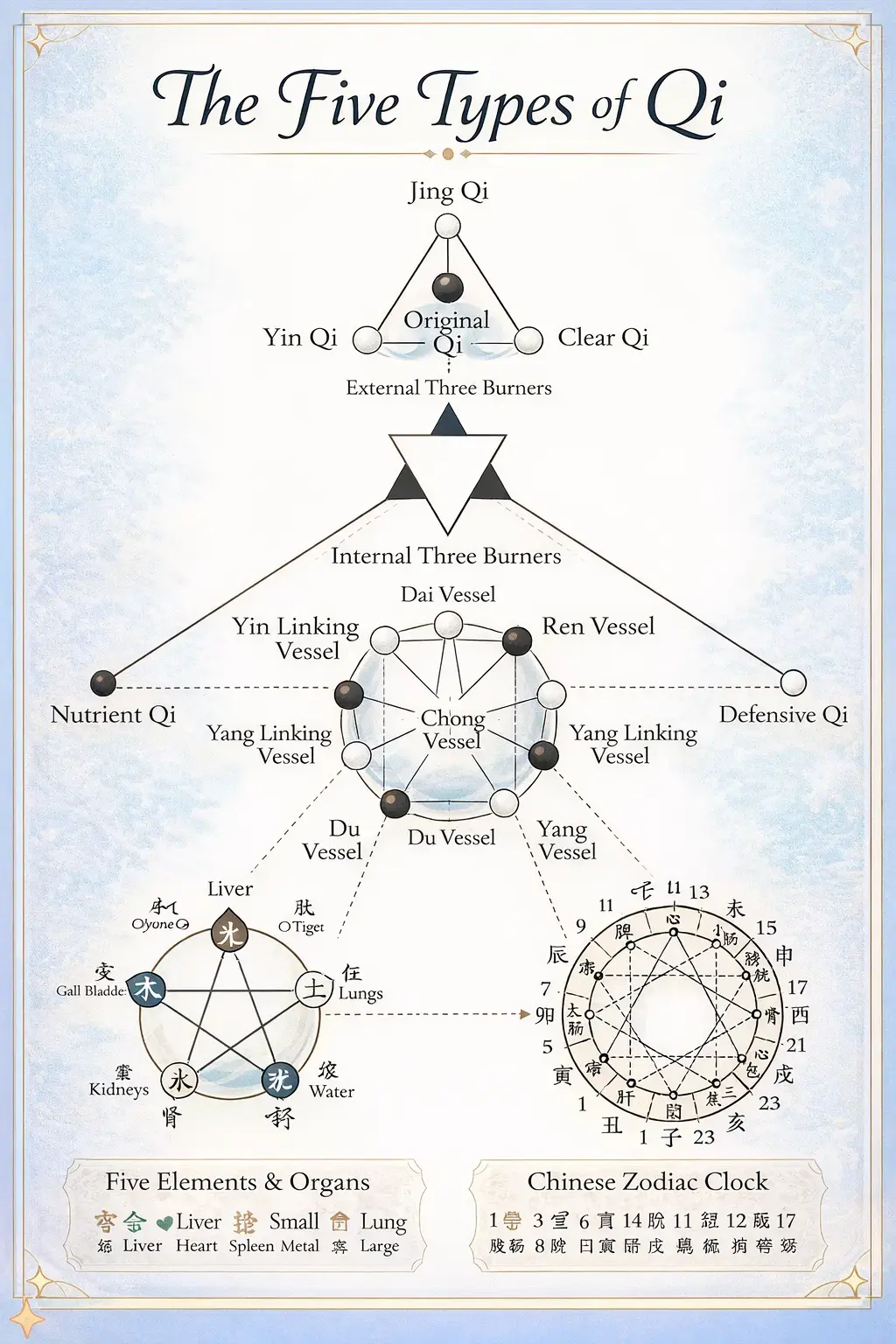
In classical Chinese medicine, Qi is understood as part of an interconnected energetic system linking organs, meridians, and functional processes throughout the body.
How Qi Is Cultivated
The cultivation of qi is the central purpose of both qigong and tai chi practice—though the two approaches differ in emphasis and method.
Zhan Zhuang (站桩, standing meditation) is the most direct method of qi cultivation available to beginners. Holding a stable, relaxed posture for extended periods gradually draws qi toward the Dan Tian , builds sensitivity to its presence, and develops the internal stillness that allows subtler qi sensations to become perceptible. Many practitioners report their first clear qi sensations—warmth, tingling, a sense of fullness or gentle pressure—during standing practice.
Dantian Breathing (丹田呼吸) develops qi cultivation through the breath. The rhythmic expansion and contraction of the lower abdomen drives qi into the Dan Tian and gradually increases its density and mobility there. The Dan Tian itself—the “elixir field” below the navel—is understood as the primary storage and generation center for qi in the body.
Slow tai chi form practice cultivates qi through movement. The continuous, connected quality of well-executed tai chi—silk reeling running through every transition, weight shifts clear and unambiguous, kua open and mobile—creates a kind of internal pumping action that circulates qi through the meridian pathways more effectively than static practice alone.
The practitioner’s yi (intention) plays a crucial role: the classical principle yi dao qi dao (意到气到) —“where intention goes, qi follows”—means that the quality of mental attention during practice directly affects where qi accumulates and how it moves.
Qigong practices such as Baduanjin (八段锦) and Liu Zi Jue (六字诀) target specific meridian pathways and organ systems, making them particularly useful for therapeutic qi cultivation. Baduanjin’s eight sequences are structured to open major meridian pathways in a systematic order. Liu Zi Jue’s six healing sounds each resonate with a specific organ and its associated qi.
At this point, you might be wondering:
What does Qi actually feel like in the body?
Understanding the theory is one thing—but real insight begins with direct sensation.
→ Read: How Qi Feels — A Beginner’s Guide
Qi in Motion: Analyzing Classic Tai Chi Forms
Understanding the five qi types is not just theoretical—it becomes tangible when we examine how specific Tai Chi movements cultivate and direct them. Each form, with its unique combination of opening and closing, rising and sinking, spiral and extension, creates a distinct pattern of qi circulation. Here we analyze two foundational forms through the lens of the five qi framework.
Cloud Hands (云手): Harmonizing Zong Qi and Wei Qi
Cloud Hands is a continuous, flowing lateral movement that emphasizes weight shifting, waist rotation, and arm circles. Its effect on qi is twofold:
- Zong Qi (Gathering Qi) enhancement: The coordinated opening of the chest during the outward arm sweep, combined with a natural inhalation, expands the thoracic cavity and draws Zong Qi into the chest center (Shan Zhong). The subsequent closing and sinking with exhalation compresses and distributes this gathered qi downward, linking breath with heart-driven circulation. This rhythmic pumping strengthens Zong Qi’s dual role—governing respiration and assisting blood flow.
- Wei Qi (Defensive Qi) activation: The continuous, spiraling arm movements—especially the palm facing outward as if warding—activate Wei Qi at the body’s surface. The moderate speed and relaxed tension allow Wei Qi to spread evenly through the skin and superficial muscles, enhancing its protective function. Practitioners often report a sensation of a “qi shield” or warm layer surrounding the body after sustained Cloud Hands practice.
Breath–movement–qi connection: In Cloud Hands , the breath becomes the tide that moves the qi. Inhale as arms open and weight shifts to the back leg (storing Zong Qi in the chest); exhale as arms press across and weight settles (sending Zong Qi downward and spreading Wei Qi outward). The waist, as the commander, ensures this breath-qi coordination remains continuous.
Single Whip (单鞭): Cultivating Ying Qi and Anchoring Yuan Qi
Single Whip is a form of contrasts: a gathering and coiling motion followed by a decisive opening and extension. Its qi dynamics are equally distinct:
- Ying Qi (Nutritive Qi) nourishment: The coiling phase—drawing the right hand into a hook while left hand folds—gently compresses the meridians, particularly the Pericardium and Triple Burner(三焦,Triple Burner/San Jiao) channels in the arms. This compression is followed by a sudden release as the left palm pushes forward and the hook opens slightly, creating a “squeeze and flush” effect that propels Ying Qi deeper into the meridians. The result is enhanced nourishment of the organs and tissues along the extended arm’s pathways.
- Yuan Qi (Original Qi) anchoring: The final posture—front arm extended, back arm hooked, weight predominantly on the rear leg—creates a stable, rooted structure. The lower Dan Tian is naturally engaged, and the relaxation of the perineum ( Hui Yin point ) allows Yuan Qi to settle. This rooted stillness, even within motion, signals the body to preserve and store fundamental vitality rather than expend it.
Breath–movement–qi connection: In Single Whip, the inhale accompanies the gathering and coiling (storing Ying Qi in the meridians), while the exhale powers the extension and opening (releasing Ying Qi to nourish). The momentary stillness at the posture’s completion is not empty—it is the moment Yuan Qi sinks and stabilizes, ready for the next transition.
The Unified Model: Form, Breath, and Qi as One System
These examples reveal a consistent pattern: every Tai Chi movement, when performed with proper intention and relaxation, creates a specific qi dynamic that can be understood through the five qi framework. The relationship is not arbitrary—it follows the classical principle that yi (intention) leads qi, and qi leads the body . In practice:
- The form shapes the pathways—openings gather Zong Qi, extensions distribute Ying Qi, spirals activate Wei Qi, and rooted stances anchor Yuan Qi.
- The breath provides the rhythm—inhalation stores and gathers, exhalation releases and sinks, coordinating the qi’s movement with the body’s mechanics.
- The qi itself responds to this coordinated intention, flowing, gathering, and transforming according to the needs of the moment.
This integrated model transforms abstract theory into a practical guide: by understanding which qi type a movement cultivates, practitioners can focus their intention more precisely and deepen their internal experience of the form.
Qi, Science, and the Question of Evidence
The scientific status of qi is genuinely contested—and honestly acknowledging this is more useful than either dismissing the concept or defending it uncritically.
What the research consistently shows is that practices oriented around qi cultivation—acupuncture, qigong, tai chi—produce measurable physiological effects. Improved autonomic nervous system regulation, reduced inflammatory markers, enhanced immune function, demonstrable changes in heart rate variability and cortisol levels. These effects are real. The debate is whether “qi” is the best description of the underlying mechanisms.
Several research directions have explored possible physical correlates for qi and meridian pathways. Fascial networks—the continuous sheets of connective tissue that run throughout the body—show properties (electrical conductance, mechanical transmission, fluid dynamics) that partially overlap with classical meridian descriptions. Bioelectric fields and biophoton emission have been proposed as qi-related phenomena. None of these hypotheses has achieved consensus, and none fully accounts for the classical system.
The most intellectually honest position is probably this: qi describes something real about how the body functions as an integrated, dynamic system—something that Western physiology has not yet fully characterized. Practitioners who work with qi consistently find it a more useful guide to practice than ignoring it.
The absence of a complete mechanistic account does not make the functional concept useless—it makes it an open question worth taking seriously.
Yi Leads Qi: The Internal Hierarchy
The classical statement of qi’s role in tai chi and qigong is precise: 意到气到,气到劲到—where intention arrives, qi arrives; where qi arrives, force arrives. This hierarchy—yi leading qi, qi leading force—is not just a theory. It describes a specific training orientation.
A practitioner who tries to generate force through muscular effort is working from the bottom up: body → qi (maybe) → yi (as an afterthought). A practitioner working according to the classical hierarchy does the opposite: yi initiates, qi follows, the body moves as a consequence.
The difference in the quality of movement produced is immediately perceptible to anyone with listening jing (听劲).
Developing this hierarchy requires exactly what tai chi and qigong training provides: enough stillness to perceive qi, enough sensitivity to feel yi’s effect on qi, enough repetition to make the yi-qi-force sequence habitual rather than deliberate. It is not achieved quickly.
But the direction is clear from the beginning—and orienting toward it from the first practice session produces better results than ignoring it until “advanced” stages of training.
- Jingluo — the meridian network through which qi flows throughout the body
- Dan Tian — the primary energy center where qi is stored and cultivated
- Qigong — the practice tradition specifically designed for qi cultivation
- Yi — intention that leads qi according to the classical hierarchy
- Dantian Breathing — the breath practice that drives qi into the Dan Tian
- Zhan Zhuang — standing practice where qi cultivation begins for most practitioners
- Silk Reeling — the spiral movement that circulates qi through the limbs
- Bai Hui — the crown acupoint marking the upper terminus of the governing vessel
- Lao Gong — the palm acupoint through which qi is emitted and received
- Hui Yin — the perineal acupoint at the base of the qi circulation circuit
- Five Elements — the phase framework governing organ-meridian qi relationships
- Tai Chi Chuan — the martial art in which qi cultivation and martial development are unified
- Listening Jing — tactile sensitivity that reads qi quality through contact
Have questions about Qi in practice? Our forum thread — Qigong FAQ: Everything Beginners Ask — Answered by Senior Practitioners — covers this and many more topics answered by experienced practitioners.
Understanding Qi intellectually is only the first step. In traditional practice, Qi is not something you define—it is something you develop, refine, and embody over time.
The real question is not “What is Qi?” but:
“How does Qi change the way you move, breathe, and perceive your body?”
Deepen Your Understanding: Download our free 50-page eBook — Understanding Qi: The Complete Guide — featuring all seven articles from the Qi series, with bonus comparison tables and breathing drills.
Related Glossary Terms
Explore connected concepts in the Tai Chi knowledge graph.
Often Discussed Together
These concepts co-occur frequently across our articles and discussions.
Community & Questions
Discussions from practitioners about qi.
Is Qigong Real or Fake? Separating Fact from Fiction
[Masterclass] The Ultimate 62-Step Guide to Tai Chi's 8 Methods & 5 Steps (Ba Fa Wu Bu) with Detailed Explanations
Qigong FAQ: Everything Beginners Ask — Answered by Senior Practitioners [OFFICIAL GUIDE]
Tai Chi Books: The Lost Library of Tai Chi Unlocking Practice Through Ancient Books
Further Reading & Practical Guides
In-depth articles featuring qi.
Qigong for Autumn: A Seasonal Practice Guide for the Transition into Fall
When the season turns, qigong turns with it. This guide explains how to adapt your practice from summer expansion to autumn gathering — the Sī sound, the Lung's Metal breath, and a 15–20 minute daily protocol from 立秋 to 秋分.
Chen Style Silk Reeling Explained: The Spiral Power of Tai Chi (Chan Si Jin)
Silk reeling (缠丝劲, Chan Si Jing) is the continuous spiral that threads the whole body into one connected screw — kua initiates, waist transmits, joints thread in sequence. This guide explains the mechanics, the 10-minute single-arm drill protocol, common mistakes, push hands application, and the lineage that carries the method.
Tai Chi Walking for Seasonal Transitions: A Gentle 7-Day Routine
Use Tai Chi Walking as a gentle 7-day reset during seasonal transitions, with safe low-impact practice cues for late summer into autumn. A practical guide for when the body feels heaviness, fatigue, and shifting rhythms.
Tai Chi for Alzheimer’s & Dementia: Research & Real Results
Does Tai Chi help with Alzheimer's or dementia? Research from Ruijin Hospital, real caregiver experiences, and safe practice tips. Learn how slow movement may support brain health.
Baduanjin Breathing: A Wudang Master's 25-Year Guide
Master Gu (15th gen Wudang) reveals why most Baduanjin breathing increases tension — plus step-by-step fixes & the science behind correct breath work. Start breathing correctly today.