Not All Qi Is the Same: The 5 Types of Qi in Qigong and Chinese Medicine
Key Takeaways
- Traditional Chinese Medicine classifies 5 types of Qi: Yuan Qi (original), Zong Qi (gathering), Ying Qi (nutritive), Wei Qi (defensive), and Zangfu Qi (organ)
- Yuan Qi is inherited from parents and stored in the kidneys — it determines your constitutional vitality at birth
- Wei Qi circulates beneath the skin surface and governs immunity — Tai Chi practice measurably strengthens this layer
- Understanding the 5 Qi types transforms Tai Chi from abstract "energy work" into a precise physiological practice
Expert Contributors: Master Mingde Chen, 12th Generation Tai Chi Inheritor & Dr. Jing Li, PhD, Medical Reviewer
Part of the Understanding Qi series — follow this path to go from concept to practice:
New to Qigong? Start with our beginner’s guide → before diving into the five types.
- ★ Series Overview — complete guide + free PDF download
- What Is Qi — the foundational definition
- Qi vs Energy — why Qi is not simply “life force”
- The Philosophy of Qi — from cosmic origin to modern relevance
- Five Types of Qi — Yuan, Gu, Zong, Ying, and Wei Qi explained
- Why Science Struggles with Qi — and what we can learn from that
- How Qi Feels — a beginner’s guide to direct sensation
- Qi in Tai Chi Practice — from theory to embodiment
If you’ve practiced yoga, you know prana — the life force that moves through the body. If you’ve tried Reiki, you’ve felt universal energy channeled through the hands.
But if you’ve practiced Qigong, you’ve likely heard one word over and over: Qi.
Here’s the catch: Qi is not one thing.
In classical Chinese medicine and Qigong theory, there are five distinct types of Qi — each with its own origin, its own job, and its own way of being cultivated.
This isn’t abstract philosophy. It’s a practical framework that has guided healing and training for over 2,000 years — and it’s now being explored through the lens of modern science.
In this guide, you’ll learn:
- The five types of Qi and how they differ
- Where each type comes from and what it does
- How to cultivate each type through specific Qigong and Tai Chi practices
- What modern science reveals about these ancient concepts
Why This Matters: The Problem with “Qi = Energy”
In the West, Qi tends to be filed under one of two categories: a mystical life force that defies explanation, or a pre-scientific metaphor that modern medicine has superseded.
Neither is accurate.
In Chinese philosophy, Qi is not a substance — it’s a process. It’s the answer to the question: How does this living system move, transform, and relate to everything else?
This is why the Huangdi Neijing (Yellow Emperor’s Classic) doesn’t define Qi by what it is, but by what it does. And what it does is best understood through its five distinct expressions.
Dr. Jing Li explains: “Think of it like electricity. Electricity is one thing — but it powers your lights, heats your oven, runs your computer, and charges your phone. Same source, different functions. Qi is similar: one fundamental substance, but with different roles depending on where it is and how it’s used.”
All five types of Qi converge in the Dantian (丹田) — the body’s primary energy reservoir where Yuan Qi (inherited essence) and Gu Qi (food qi) combine and are distributed through the meridian system.
The Five Types of Qi: A Complete Reference
Qi Classification Table
| Qi Type | Alternative Names | Core Function | Yin-Yang Attribute | Qigong Practice Connection |
|---|---|---|---|---|
| Yuan Qi (元气) | Original Qi, True Qi | Life’s fundamental driving force; promotes growth, development, activates organ function | Yin (foundational qi) | Yi focus on Dan Tian, return breath to origin, stillness practice to preserve root |
| Gu Qi (谷气) | Grain Qi, Food Qi | Provides post-natal nourishment and energy; material basis for other qi types | Neutral (post-natal foundation) | Regulate Spleen/Stomach, combine diet with practice, enhance energy transformation |
| Zong Qi (宗气) | Gathering Qi | Governs breathing, assists heart in blood circulation, affects voice and pulse strength | Yang (propelling qi) | Breath regulation training, deep breathing methods, sound guiding (e.g., Liu Zi Jue) |
| Ying Qi (营气) | Nutritive Qi, Constructive Qi | Transforms into blood, nourishes organs and tissues, maintains metabolism | Yin (nutritive qi) | Focus on meridians, seek movement within stillness, promote qi-blood harmony |
| Wei Qi (卫气) | Defensive Qi | Defends against pathogens, warms surface tissues, regulates sweat pores | Yang (protective qi) | Dynamic qigong (e.g., Baduanjin), consolidate surface yang, protect against wind-cold invasion |
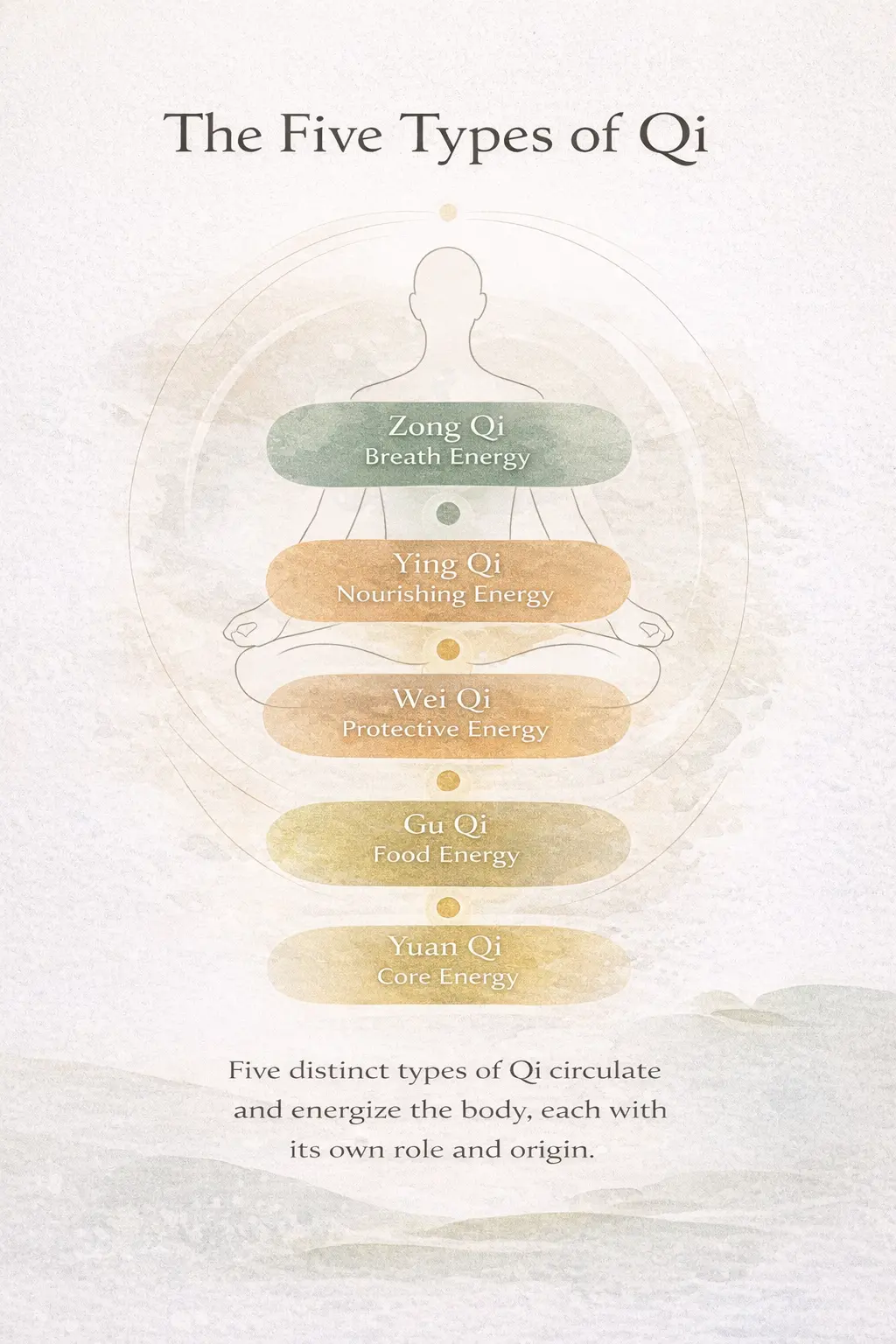
The five types of Qi represent different functional expressions of life energy in Qigong practice, each originating from a distinct source and supporting specific physiological processes.
How These Five Qi Types Work Together
Before diving into each type individually, it’s helpful to understand how they relate to one another:
- Gu Qi is the source of all post-natal qi, transformed by the Spleen and Stomach from food and drink.
- Zong Qi is formed in the chest by combining Gu Qi with the clean air inhaled by the lungs — serving as the crucial link between breathing and heart-driven blood circulation.
- Ying Qi and Wei Qi both arise from further differentiation of Gu Qi. One is Yin, the other Yang; one moves inward, the other outward — together they maintain internal balance and external protection.
- Yuan Qi is the fundamental root, driving the entire qi transformation process, while constantly relying on Gu Qi for replenishment.
Qigong practice — through regulating body, breath, and mind — harmonizes the movement of these five qi types, leading to the state of “sufficient qi, robust blood, and clear spirit” (气足、血旺、神清) that defines true health.
Yuan Qi (元气) — Your Inheritance
What Is Yuan Qi?
Yuan Qi, also called Original Qi or True Qi, is the fundamental vitality you’re born with. It’s the battery that powers your entire life.
Source
- Pre-natal essence inherited from your parents
- Stored in the Kidneys
- Cannot be created — only preserved and replenished through post-natal nourishment
Core Function
Yuan Qi is the root of all yin and yang in the body. It:
- Drives growth, development, and reproduction
- Activates the functional systems of all organs
- Provides the warmth and motivation for all physiological processes
Think of it as the national treasury — the deep reserve that everything else depends on.
How to Cultivate Yuan Qi
Unlike other types of Qi, Yuan Qi cannot be increased through practice. But it can be preserved and its depletion slowed.
Key practices :
- Zhan Zhuang (Standing Meditation) — Holding stable postures allows the body to settle into its deepest relaxation, minimizing unnecessary expenditure of Yuan Qi.
- Dan Tian focus — Directing awareness to the lower Dan Tian during stillness practice helps Yuan Qi settle and stabilize.
- Return breath to origin — Breathing that is fine, long, even, and quiet, without force, conserves rather than consumes.
- Adequate rest — Sleep is when Yuan Qi is most effectively restored.
Master Mingde Chen shares: “In my early years, I was taught that Yuan Qi is like a candle. Once lit, it burns until the end. Qigong isn’t about adding more wax — it’s about making the flame burn more steadily, with less flicker. That’s what standing practice does: it steadies the flame.”
Scientific Parallels
Researchers have explored connections between Yuan Qi and:
- Stem cell activity — The body’s fundamental regenerative capacity
- Telomere length — A biological marker of aging
- Mitochondrial function — Cellular energy production
A 2018 study published in Frontiers in Immunology found that long-term Qigong practitioners showed slower rates of telomere shortening compared to controls — a finding consistent with the “preserving the root” function of Yuan Qi cultivation.
Gu Qi (谷气) — Your Fuel
What Is Gu Qi?
Gu Qi, or Grain Qi, is the Qi extracted from the food and drink you consume. It’s the daily fuel that keeps everything running.
Source
- Derived from digestion of food and water by the Spleen and Stomach
- Forms the material basis for Ying Qi, Wei Qi, and Zong Qi
Core Function
Gu Qi provides the post-natal energy needed for all activities. Without adequate Gu Qi:
- Blood cannot be formed
- Organs lack nourishment
- Wei Qi becomes deficient, increasing susceptibility to illness
Think of it as your daily paycheck — the ongoing income that supports your lifestyle.
How to Cultivate Gu Qi
Key practices:
- Dietary awareness — Whole foods, appropriate portions, and eating according to season support optimal Gu Qi extraction
- Spleen/Stomach Qigong — Exercises that gently stimulate the digestive organs
- Liu Zi Jue (Six Healing Sounds) — The “Hu” sound specifically targets the Spleen and enhances digestive transformation
- Post-meal walking — Gentle movement after eating aids the Spleen in its transformative work
Scientific Parallels
Research on Gu Qi aligns with:
- Nutritional science — The conversion of food into usable energy
- Gut microbiome research — The role of gut bacteria in extracting nutrients
- Metabolic function — How efficiently the body processes fuel
A 2013 study in the Journal of Traditional Chinese Medicine found that Qigong practice significantly improved symptoms in patients with functional dyspepsia — a condition directly related to Gu Qi transformation.
Zong Qi (宗气) — The Pump
What Is Zong Qi?
Zong Qi, or Gathering Qi, accumulates in the chest and governs the coordination of breathing and heart function. It’s the bridge between the air you breathe and the blood that carries nourishment.
Source
- Formed in the chest by combining Gu Qi (from food) with Qing Qi (clean air inhaled by the lungs)
Core Function
Zong Qi has three primary roles:
- Governs respiration — It powers the lungs’ ability to draw in and expel air
- Assists heart circulation — It helps propel blood through the vessels
- Affects voice and pulse — Strong Zong Qi produces a full, resonant voice and a strong, regular pulse
Think of it as the transportation network — the system that moves resources where they need to go.
How to Cultivate Zong Qi
Key practices :
- Deep abdominal breathing — Slow, diaphragmatic breathing directly builds Zong Qi
- Extended exhalation — Lengthening the exhale strengthens the gathering function
- Six Healing Sounds (Liu Zi Jue) — The “Si” sound (for Lungs) and “Chui” sound (for Heart) enhance Zong Qi
- Expansive movements — Forms that open the chest, like “Parting Wild Horse’s Mane,” gather Zong Qi
Dr. Jing Li notes: “From a biomechanics perspective, what Zong Qi describes is remarkably precise. The coordination of breath and heart function — cardiorespiratory coupling — is a real physiological phenomenon. When we measure heart rate variability during Qigong practice, we’re essentially measuring Zong Qi function.”
Scientific Parallels
Research on Zong Qi connects to:
- Heart rate variability (HRV) — A marker of autonomic nervous system balance
- Respiratory sinus arrhythmia — The natural variation in heart rate during breathing
- Cardiopulmonary function — How efficiently heart and lungs work together
Harvard Medical School research has demonstrated that slow, deep breathing increases HRV, indicating improved cardiorespiratory coupling — exactly what Zong Qi theory describes.
Ying Qi (营气) — The Nourisher
What Is Ying Qi?
Ying Qi, or Nutritive Qi, flows inside the meridians, accompanying the blood to nourish the organs and tissues. It’s the irrigation system of the body.
Source
- Derived from Gu Qi
- Transformed by the Spleen and Stomach into a more refined, nutritive form
Core Function
Ying Qi:
- Nourishes all organs and tissues
- Helps form blood (Ying Qi and blood share a common source)
- Maintains physiological metabolism at the cellular level
Think of it as the food supply to every home — the steady delivery of nutrients to every cell.
How to Cultivate Ying Qi
Key practices :
- Meridian-focused movement — Silk Reeling (Chan Si Jin) exercises specifically circulate Ying Qi through the channels
- Acupressure — Gentle stimulation of points like Zusanli (ST-36) and Sanyinjiao (SP-6) enhances Ying Qi flow
- Seeking movement within stillness — During standing meditation, a subtle internal “pumping” can be felt as Ying Qi circulates
- Balanced diet with blood-building foods — Dark leafy greens, beets, and other nutrient-dense foods support Ying Qi
Scientific Parallels
Ying Qi research aligns with:
- Microcirculation studies — Blood flow in the smallest vessels
- Tissue oxygenation — How effectively oxygen reaches cells
- Hematopoiesis — Blood formation and quality
A 2017 study in Evidence-Based Complementary and Alternative Medicine showed that acupuncture at specific points significantly increased local microcirculation — a measurable correlate of enhanced Ying Qi flow.
Wei Qi (卫气) — The Shield
What Is Wei Qi?
Wei Qi, or Defensive Qi, flows outside the meridians, spreading through the skin, muscles, and superficial tissues. It’s your immune system in Qi form.
Source
- Also derived from Gu Qi, but the more vigorous portion
- Requires Kidney Yang warmth to be distributed effectively
Core Function
Wei Qi:
- Defends against external pathogens (wind, cold, damp, heat)
- Warms and moistens the skin and muscles
- Regulates the opening and closing of pores
Think of it as the border patrol — constantly scanning for threats and responding immediately.
How to Cultivate Wei Qi
Key practices :
- Dynamic Qigong — Forms like Ba Duan Jin (Eight Brocades) spread Wei Qi to the surface
- Moderate sweating — Gentle practice that warms the body without exhausting it strengthens Wei Qi
- Tapping and brushing — Lightly tapping the skin after practice awakens Wei Qi at the surface
- Protective awareness — In cold or windy conditions, intention can be used to “thicken” Wei Qi at vulnerable areas
Master Mingde Chen advises: “I tell my students: if you feel a chill or sense you might be getting sick, don’t push harder. Do a very gentle, internal form — almost like moving meditation. This allows Wei Qi to gather at the surface without being exhausted. Push too hard when you’re vulnerable, and you’ll push your Wei Qi away from where it’s needed most.”
Scientific Parallels
Wei Qi research connects to:
- Immune function — Particularly Natural Killer (NK) cell activity
- Skin barrier function — The skin’s physical and immunological defenses
- Thermoregulation — The body’s ability to maintain appropriate temperature
A landmark 2007 study published in Psychosomatic Medicine found that regular Tai Chi practice increased NK cell activity in older adults by over 50% — a direct correlate of enhanced Wei Qi function.
A Simple Metaphor: Your Body as a Country
To bring all five together, imagine your body as a well‑governed nation:
| Qi Type | Role in the Country |
|---|---|
| Yuan Qi | The national treasury — deep reserve that must be protected |
| Gu Qi | Daily tax revenue — what you take in to keep things running |
| Zong Qi | Transportation network — moving resources where needed |
| Ying Qi | Food supply to every home — steady nourishment for all citizens |
| Wei Qi | Border patrol and military — defending against invaders |
A strong country needs all five. A healthy body does too.
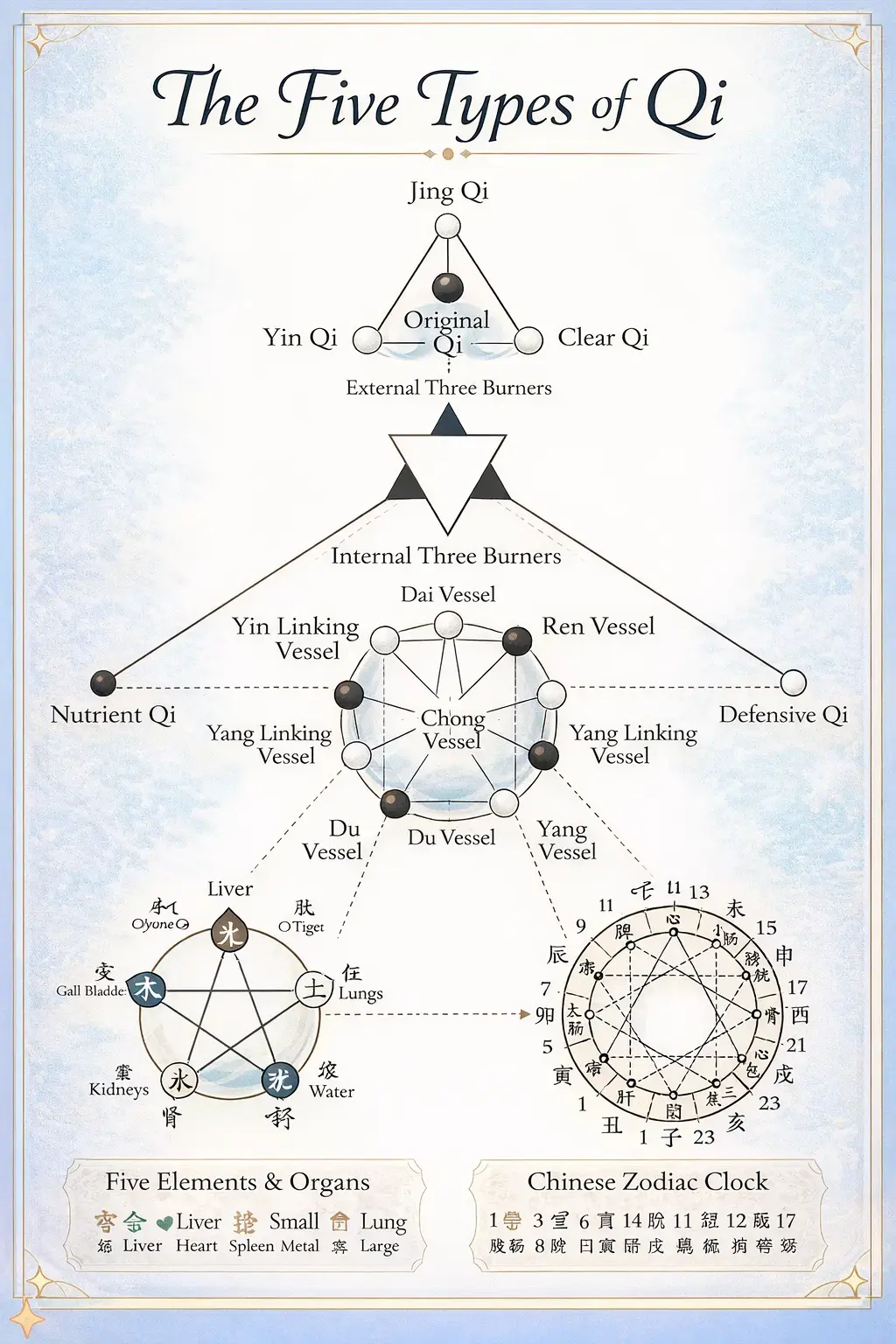
In classical Chinese medicine, Qi is understood as part of an interconnected energetic system linking organs, meridians, and functional processes throughout the body.
Practical Guide: Which Qi Do You Need Most?
Different people — and different seasons of life — call for emphasis on different Qi types.
| If you… | Focus on… | Simple practice |
|---|---|---|
| Feel depleted, aging, recovering from illness | Yuan Qi | Daily Zhan Zhuang (5-10 minutes), early bedtime |
| Have poor digestion, low energy after meals | Gu Qi | Gentle Spleen Qigong, eat warm cooked foods |
| Experience shortness of breath, weak voice | Zong Qi | Extended exhalation breathing, chest-opening forms |
| Look pale, feel “empty,” have poor circulation | Ying Qi | Silk Reeling exercises, nourishing diet |
| Get sick often, feel chilly, sensitive to weather | Wei Qi | Dynamic Qigong (Ba Duan Jin), warm clothing |
Conclusion: The Art of Balancing Five
The five types of Qi are not just a piece of ancient history. They are a living framework — one that has guided healers and practitioners for millennia, and one that modern science is only beginning to catch up with.
Whether you’re new to Qigong or a seasoned practitioner, understanding these five energies can transform your practice. You’ll stop asking “Is this working?” and start feeling how it works — in your breath, in your body, in your daily life.
Master Mingde Chen concludes: “I’ve practiced for over forty years, and I’m still learning how these five Qi types interact. Some days I need more stillness to preserve Yuan Qi. Other days I need more movement to activate Wei Qi. The art is in sensing which is needed — and responding without forcing. That’s what we mean by ‘following the Dao.’”
Ready to apply this understanding in movement? → The 5 Stages of Learning Tai Chi — see how Qi awareness develops through practice.
So next time you step onto the mat, remember: you’re not just moving Qi. You’re balancing five. And that’s the real art of Qigong.
Qi Classification Quick Reference Table
| Qi Type | Source | Core Function | Key Practice |
|---|---|---|---|
| Yuan Qi (元气) | Kidneys (inherited) | Life’s fundamental drive | Standing meditation |
| Gu Qi (谷气) | Spleen/Stomach (food) | Daily energy | Spleen Qigong, diet |
| Zong Qi (宗气) | Lungs + Spleen (breath + food) | Cardiorespiratory coupling | Deep breathing |
| Ying Qi (营气) | Gu Qi refinement | Nourishment, blood formation | Silk Reeling, acupressure |
| Wei Qi (卫气) | Gu Qi + Kidney Yang | Immunity, surface protection | Dynamic Qigong |
Related Glossary Terms
- Yuan Qi — Original Qi, the fundamental vitality inherited at birth
- Dan Tian — The primary energy center where Qi is stored
- Zhan Zhuang — Standing meditation, the foundation of Qi cultivation
- Ba Duan Jin — Eight Brocades Qigong, excellent for Wei Qi
- Liu Zi Jue — Six Healing Sounds, targets specific organ Qi
- Silk Reeling — Chan Si Jin, circulates Ying Qi through meridians
Try It for Yourself: A 60-Second Qi Experiment
Before you decide which Qi type to cultivate, experience Qi directly. This simple practice takes less than a minute and requires nothing but your attention.
☯️ The Palm Awakening Practice
- Rub your palms together vigorously for 10–15 seconds until you feel warmth.
- Hold your palms facing each other , about 6 inches apart, as if holding a small ball.
- Close your eyes and slowly bring your palms closer, then farther apart — like gently squeezing and releasing a soft balloon.
- Notice what you feel between your palms: warmth, tingling, pressure, magnetism, or simply presence.
Many traditions describe this sensation as Qi — the body’s subtle vitality becoming perceptible.
Once you’ve felt Qi in your palms, you’re ready to sense it in your Dan Tian, your meridians, and your forms. Learn how these sensations develop in practice → . The five types of Qi are simply maps of where this feeling goes and what it does.
Want to go deeper? Our free guide to Qi cultivation walks you through simple standing practices that build on this awareness — no sign-up required.
Which Qi Type Should You Focus On?
Different needs call for different emphasis. Here’s a quick reference:
- Feel depleted, aging, recovering → Focus on Yuan Qi (standing meditation, rest)
- Poor digestion, low energy after meals → Focus on Gu Qi (Spleen Qigong, diet)
- Shortness of breath, weak voice → Focus on Zong Qi (deep breathing, chest-opening forms)
- Pale, poor circulation → Focus on Ying Qi (Silk Reeling, nourishing foods)
- Frequent colds, sensitive to weather → Focus on Wei Qi (dynamic Qigong, warm clothing)
🔍 Go Deeper: The Complete Qi Knowledge System
This article broke down the five functional types of Qi — Yuan, Gu, Zong, Ying, Wei — and how they work together. But knowing the types is just the first step toward applying them.
We’ve compiled all 7 in‑depth Qi articles (over 10,000 words) into one free 50+ page PDF ebook, Understanding Qi . From philosophy, science, and taxonomy to direct sensation — everything you need in one place.
Master Mingde Chen
12th generation Chen-style inheritor with decades of teaching experience.
View all articles →