Tai Chi Glossary > Eighteen Arms of Wushu / 十八般兵器
Eighteen Arms of Wushu (十八般兵器)
Definition: The Eighteen Arms of Wushu are the best-known traditional catalogue of classical Chinese martial weapons. In Chinese they are called 十八般兵器 (Shiba Ban Bingqi), literally “the eighteen categories of weapons.” The phrase does not always point to one perfectly fixed list across all dynasties or schools. Instead, it refers to the idea that a complete martial education includes multiple weapon families rather than only empty-hand technique.
You’ve heard the phrase “ master of the 18 arms ,” but what does it actually mean? Forget scrolling through endless, dry historical texts. Here’s the straight answer:
The 18 Arms of Wushu — formally known in Chinese as 十八般兵器 (Shíbā Bān Bīngqì) , also written as 十八般武艺 (Shíbā Bān Wǔyì) — are the core classical weapons of Chinese martial arts. Think of them as the original toolkit for a warrior, each designed for a specific purpose on the battlefield. But today, they’re less about combat and more about building an unstoppable body and mind. They are the ultimate key to understanding the depth of Kung Fu and Tai Chi . If you’re exploring Chinese martial arts and wondering where Tai Chi fits in, start here: new to Tai Chi? Start here .
In a nutshell : If you want to develop power, coordination, and a profound connection to Chinese martial culture, learning these weapons isn’t an option—it’s essential.
So, let’s cut through the noise and get to the good stuff.
Where Did the 18 Arms of Wushu Come From? (A Quick History)
This isn’t just ancient history; it’s a story of adaptation. The “18 Arms” concept didn’t pop up overnight. It evolved over centuries, starting around the Warring States period.
Here’s the timeline that shaped it all:
- Warring States Period (c. 475–221 BC) : The idea was born. Military strategists like Sun Bin and Wu Qi supposedly conceptualized it. Why? To systematize soldier training.
- Han Dynasty (202 BC–220 AD) : Big tech upgrade. Iron replaced bronze, making weapons stronger and deadlier. This was a game-changer.
- Tang Dynasty (618–907 AD) : The shift begins. Some weapons started their transition from battlefield killers to ceremonial status symbols.
- Yuan & Ming Dynasties (1271–1644 AD) : The list solidifies. This is when the term “18 Arms” appears in operas and military texts — including the Ming-dynasty scholar Xie Zhaozhe’s Wu Za Zu (五雜俎), one of the earliest written records of the canonical list. The classic list we often use today was basically set.
- Qing Dynasty to Modern Day : The final pivot to performance and health. With guns making most of these weapons obsolete, they found a new life in traditional martial arts, opera, and as tools for physical cultivation.
The 18 Arms aren’t a static list. They’re a living record of Chinese military and cultural history. They adapted to survive.
The Shaolin Temple, Warrior Monks, and the 18 Arms
No discussion of the 18 Arms is complete without the Shaolin Temple. Nestled within the ancient walls of the Shaolin Temple in Henan Province, China, lies a treasure trove of martial arts knowledge that has captivated warriors, scholars, and enthusiasts for centuries.
At the heart of this institution are the Shaolin 18 Arms — the traditional weapons curriculum of the Shaolin Temple’s warrior monks. These weapons are integral to Shaolin Kung Fu training and are used for combat, self-defense, and physical conditioning. Throughout history, from dynasty to dynasty, the official groupings of the weapons changed many times over. Even in modern times, the list of the “Shaolin 18 Arms” will vary based on location, martial arts style, and regional histories and interpretations.
Who Were the Warrior Monks?
The warrior monks (武僧, Wǔ Sēng) of the Shaolin Temple were not typical soldiers. They were practitioners who pursued martial excellence and spiritual cultivation simultaneously — and the weapons they trained with reflected both dimensions. Mastery of these weapons required extensive training, discipline, and understanding of martial arts principles. By mastering these weapons, the warrior monks not only honed their combat skills but also cultivated their character and spiritual development.
The weapons were passed down through generations of Shaolin practitioners through oral tradition, written texts, and hands-on instruction. This transmission and preservation ensured that the knowledge associated with each weapon remained faithful from one generation to the next — maintaining the integrity of the Shaolin martial arts tradition to this day.
Shaolin vs. Wudang: Two Mountains, Two Philosophies
The 18 Arms are also associated with a second sacred site: the Wudang Mountains (武当山) in Hubei Province. While Shaolin Kung Fu emphasizes external power, directness, and hard techniques, the Wudang tradition — rooted in Taoist internal arts — approaches the same weapons through the lens of softness, circularity, and internal force.
| Dimension | Shaolin Temple | Wudang Mountains |
|---|---|---|
| Tradition | Buddhist, external | Taoist, internal |
| Weapon style | Direct, powerful, hard | Circular, soft, flowing |
| Core principle | External strength (外功) | Internal cultivation (内功) |
| Most associated weapon | Staff (Gun 棍) | Straight Sword (Jian 剑) |
Both lineages revere the 18 Arms. But what changes is the spirit in which each weapon is practiced. Understanding both traditions gives you a far richer picture of why these weapons have endured for over a thousand years.
Why Were These Specific Weapons Chosen? The Significance of the 18 Arms
The selection of weapons at the Shaolin Temple was not arbitrary. It was a deliberate and strategic process that reflected the temple’s commitment to martial excellence, spiritual cultivation, and the preservation of Chinese martial arts heritage. There were five key factors:
⚔️ Practicality and Versatility Each weapon was chosen for its effectiveness across different combat scenarios — long-range attacks, close-quarters combat, and defensive maneuvers. This ensured that warrior monks were well-equipped to handle a wide range of adversaries and situations.
📜 Cultural and Historical Influences Many of the chosen weapons carry deep cultural and historical significance in Chinese martial arts and military history. The staff, spear, and straight sword have been used in Chinese warfare for centuries — natural choices for monks who sought to defend the temple and its teachings.
🔯 Symbolism and Tradition Each weapon embodies specific martial virtues central to Shaolin Kung Fu: discipline, courage, agility, and wisdom . Training with a weapon was not merely physical practice — it was a form of moral cultivation.
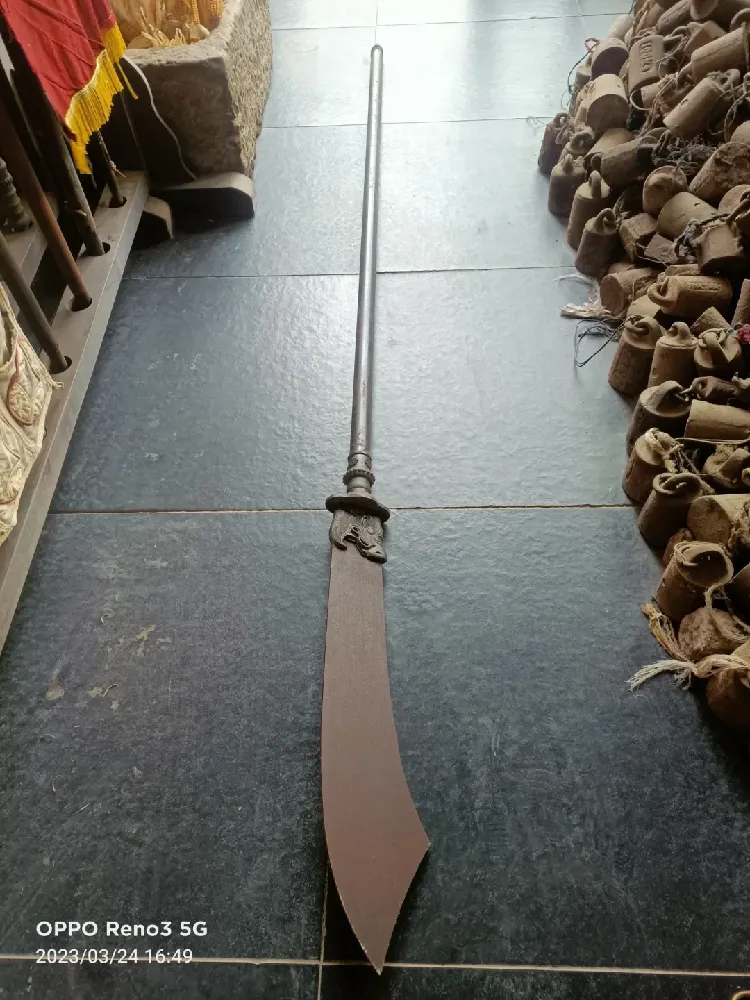
🔄 Adaptation and Innovation Over time, warrior monks adapted and innovated upon traditional weapons to suit their specific needs. This led to unique weapon variations like the Monk’s Spade (Yue Ya Chan 月牙铲) — a weapon that combines a spade blade with a crescent moon blade, reflecting both the practical needs and spiritual symbolism of temple life.
🏛️ Transmission and Preservation The weapons were passed down through generations through oral tradition, written texts, and direct instruction. Each weapon in the 18 Arms carries centuries of accumulated knowledge — not just technique, but the philosophy and principles behind it.
Each weapon was chosen not only for its practical effectiveness in combat, but also for its symbolic significance and role in shaping the identity and legacy of the warrior monks. This dual purpose — practical and philosophical — is what separates the 18 Arms from a simple weapon list and elevates them into a cultural heritage.
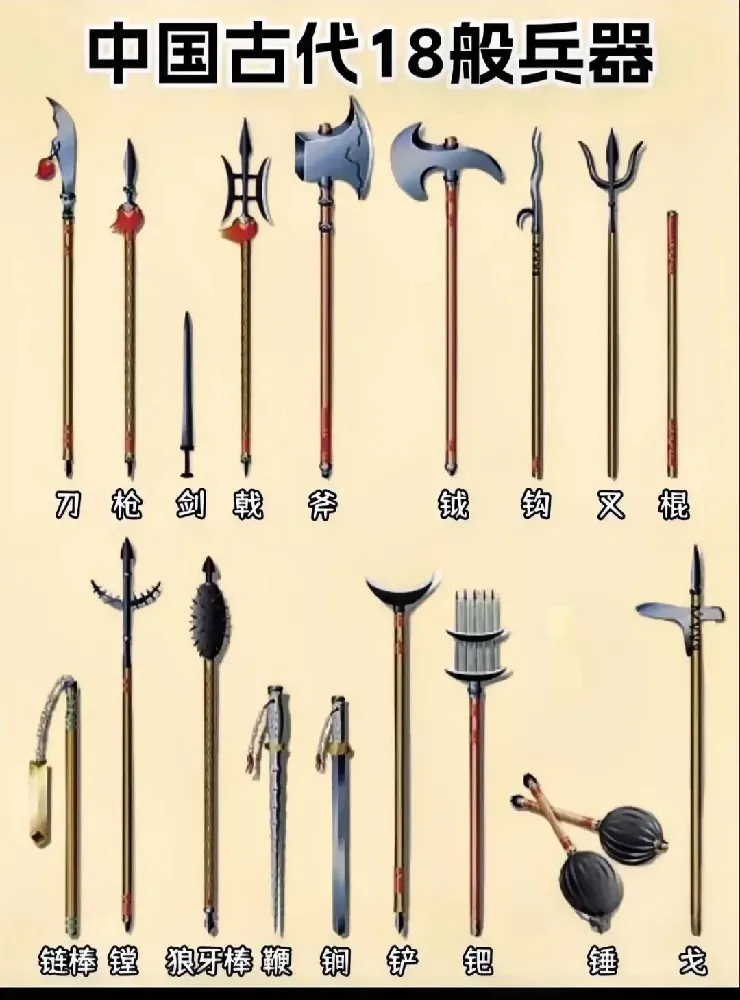
The Complete List: What Are the 18 Weapons?
Also known as 十八般兵器 (Shíbā Bān Bīngqì) or 十八般武艺 (Shíbā Bān Wǔyì) in Chinese, the “Eighteen Arms of Wushu” represent the canonical set of classical Chinese martial arts weapons. Here is the complete list:
Jump to weapon: 刀 Dao · 枪 Qiang · 剑 Jian · 戟 Ji · 斧 Fu · 钺 Yue · 钩 Gou · 叉 Cha · 鞭 Bian · 锏 Jian · 锤 Chui · 抓 Zhua · 镋 Tang · 棍 Gun · 槊 Shuo · 棒 Bang · 拐 Guai · 流星 Liuxing
| Weapon Name (Chinese) | Key Characteristics & Use |
|---|---|
| 1. 刀 (Dāo) - Broadsword | The fierce slasher. Single-edged, curved blade designed for powerful chopping and cutting. |
| 2. 枪 (Qiāng) - Spear | The “King of Weapons.” A long-range piercing tool that teaches precision and whole-body power. |
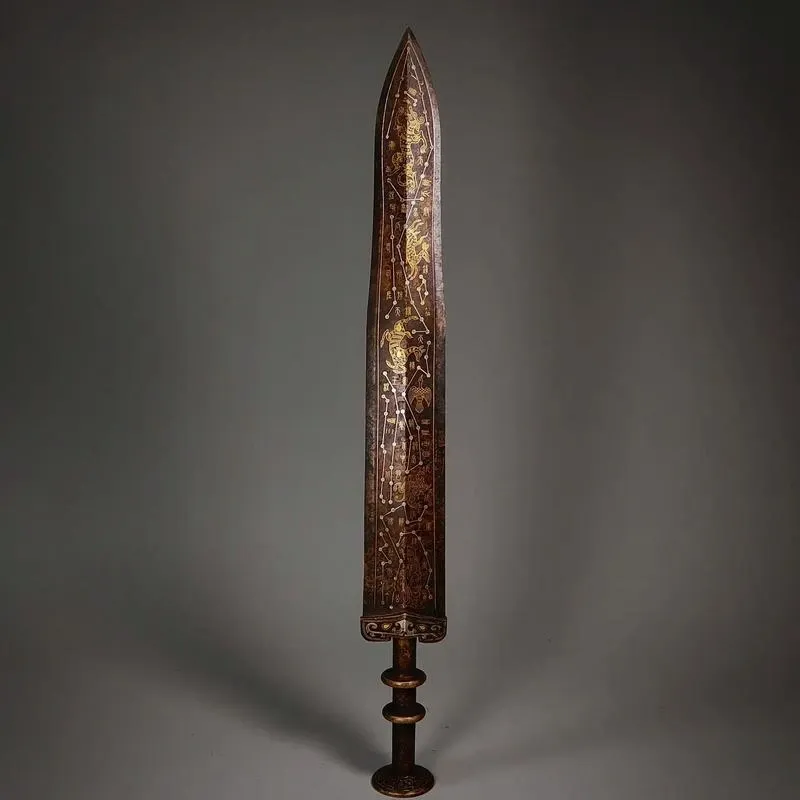
| 3. 剑 (Jiàn) - Straight Sword | The “Gentleman of Weapons.” A double-edged, straight blade for thrusting and elegant, precise cuts. |
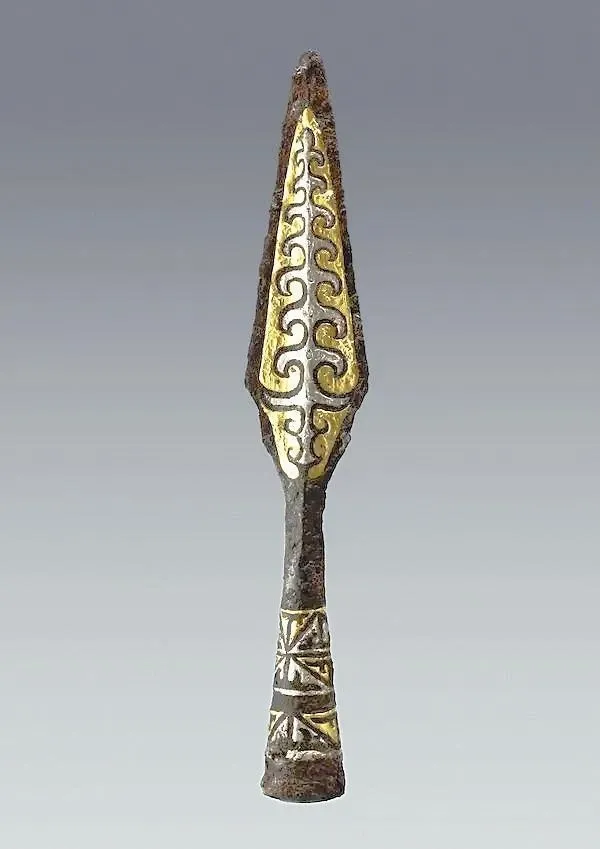
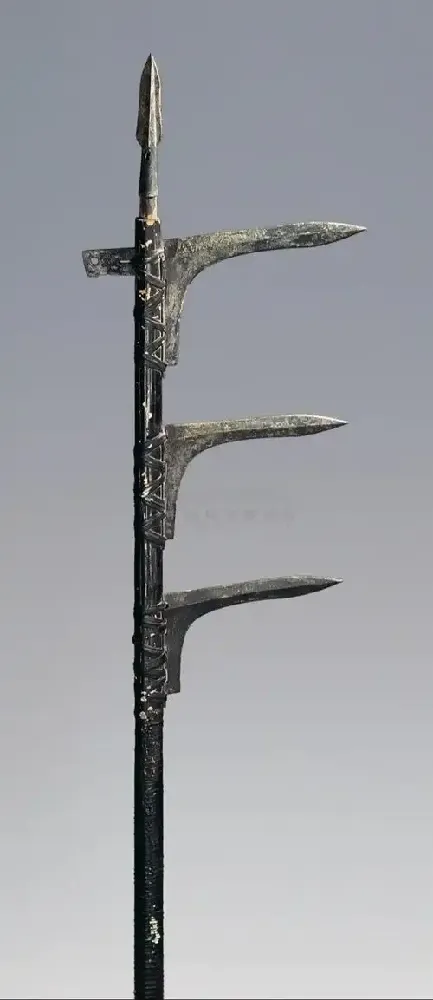
| 4. 戟 (Jǐ) - Halberd | A battlefield multitool. Combines a spear point with an axe head for piercing, hooking, and chopping. |
| 5. 斧 (Fǔ) - Axe | Pure, brute-force power. A heavy blade on a handle for devastating chops. |
| 6. 钺 (Yuè) - Battle-Axe | A larger, more ceremonial version of the axe, often symbolizing authority. |
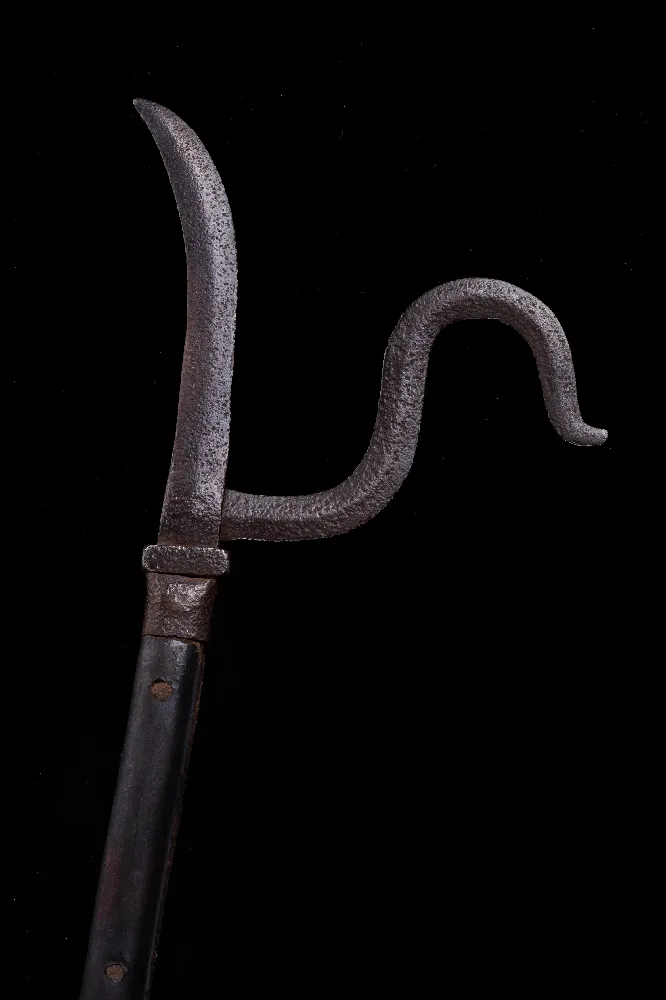
| 7. 钩 (Gōu) - Hook Sword | Uniquely Chinese. Features a sharp hook for disarming opponents and a blade for striking. |
| 8. 叉 (Chā) - Fork | A simple but effective multi-tined weapon for thrusting and trapping enemy weapons. |
| 9. 鞭 (Biān) - Iron Whip | A heavy, rigid bar made of linked sections. Designed to smash through armor. |
| 10. 锏 (Jiǎn) - Mace | Similar to the whip but often with ridges. A crushing weapon without a sharp edge. |
| 11. 锤 (Chuí) - Hammer | The ultimate blunt-force instrument. Often used in pairs to deliver overwhelming power. |
| 12. 抓 (Zhuǎ) - Claw | A bizarre but effective weapon. A metal claw on a stick, used to grab and tear. |
| 13. 镋 (Tǎng) - Trident-Halberd | Like a fork on steroids. A long spear with two crescent-shaped blades on the sides. |
| 14. 棍 (Gùn) - Staff | The “Grandfather of all Weapons.” A simple wooden rod that teaches fundamental power and control. |
| 15. 槊 (Shuò) - Long Lance | A heavy cavalry spear. Long, powerful, and designed for use on horseback. |
| 16. 棒 (Bàng) - Club | A shorter, thicker, and more brutal version of the staff. All about impact. |
| 17. 拐 (Guǎi) - Tonfa | The classic side-handle baton. Excellent for blocking, striking, and joint locks. |
| 18. 流星 (Liúxīng) - Meteor Hammer | The ultimate flexible weapon. A weight on a long rope, requiring incredible skill to control. |
Beyond Combat: How the Shaolin Warrior Monks Used These Weapons in Daily Life
One of the most fascinating and overlooked aspects of the 18 Arms is that several of these weapons served multiple purposes beyond combat, fulfilling practical functions in daily temple life. This dual-purpose nature is part of what made them so valued by the warrior monks.
🌙 Monk’s Spade (Yue Ya Chan 月牙铲) The monk’s spade combines a spade-like blade with a crescent-shaped blade on the opposite end. While primarily used for combat and self-defense, the spade blade served for digging, gardening, and farming around the temple grounds. The crescent blade cut vegetation and cleared debris. It was also used as a ceremonial tool in religious rituals — making it perhaps the most versatile item in the entire 18 Arms.
🌲 Staff (Gun 棍) The staff is one of the most fundamental weapons in Shaolin Kung Fu, and it was equally fundamental to daily life. Beyond martial training, the staff was used for walking, hiking, and traveling through rugged terrain. Its length and construction made it a makeshift pole for carrying loads and setting up temporary shelters — a true multipurpose tool of the road.
🎣 Spear (Qiang 枪) Beyond its martial role, the spear was used for hunting and fishing in the wilderness surrounding the temple. Its long reach and sharp point made it effective for catching fish and game, while its lightweight design made it easy to wield outdoors. It also served for signaling, communication, and as a walking stick during long journeys.
🪵 Cudgel / Short Staff (Duan Gun 短棍) The cudgel’s compact size made it convenient for practical tasks like gathering firewood, building shelters, and clearing vegetation. It could also serve as a self-defense tool against wild animals encountered during travel — making it the everyday carry of the ancient monk.
These examples highlight how the weapons used by Shaolin warrior monks served multiple purposes beyond combat, reflecting the resourcefulness and adaptability of the temple’s martial arts tradition. A weapon that only fights is a tool. A weapon that also works, farms, and travels with you becomes part of a way of life.
How Are the 18 Arms Classified? (Making Sense of the Chaos)
With 18 different weapons, it can feel overwhelming. How do you make sense of it all? Think of it like organizing a toolbox. You don’t just throw everything in a drawer. You group them by what they do. Chinese masters did the same thing.
By Length: The “Nine Long and Nine Short” System
This is a classic, intuitive way to split them up.
The Nine Long (for reach and power):
- Spear, Halberd, Staff, Battle-Axe, Fork, Trident, Hook, Lance, and Spade.
- Use Case: Keeping your enemy at a distance, controlling the battlefield, and generating immense power through leverage.
The Nine Short (for agility and close-quarters):
- Broadsword, Straight Sword, Tonfa, Axe, Whip, Mace, Hammer, Club, and Pestle.
- Use Case: Quick draws, tight spaces, and powerful, compact movements.
By “Hardness”: Rigid vs. Flexible
This is where it gets really interesting for a modern practitioner.
Hard Weapons (like the Staff, Spear, and Broadsword):
- What they teach you : Power generation, structure, and precision. You learn to channel force directly from your body through a rigid object.
- Why it matters for Tai Chi : It makes your movements more rooted and powerful. You can’t be sloppy with a heavy spear — it forces your structure to be correct.
Soft Weapons (like the Meteor Hammer and Rope Dart):
- What they teach you : Unbelievable coordination, timing, and spatial awareness. You’re controlling momentum, not just muscle.
- Why it matters for Tai Chi : This is the ultimate expression of “sticking and yielding.” You learn to redirect energy in its purest form. It’s a moving meditation on flow.
The Big Insight : Training with a hard weapon shows you how to be solid like a mountain. Training with a soft weapon shows you how to be flowing like water. A complete martial artist needs to understand both.
Why Should a Modern Martial Artist Bother with These Weapons?
Let’s be real. You’re not planning to storm a medieval castle. So, why spend hours learning to swing a 7-foot spear or untangle a meteor hammer?
The answer is simple: Weapons are the ultimate teacher .
They aren’t just accessories to your empty-hand forms; they are the fastest way to expose your flaws and amplify your power. Think of them as a brutal, honest feedback system for your body.
The Unbeatable Benefits of Weapon Training
- ✔️ They Build Functional Strength. You can’t curl a 10-pound dumbbell and call it functional. But try holding a Zhan Zhuang (standing post) stance with a heavy staff extended. You’ll feel your legs, core, and back ignite in a way no gym machine can replicate. This is strength you can use.
- ✔️ They Supercharge Your Coordination. Your body and the weapon must move as one. If your hands are clumsy, the spear wobbles. If your footwork is off, the broadsword feels awkward. Weapons force your nervous system to level up.
- ✔️ They Deepen Your Understanding of Force. Ever hear a Tai Chi master talk about “issuing power” (Fa Jin )? It’s an abstract concept until you hold a whip or a staff. A hard weapon teaches you direct, penetrating force. A soft weapon teaches you whipping, shocking force. You don’t just think about energy — you feel it, channel it, and project it.
A top-tier instructor once told me : “Your empty-hand form is the shadow. The weapon is the substance. You can fake a punch, but you can’t fake the vibration of a well-executed staff strike.”
The Tai Chi and Internal Arts Connection
If you practice Tai Chi, this is non-negotiable. The classic weapons — Jian (sword), Dao (saber), and Qiang (spear) — are considered extensions of the core principles.
- Tai Chi Jian (Sword) : This is where “softness overcomes hardness” comes to life. The flexible, double-edged Jian requires finesse, not brute force. It’s a moving meditation on precision, timing, and yielding. Here’s a complete breakdown of what Tai Chi Sword practice actually involves — including forms, benefits, and how it differs from other sword styles.
- Tai Chi Dao (Saber) : This teaches you how to express controlled, explosive power . The saber form is more vigorous, training your ability to generate power from the waist and deliver it with intent.
- Tai Chi Qiang (Spear) : The spear is all about internal connection. The power doesn’t come from your arms; it comes from your back and your root, transmitted through a straight line to the tip. It’s the purest expression of whole-body force.
Which of the 18 Arms Should You Learn First?
Don’t try to learn all 18 at once. That’s a surefire path to frustration. You need a solid foundation. Here’s a logical, battle-tested path to get you started.
Step 1: The Humble Staff (Gun) — Your Foundation
The staff is the great equalizer. It’s the first weapon for a reason.
- Why? It’s simple, relatively safe, and unforgiving. It teaches you the most important concepts: leverage, distance management, and full-body coordination. Every mistake in your structure is magnified.
- Your Goal : Learn to make the staff feel like an extension of your spine, not a separate piece of wood.
If you practice within a Shaolin tradition, the staff has an even deeper lineage: 1,500 years of battlefield refinement documented in the Shaolin Staff (Gunfa) system , which remains the most comprehensive single-weapon curriculum in Chinese martial arts.
Step 2: Choose Your Path — The Saber (Dao) or Spear (Qiang)
Once the staff feels natural, you have a choice.
- Choose the Broadsword (Dao) if: You love powerful, committed movements. It’s direct, fierce, and great for building leg strength and explosive waist rotation.
- Choose the Spear (Qiang) if: You are fascinated by precision and internal connection. It demands a calm focus and teaches you to project energy to a single, tiny point.
Step 3: The Straight Sword (Jian) — The Refinement
The Jian is often called the “scholar’s weapon” for a reason. It’s advanced.
- Don’t start here. Its light weight and double-edged blade require exquisite control. Without the foundation of the staff and saber/spear, your Jian form will look limp and unconvincing. You earn the right to train the Jian.
A Quick Warning : The flashy stuff like the Meteor Hammer or Hook Swords are graduate-level studies. They look cool on Instagram, but without a rock-solid base, you’ll spend more time untangling knots and bandaging yourself than actually training.
When you’re ready to begin, the first decision is choosing the right sword for your level and body type. Our Tai Chi Sword beginner’s guide covers materials, weight, and the 5-point checklist every beginner should run through before their first purchase.
How to Actually Start Training (Without Getting Hurt)
This isn’t a DIY project from YouTube. Seriously. Getting a 6-foot staff spinning the wrong way can take out a window (or a friend). Here’s your safe-start checklist:
- ✔️ Find a Qualified Instructor. This is non-negotiable. Look for a school or teacher that has a clear weapon curriculum within their system (e.g., Tai Chi, Shaolin Kung Fu, Choy Li Fut).
- ✔️ Start with a Wooden Trainer. Do not buy a sharp, metal sword. A simple wooden Jian or Dao is cheap, safe, and perfect for learning the basics.
- ✔️ Master the “Basics” (Ji Ben Gong) First. Your teacher will make you practice the same thrusts, cuts, and stances for what feels like forever. This is the most important part. Be patient. Precision before power.
- ✔️ Practice in a CLEAR, OPEN SPACE. Indoors, make sure you’re at least a full weapon’s length (in all directions!) from any furniture, lights, or beloved possessions.
The 18 Arms of Wushu are a lifetime journey. But every journey starts with a single, well-executed step.
Beyond the Battlefield: The Deeper Meaning of the 18 Arms
Let’s be clear: the 18 Arms are not a random collection of antique metal. They are a physical library of Chinese philosophy and culture. That library has keepers. The Chen family masters of Chenjiagou — from the founder Chen Wangting through to the Four Diamond Kings — built their entire system around these weapons. Their story is the most complete account we have of how a weapons tradition becomes a living cultural heritage . When you learn these weapons, you’re not just learning to fight; you’re learning to think.
Think of it this way: each weapon is a different dialect in the language of martial arts. The staff speaks in simple, profound truths. The straight sword communicates with poetic elegance. The meteor hammer talks in flowing, unpredictable verses. To be fluent in Kung Fu or Tai Chi, you need to understand more than one dialect.
This is where the magic happens : The self-discipline you learn from the strict form of the spear translates directly into the focus you need at work or in your personal life. The adaptability you develop from switching between a heavy saber and a light sword? That’s a mindset you can use to tackle any of life’s unpredictable challenges.
From Ancient Warriors to Movie Stars
How did these ancient weapons avoid the scrapheap of history? Storytellers. Chinese opera and, later, Hong Kong cinema became the guardians of this knowledge. The breathtaking fights you see in movies by directors like Zhang Yimou or starring legends like Jet Li are direct descendants of this tradition.
The weapons became characters themselves, each with its own personality and story. This kept the culture alive and burning bright in the public imagination, ensuring that a new generation would always be curious enough to pick up a staff and learn.
Jin Yong’s novels — from the “Smiling Proud Wanderer” to “The Deer and the Cauldron” — drew heavily on this classical weapon tradition. The circular sword technique (圆形剑法) that appears in several of his works is a stylized version of real Jian footwork patterns, where the practitioner moves in circular arcs to control the opponent’s centerline. This is not fiction invented whole-cloth; it is classical Jian theory rendered into narrative form.
Common Myths & Mistakes (What Most Beginners Get Wrong)
Myth #1: “I need to buy the coolest, sharpest replica I can find.”
The Reality : This is a terrible and dangerous idea. A sharp blade is for display, not for learning. Start with a well-balanced, blunt wooden or synthetic trainer. Your focus should be on form and control, not on pretending to be a movie hero.
Myth #2: “Weapons training is only for advanced students.”
The Reality : The opposite is true! The staff and the spear are foundational tools. They are often taught to beginners to build the core strength and body mechanics that make empty-hand techniques more powerful. You don’t “earn” a weapon after years of practice; you use the weapon to become a better martial artist, faster.
Myth #3: “I can learn this properly from YouTube.”
The Reality : You can learn the sequence of a form from a video. But you cannot learn the essence — the internal power, the subtle angle corrections, the feeling of energy transmission. Without a teacher to correct you, you will ingrain bad habits that are extremely difficult to unlearn. A video can’t see your mistakes.
Your Next Step: How to Begin Your Journey
The history is fascinating, the philosophy is deep, but none of it matters without action. So, what’s your move? If you’re serious about this, here is your mission:
- Get Curious, Not Just Furious. Don’t just think about which weapon looks the coolest. Ask yourself: What do I need? Do I need to build a stronger foundation (Staff)? Do I need to learn to generate power (Saber)? Or do I need to refine my precision and calm (Straight Sword)?
- Find Your Guide. Search for “Tai Chi weapons class near me,” “traditional Kung Fu school,” or “Wushu training.” Look at the school’s website — do they show instructors practicing with weapons? Send an email. A good teacher will be happy to answer your questions and will emphasize safety and basics.
- Embrace the Grind. Your first few months will not look like a Crouching Tiger, Hidden Dragon scene. It will be repetitive. It will be humbling. Your shoulders will ache from holding a basic spear posture. This is the real work. This is where you build the skill that lasts a lifetime.
Conclusion: The Weapon is a Mirror
The Eighteen Arms of Wushu (十八般兵器) are more than a list. They are a challenge, a history lesson, and a tool for self-mastery.
A weapon doesn’t lie. It shows you exactly where your power leaks, where your focus wavers, and where your structure is weak. In that sense, the weapon is a mirror. It reflects the practitioner you are today and shows you the path to the practitioner you can become.
The journey through this ancient arsenal — whether through the Shaolin tradition, the Wudang tradition, or the living flame of Tai Chi — is a lifelong pursuit. But every master, every legend, and every quiet practitioner in a park somewhere started exactly where you are now: curious, and ready to take the first step.
So, what will you see when you look into the mirror?
Explore Traditional Chinese Martial Arts Systems
- → Tong Bei Quan: The Through-Back Fist
- → Southern Fist, Northern Leg (Nan Quan Bei Tui)
- → Shaolin Staff: 1500-Year Complete Guide
- → Wing Chun: Science and Philosophy
- → Wushu for Beginners
- → Dim Mak: Vital Point Striking
- → Mian Quan (Cotton Fist)
- → The Two Shaolins: North vs South
- → Tongbei Quan
- → Wudang Combat System
- → Nunchaku
- → Shaolin Kung Fu
- → Martial Arts in Military Training
Frequently Asked Questions About the 18 Arms of Wushu
-
What exactly are the 18 Arms of Wushu?
The 18 Arms of Wushu (十八般兵器, Shíbā Bān Bīngqì), also known as 十八般武艺 (Shíbā Bān Wǔyì), are the classical set of Chinese martial arts weapons: Broadsword (刀), Spear (枪), Straight Sword (剑), Halberd (戟), Axe (斧), Battle-Axe (钺), Hook Sword (钩), Fork (叉), Iron Whip (鞭), Mace (锏), Hammer (锤), Claw (抓), Trident-Halberd (镋), Staff (棍), Long Lance (槊), Club (棒), Tonfa (拐), and Meteor Hammer (流星).
-
Is the list of 18 Arms always the same?
No. The specific 18 weapons have varied across dynasties and sources. The version most commonly referenced today was standardized during the Ming and Qing dynasties. Some historical texts include a fist (拳) as one of the 18, while others substitute different weapons. The concept of “18 Arms” represents a complete martial education rather than a fixed inventory.
-
What is the most important of the 18 Arms?
While all are important, the Spear (Qiang) is traditionally called the “King of Long Weapons” for its versatility, and the Straight Sword (Jian) is the “Gentleman of Weapons” for its refinement. However, for building a solid foundation, the Staff (Gun) is arguably the most important for beginners.
-
Which of the 18 Arms is best for a beginner?
The Staff (棍, Gùn) is universally recommended as the first weapon. It is the safest to learn, the most forgiving of errors, and it builds the fundamental body mechanics — leverage, structure, and full-body coordination — that make every subsequent weapon easier to learn.
-
Which is the hardest weapon to master?
The Meteor Hammer (Liuxing) is notoriously difficult due to its flexible nature. It requires an extremely high level of timing, spatial awareness, and coordination to use effectively without injuring oneself. The Hook Swords (Gou) are also very complex due to their unique shape and techniques.
-
What is the difference between the Shaolin and Wudang approaches to the 18 Arms?
Both the Shaolin Temple and the Wudang Mountains are centers of the 18 Arms tradition, but they approach these weapons from fundamentally different philosophical starting points.
Shaolin Kung Fu (associated with the Shaolin Temple in Henan Province) emphasizes external power, direct force, and hard techniques. The warrior monks of Shaolin trained with weapons primarily for combat effectiveness and physical conditioning, as well as spiritual development through discipline and rigorous training.
The Wudang tradition (associated with the Wudang Mountains in Hubei Province) emphasizes internal cultivation, circular movement, and softness. Weapons in the Wudang lineage — especially the straight sword (Jian) — are practiced as expressions of Taoist principles: yielding, flowing, and redirecting force rather than meeting it head-on.
In practice: the same weapon, such as the Jian (straight sword), will look and feel entirely different when practiced in a Shaolin context versus a Wudang or Tai Chi context. The form changes; the underlying philosophy changes even more.
-
Do the 18 Arms have spiritual or philosophical significance beyond fighting?
Yes — and for many practitioners, this is the more important dimension. The selection of weapons at the Shaolin Temple was deliberately influenced by symbolism and tradition. Each weapon was understood to embody specific martial virtues: discipline, courage, agility, and wisdom.
By mastering a weapon, a practitioner was not only developing combat skill but also cultivating character and spiritual development. This is why the warrior monks at the Shaolin Temple were monks first and fighters second — their martial training was inseparable from their spiritual practice.
In modern practice, this dimension survives in several ways:
- The straight sword (Jian) is practiced in Tai Chi as a moving meditation, training mental calm and precision of attention
- The staff form in Shaolin Kung Fu teaches persistence, humility, and structural integrity — values that transfer directly to daily life
- The flexible weapons (meteor hammer, rope dart) cultivate the ability to yield and adapt — a philosophical stance as much as a physical one
Training with these weapons, done seriously, is a form of self-cultivation in the same tradition that the Shaolin warrior monks practiced for over a thousand years.
-
How are the 18 Arms related to Tai Chi?
Tai Chi integrates weapons as moving meditation to deepen internal principles. The Tai Chi Straight Sword (Jian) cultivates lightness, precision, and mental calm. The Tai Chi Broadsword (Dao) develops explosive power from the waist. The Tai Chi Spear (Qiang) trains whole-body connection and internal force (Jin).
-
What is the difference between the 18 Arms of Wushu and the weapons used in Tai Chi?
Tai Chi primarily uses three of the 18 Arms: the Straight Sword (Jian), the Broadsword (Dao), and the Spear (Qiang). These are considered extensions of Tai Chi’s internal principles. The full 18 Arms covers a broader range that includes weapons specific to Shaolin Kung Fu, military combat, and other Chinese martial arts styles.
-
Did the list of 18 Arms ever change?
Yes, the specific list has varied throughout history and by region. The version we use today is the most common one that became standardized in the Ming and Qing dynasties, particularly through opera and martial arts societies. Earlier lists sometimes included bows, crossbows, or shields.
-
Are the 18 Arms of Wushu still used for combat today?
No, their practical military application ended with the advent of firearms. Today, they are practiced for self-cultivation, physical fitness, and the preservation of cultural heritage within martial arts systems. They are also a core component of modern Wushu (performance martial arts) competitions.
-
Are the 18 Arms of Wushu still taught today?
Yes, actively. They are taught in Wushu competition programs worldwide, in traditional Kung Fu schools, and as part of Tai Chi weapon curriculum. Several of the weapons — particularly the sword, spear, and staff — are standard events in international Wushu competitions governed by the International Wushu Federation (IWUF).
-
Can I learn these weapons from online videos?
You can learn the basic shapes and sequences of a form online. However, to understand the combat applications, internal power generation, and subtle body mechanics, a qualified instructor is essential. A teacher provides real-time correction that videos cannot, preventing you from ingraining bad habits.
-
What’s the difference between a Dao and a Jian?
Dao (Broadsword): Single-edged, curved. Used primarily for slashing and chopping. It’s a more aggressive, power-oriented weapon.
Jian (Straight Sword): Double-edged, straight. Used for thrusting, slicing, and precise cuts. It’s a more refined, technique-oriented weapon.
Related terms
Related Glossary Terms
Explore connected concepts in the Tai Chi knowledge graph.
Further Reading & Practical Guides
In-depth articles featuring Eighteen Arms of Wushu.
Shaolin Staff Gunfa: The Complete 1500-Year-Old Guide to Techniques, History & Training
Explore Shaolin Staff, the King of All Arts. Master its three fundamental techniques: splitting, sweeping, and thrusting. Learn the core philosophy and how to choose your first staff. Unlock the secrets of this ancient Chinese martial art.
Shaolin Kung Fu: Ancient Power for Modern Peace
Experience Shaolin Kung Fu’s timeless blend of strength and mindfulness. Learn from Tai Chi Wuji’s masters — start your 7-day journey to inner balance today.
Tai Chi Sword Guide: Choose, Learn & Master (Free Checklist)
New to Tai Chi Sword? Our 2025 guide shows you how to choose the right sword, avoid common mistakes, and learn key techniques step-by-step. Download your FREE Sword Selection Checklist & Beginner Practice Plan!