Wushu for Beginners: How to Start, Basics and Taolu vs Sanda
Key Takeaways
- Wushu is the broad Chinese term for martial arts: it takes in traditional styles such as Tai Chi and Shaolin alongside the modern competitive system, while Qigong is a related practice rather than a branch of wushu
- Competitive wushu has two main paths: Taolu (forms/routines) for performance, and Sanda (sparring) for combat — choose your goal first
- Beginners need 3-6 months of basic stances, kicks, and flexibility before attempting acrobatics or weapon forms
- Higher impact than Tai Chi — proper warmup and progression are essential to avoid injury in the first 8 weeks
On This Page
Loading...
What Wushu Is, and Where to Start
Wushu (武术) is the Chinese term for martial arts: the traditional fighting systems, the modern performance sport, and the wider cultural practice. The full definition is in the glossary; this guide is about the practical question — how to begin.
Most people meet Wushu through a performance: the jumps, the weapons, the speed. It is easy to assume that is the starting point. It is the destination. Every routine begins with a grounded stance and a basic technique, and those are learnable at almost any age and almost any level of fitness.
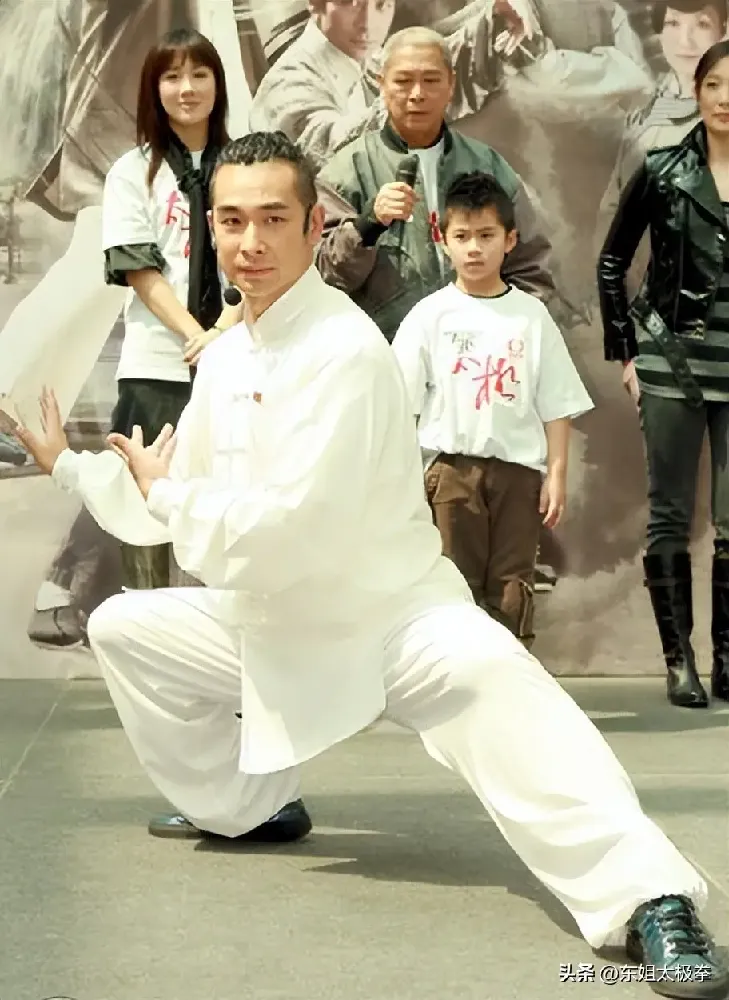
Wushu, Kung Fu and Gongfu: What the Words Mean
“Is Wushu the same as Kung Fu?” is the first question most beginners ask, and it is worth getting straight.
“Kung Fu” (gongfu) can describe any skill earned through sustained effort — cooking, calligraphy, or fighting. Wushu is the broader Chinese term for martial arts as a whole. In everyday English the two are used almost interchangeably, but in Chinese they are not synonyms: wushu names the field, gongfu names the quality of skill developed within it. See the entries for Gongfu and Wushu.
Taolu and Sanda: The Two Sides of Modern Wushu
Modern competitive Wushu has two paths. They are complementary rather than opposed, and most beginners eventually meet both.
Taolu: Forms and Performance
Taolu is the art of pre-arranged sequences — forms. They include attacks, blocks, stances, jumps and acrobatics, and they are judged on technical merit and expression. Beginners start with the fundamentals: stances that root you to the ground, basic strikes and blocks. Flexibility is not a prerequisite. A stable horse stance is worth more than a forced split, and flexibility comes with consistent practice.
Sanda: Sparring and Application
Sanda (also called Sanshou) is the full-contact side: punches, kicks, throws and sweeps, trained against a resisting partner. It is where the question “can Wushu be used for self-defence?” gets a direct answer. The first thing a good Sanda class teaches is not how to hit hard but how to fall safely; receiving a throw without injury builds confidence faster than any drill.
If you are choosing where to put your attention first: Taolu suits readers who want expression, form and body control; Sanda suits those who want contact, self-defence and competition. Many schools teach both, so it is not a permanent choice.
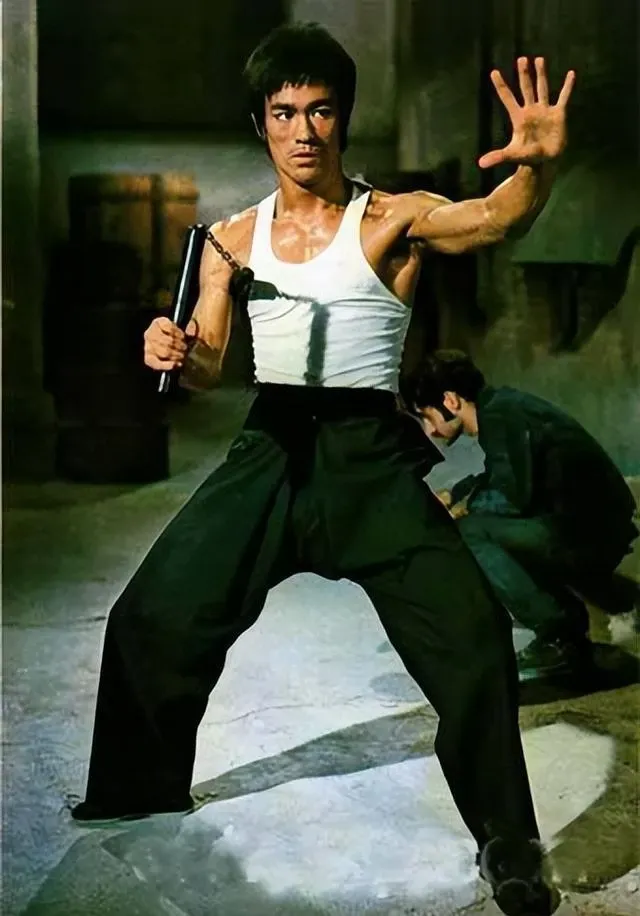
What Wushu Training Develops
Wushu is a full-body practice, and the benefits are cumulative rather than dramatic. Holding deep stances builds leg strength; dynamic drills build cardiovascular endurance; stretching into new positions builds flexibility safely. Coordination improves because every movement is a skill, not a repetition.
The mental side is similar. A form demands full attention — the angle of a hand, the timing of a breath — and that leaves little room for anything else. Many practitioners describe it as moving meditation, though the effect is closer to focused practice than to relaxation for its own sake.
Weapons: From Empty Hand to Staff and Sword
Weapons come after a foundation, not before. In most traditional systems a weapon is the stage where empty-hand structure is tested, because a weapon makes every leak in alignment visible.
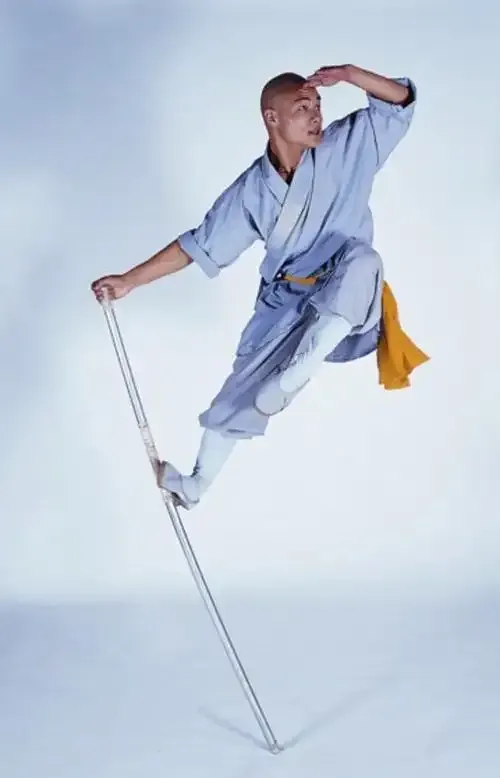
Empty-Hand Forms: Changquan and Nanquan
Beginners usually start with empty-hand forms. Changquan (Long Fist) is known for extended movements and athletic jumps; Nanquan (Southern Fist) for strong, stable stances and powerful arm techniques. The northern–southern split is a story of its own — see Nan Quan and Bei Tui. Taijiquan belongs to the same family and teaches balance, relaxation and internal timing — see the Taiji entry.
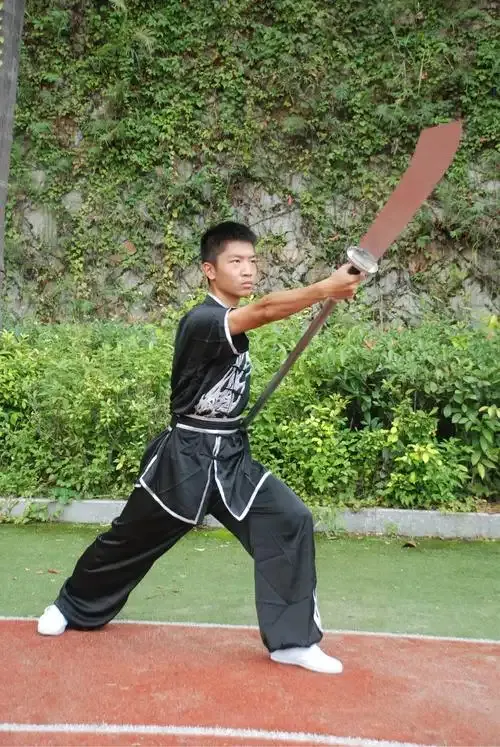
Weapons: Staff, Sword and Saber
Once the foundation is there, a first weapon is usually the staff (gun): long, simple, and unforgiving of poor structure. The straight, double-edged jian teaches precision; the curved dao teaches bold, sweeping power. For the staff specifically, see the guide to the Shaolin staff. For the classical weapons canon, see the Eighteen Arms of Wushu; for the traditions around it, see Traditional Chinese Martial Arts.
A common question is why performance swords are so flexible. They are made for Taolu, not combat: the flex produces the sound and shimmer that judges and audiences expect. It is a tool for performance, like a dancer’s ribbon.
How to Start: Your First Class and What to Expect
Starting is simpler than most people expect.
Find a school with a coach who teaches adults and can explain what they are correcting. Visit for a trial class; the atmosphere matters as much as the credentials. For the first few sessions, comfortable workout clothes and a water bottle are enough — no uniform, no weapon, no special shoes.
When you visit, ask three questions: what the first three months look like, whether the class teaches Taolu, Sanda or both, and how progress is assessed. A good school will answer all three plainly. The national grading system is explained in how the Wushu Dan ranking works.
If you want to build the movement vocabulary before committing to a class, the site’s Tai Chi learning path and the forms library are the closest equivalent: the same structural work, at a slower pace. The video library shows the movements being performed.
Wushu in Film and Sport
Wushu’s influence is wider than the training hall. Jet Li, a former Chinese Wushu champion, and Jackie Chan, trained in the Chinese opera tradition, brought its athleticism into international film. The wire-work “flying” of those films echoes the traditional idea of qinggong, and weapons such as the nunchaku became pop-culture icons in the same wave.
Competitively, Wushu is not an Olympic sport at the Games proper, but it has been added to the Youth Olympic programme and appears at regional multi-sport events such as the Asian Games. The International Wushu Federation governs the sport and continues to campaign for wider inclusion.
Taolu vs Sanda at a Glance
| Aspect | Taolu (Forms) | Sanda (Sparring) |
|---|---|---|
| Primary focus | Aesthetic expression, form, artistic flow | Combat efficiency, practical application |
| Training content | Pre-arranged sequences, weapon routines, flexibility | Punching, kicking, throws, defence |
| Format | Individual or group performance, judged | Competitive fighting on a lei tai, scored |
| Best for | Expression, flexibility, body control | Self-defence, combat sport, practical skills |
| In one line | The “poetry” of martial arts | The “conversation” of combat |
FAQ
-
I’m not flexible or in great shape. Is Wushu too hard for me?
No. Beginners build fitness and flexibility progressively, at their own pace. A stable stance matters more than a forced stretch, and flexibility follows consistent practice.
-
Is Wushu actually effective in a fight?
Taolu is for performance and physical mastery. Sanda is the direct combat system: punches, kicks, clinch work, throws and sweeps, trained against a resisting partner. For self-defence, Sanda is the relevant half.
-
Does Wushu have a belt ranking system?
It varies. The traditional Chinese system uses the Duan grades; many Western schools add coloured sashes or belts to mark progress. What matters is consistent grading and clear goals.
-
What weapons do beginners use?
Usually the staff (gun) first, then the broadsword (dao) and straight sword (jian), and later the spear (qiang). Each asks for a different quality: coordination with the staff, sweeping power with the dao, precision with the jian. Within taiji specifically, the weapon curriculum and which routines are standardised are mapped in Tai Chi Weapons.
-
How is Wushu different from Karate or Taekwondo?
Wushu combines traditional Chinese systems with a modern sport structure, gives equal weight to Taolu and Sanda, and places unusual emphasis on flexibility, acrobatics and weapon work. The cultural and philosophical framing is also more explicit.
-
What should I look for in a school or coach?
A coach who teaches adults and can explain corrections, a clear curriculum, a balance of Taolu and Sanda, sensible safety protocols, and a progression system with competition opportunities if you want them.
-
How does Wushu contribute to health and wellbeing?
Full-body conditioning, cardiovascular fitness, flexibility, balance and coordination, plus the stress reduction that comes from sustained focused movement. The effects are modest and cumulative, not a substitute for treatment.
Where to Go Next
Master Mingde Chen
12th generation Chen-style inheritor with decades of teaching experience.
View all articles →