Tai Chi Walking for Weight Loss: Does It Really Work? (Science + 4-Week Plan)
Key Takeaways
- 4-week structured plan: daily Tai Chi walking + Qigong for progressive fat loss
- The Cat Step technique engages deep core muscles — burns more calories than regular walking
- Clinically shown to lower cortisol, the hormone directly linked to belly fat storage
- Zero-impact practice; safe for seniors, postpartum, and those with joint pain
Written by Master Mingde Chen , 12th Generation Chen Style Tai Chi Inheritor
Reviewed by Dr. Jing Li , PhD in Biomechanics, Chief Technical Consultant at Wuji Taichi
⚡ Quick Summary
- 🎯 Key Mechanism: Controlled weight placement + continuous muscle engagement
- 🔥 Fat Loss Advantage: Higher energy expenditure at lower speeds (Time under tension)
- 🛡️ Safety: Zero-impact, joint-friendly (Protects knees)
- 📅 Best Practice: 15–30 minutes daily for 4–6 weeks
Est. Burn: ~150–250 kcal / 30 mins | Frequency: Daily
Tai Chi Walking is a specialized metabolic technique that transforms simple steps into a fat-burning workout by engaging the deep stabilizer muscles of the core and hips. Unlike regular walking which relies on momentum, this “Cat Step” method demands 100% muscular control for every inch of movement, significantly increasing calorie expenditure without any joint impact. By combining constant weight shifting with deep diaphragmatic breathing, it turns a low-intensity activity into a powerful tool for reducing visceral fat.
I think Tai Chi walking exposes what I call the Momentum Walking Trap : modern walking relies on gravity and forward falling, not muscular control. This makes it easy, repetitive, and metabolically weak. In this article, I will explain how Tai Chi walking transforms ordinary steps into a proven fat-burning practice through three mechanisms: controlled weight placement, continuous muscle engagement, and stress-hormone regulation.
Based on my teaching experience with thousands of students, those who practice Tai Chi walking correctly for 15–30 minutes a day often notice measurable changes within 4–6 weeks: improved posture, reduced knee discomfort, and gradual but consistent fat loss.
A detailed beginner guide to Tai Chi Walking is available at this link: Complete Tai Chi Walking Guide
Let’s start by understanding why Tai Chi walking works when normal walking often doesn’t.
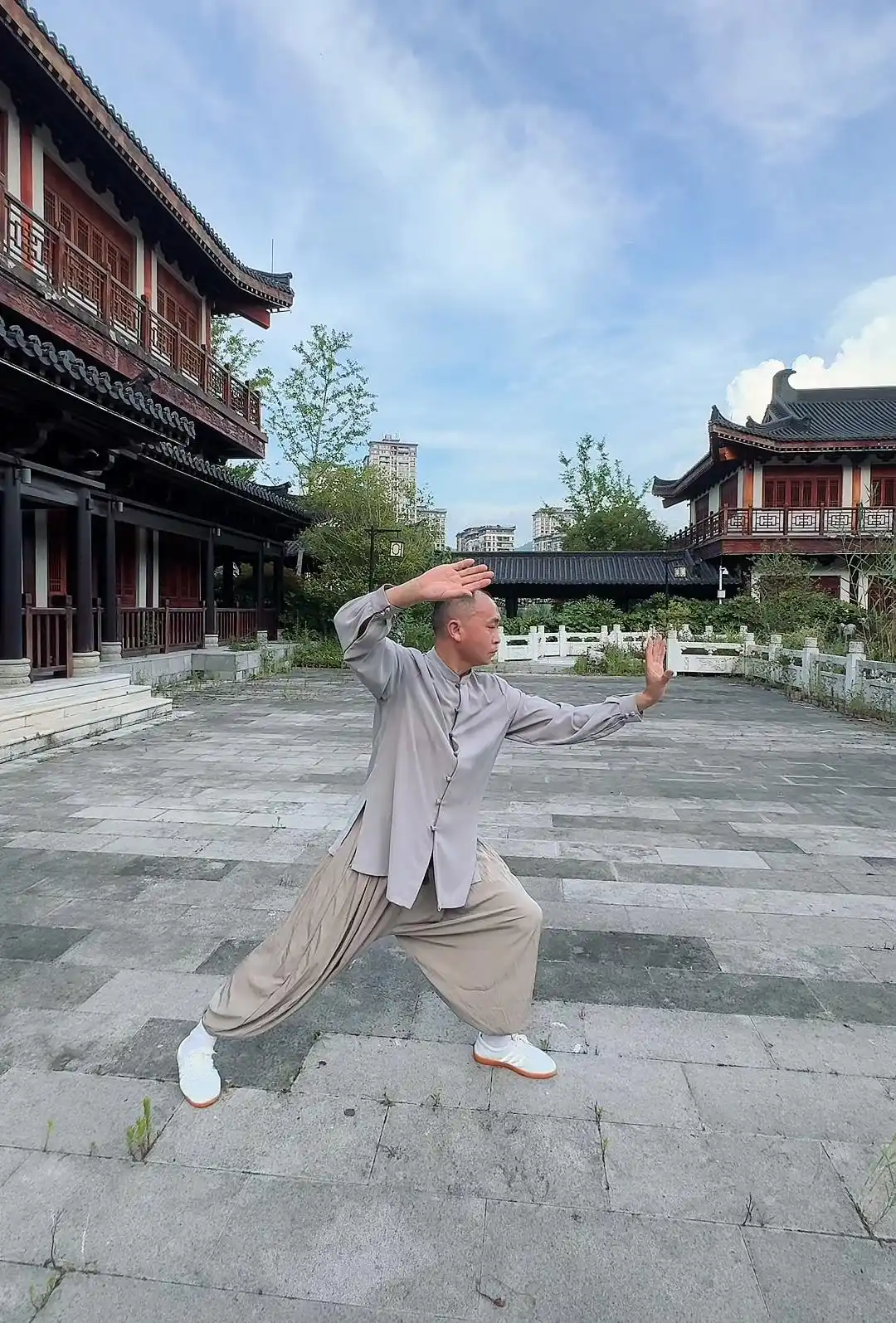
Why Does Tai Chi Walking Burn More Calories Than Normal Walking?
In my experience, people assume calorie burn is about speed or distance. That assumption is incomplete. If you’re over 60, read our seniors-specific guide .
While Tai Chi walking can support weight loss, its real effectiveness depends on how you train your body over time. Instead of treating it as a single exercise, it’s better to follow a structured program. This guide explains how to build a complete tai chi practice routine .
Mechanism 1: Continuous Muscle Engagement Without Momentum
Normal walking depends heavily on momentum. Once the body tips forward, gravity does most of the work. Muscles switch on briefly, then relax. Tai Chi walking removes that advantage.
In Tai Chi walking:
- Each step is placed, not fallen into
- Muscles remain active throughout the entire gait cycle
- There is no “free ride” from momentum
This creates what Dr. Jing Li describes as low-intensity, high-duration muscular loading , a condition known to increase energy expenditure even at slower speeds. Proper weight shifting is crucial for engaging the core.
Mechanism 2: The “Hidden Tension” Principle
One of the biggest misconceptions about Tai Chi Walking is that it is purely relaxed. I disagree. Tai Chi is relaxed in appearance, but internally structured.
I call this the Hidden Tension Paradox : unnecessary tension is released, but structural tension is maintained. This keeps the legs, hips, and deep core working continuously.
In my experience, beginners often feel more fatigue from 10 minutes of Tai Chi walking than from 30 minutes of casual walking — not because it is harder, but because nothing is wasted.
Mechanism 3: Stress Hormone Regulation and Fat Storage
Weight loss is not just mechanical. Chronic stress elevates cortisol, which is strongly associated with abdominal fat storage.
Based on principles explained in our Tai Chi Weight Loss Guide , Tai Chi walking activates the parasympathetic nervous system through slow movement and coordinated breathing. Over time, this lowers baseline stress responses.
I have repeatedly observed that students with “stress bellies” often see changes only after learning to slow down and regulate their nervous system, not after increasing intensity.
Tai Chi Walking vs Normal Walking: Which Is Better for Weight Loss?
| Dimension | Normal Walking | Tai Chi Walking |
|---|---|---|
| Movement driver | Forward falling | Controlled placement |
| Joint impact | Heel strike shock | Near-zero impact |
| Muscle involvement | Intermittent | Continuous |
| Core activation | Minimal | Constant |
| Injury risk | Accumulative | Low |
| Best for | General fitness | Sustainable fat loss |
My professional opinion:
Based on over 25 years of teaching, Tai Chi walking is more sustainable for long-term body composition change because it does not rely on joint tolerance or cardiovascular stress alone. While Tai Chi Walking supports sustainable fat loss, you may also be curious how it compares with Nordic and Japanese interval walking for calorie burn. See the full fat loss walking comparison here .
How to Perform Tai Chi Walking Correctly (Step-by-Step)
Step 1: Sink Without Collapsing ( Song )
Lower the center of gravity by relaxing downward, not by bending excessively.
- Imagine sitting lightly on a high stool
- Feel weight settle into the lower abdomen (dantian)
Common mistake : turning sinking into squatting, which overloads the knees. In my experience, less visible movement produces better internal results.
Step 2: Empty Step (Xu Bu)
The front foot touches the ground without weight.
- Heel or ball lands softly
- Weight remains on the rear leg
Teaching image: “Walking on thin ice.” This trains balance and eliminates impact.
Step 3: Gradual Weight Transfer (70/30 → 50/50 → 30/70)
Shift weight slowly and evenly.
- Knees align with toes
- Pelvis remains level
- No lateral sway
Dr. Jing Li’s biomechanical analysis shows this phase activates stabilizing muscles more than any fast gait pattern.
Step 4: Integrated Upper Body Alignment
- Head feels gently suspended
- Spine lengthens naturally
- Shoulders release downward
In my experience, exaggerated arm movement usually means the core is disengaged.
For practitioners without outdoor access, indoor Tai Chi Walking delivers equivalent metabolic benefits in any home space.
Core Engagement: Why Tai Chi Walking Changes Body Shape
Many exercises target the core temporarily. Tai Chi walking activates it continuously.
Key muscles involved:
- Transversus abdominis
- Pelvic floor
- Multifidus
Unlike crunches or planks, this engagement occurs during functional movement. Over time, posture improves first, then fat distribution follows.
Common Misconceptions That Block Results
“It’s Too Slow to Burn Fat”
Slow movement increases time under tension, which is a well-established metabolic driver.
“It’s Only for Older Adults”
In my experience, athletes often struggle more because Tai Chi exposes balance and control weaknesses.
“It Won’t Reduce Belly Fat”
Abdominal fat is often stress-driven. Tai Chi walking addresses the hormonal root, not just calories.
💡 Fat loss and body transformation in Tai Chi are closely related to posture, relaxation, and internal coordination. These are not obvious from the outside, but they are explained through key concepts in this tai chi concepts and terminology guide .
A Practical Weekly Tai Chi Walking Plan
Beginner (Weeks 1–2)
- 15 minutes daily
- Flat surface
- Focus on weight placement
Intermediate (Weeks 3–4)
- 20–30 minutes
- Add directional changes
- Maintain calm breathing
Advanced (Week 5+)
- 30 minutes
- Vary speed intentionally
- Combine with standing postures
Among beginners in our introductory programs, reduced knee discomfort commonly appears by week three, which improves adherence and consistency.
Final Perspective: Walking Isn’t the Problem — How You Walk Is
In my experience, Tai Chi walking is not about learning a new exercise, but about unlearning inefficient movement habits. If you want a deeper foundation on the technique itself, start with our comprehensive Beginner’s Guide to Tai Chi .
Join the Community: Curious about real-world results? See how other practitioners are adapting this method at home in our dedicated discussion on Tai Chi Indoor Walking experiences . We look forward to seeing your progress!
FAQ
- Can Tai Chi walking really help with belly fat?
Yes, especially when stress is a contributing factor. Tai Chi walking lowers stress responses while activating deep core muscles, supporting gradual abdominal fat reduction.
- How often should I practice for weight loss?
Daily practice of 15–30 minutes produces the most consistent results based on teaching observations.
- Do I need to walk 10,000 steps with Tai Chi walking?
Quality is far more important than quantity. In my teaching, I advise against counting steps for Tai Chi walking. Because the movement is slower and muscles are under constant tension (unlike the momentum of regular steps), 15-20 minutes of focused practice is metabolically superior to thousands of mindless steps. Focus on the feeling of your weight shifting, not the number on your tracker.
- Why do my thighs shake when I practice this?
This is actually a good sign! In Chinese martial arts, we call this eating bitter. The shaking indicates that your deep stabilizer muscles and slow-twitch fibers—which are often dormant during regular walking—are finally waking up and engaging. It means you are successfully keeping your knees bent and weight “sunk.” Rest if it becomes painful, but know that this shaking is where the fat-burning magic happens.
- Does Tai Chi Walking really work for weight loss, or is it too slow to burn fat?
Yes — Tai Chi Walking supports weight loss through sustained muscular engagement rather than speed or impact.
Unlike regular walking, where part of each step is passive, Tai Chi Walking keeps the leg and postural muscles continuously active during weight transfer. This produces steady energy expenditure even at slow speed.
Research on low-intensity continuous movement shows energy use comparable to brisk walking when large muscle groups remain engaged. In practice, Tai Chi Walking typically expends about 280–350 kcal per hour, depending on stance depth and body mass — similar to moderate walking but with lower joint stress.
The key difference is adherence: because Tai Chi Walking is low-impact and joint-friendly, people can practice consistently for months or years — which is what actually drives fat loss.
If you want the mechanism explained in detail, see 👉 what Tai Chi Walking is and how it works
- How long does it take to lose weight with Tai Chi Walking?
Most practitioners notice measurable changes within 4–8 weeks, assuming consistent practice.
Typical progression timeline:
Weeks 1–3 — improved balance, leg activation, posture awareness
Weeks 4–8 — small weight or waist changes measurable
Weeks 8–12 — visible fat reduction if combined with diet control
3–6 months — stable body-composition change
This slower but steady curve is normal for low-impact metabolic training. Tai Chi Walking does not rely on short-term calorie spikes; it builds sustainable daily expenditure.
A simple effective protocol is:
20–30 minutes per session
4–6 days per week
relaxed but continuous stepping
You can use the free home routine here: 👉 20-minute indoor Tai Chi Walking routine
- Is Tai Chi Walking good for weight loss over 50?
Yes — Tai Chi Walking is particularly well-suited for people over 50.
After midlife, three factors make high-impact exercise less effective:
joint sensitivity increases
recovery slows
injury risk rises
Tai Chi Walking addresses all three:
low joint load
continuous muscle activation
sustainable daily practice
This makes it easier to maintain the consistent energy expenditure required for fat loss in later adulthood.
It also improves balance and gait stability — important for aging populations.
For older practitioners specifically, see: 👉 Tai Chi Walking for seniors and balance
- Can I combine Tai Chi Walking with other exercises for faster weight loss?
Yes — Tai Chi Walking integrates well with other training types.
An effective weekly structure is:
Tai Chi Walking — low-intensity metabolic base (most days)
Strength training — 2–3×/week
Higher-intensity cardio — optional 1–2×/week
Tai Chi Walking works especially well as:
recovery-day movement
morning fasted exercise
evening low-stress activity
Because it does not fatigue joints or nervous system heavily, it increases total weekly activity without impairing recovery.
Many practitioners alternate:
strength day
Tai Chi Walking day
This pattern supports fat loss while preserving mobility.
- What is the Tai Chi Walking plan, and how much does it cost?
Traditional Tai Chi Walking does not require any paid program, subscription, or app.
The practice comes from classical Tai Chi stepping training and can be learned through basic instruction and consistent repetition. The essential elements are:
controlled weight transfer
heel-to-toe stepping
upright structure
slow continuous pace
You can follow the complete method free in this site’s guides:
👉 Tai Chi Walking (太极步) definition
Some commercial fitness apps market “Tai Chi Walking plans,” but these are modern packaging of a traditional practice rather than a necessary purchase.
Consistency — not cost — determines results.
References & Scientific Sources
- Wayne, P. M., et al. (2018). Tai Chi and Qigong for cancer-related symptoms and quality of life: A systematic review and meta-analysis. Journal of Cancer Survivorship .
- Yeh, G. Y., et al. (2004). Effects of Tai Chi mind-body movement therapy on functional status and exercise capacity . American Journal of Medicine .
- Lan, C., et al. (2002). The effect of Tai Chi on cardiorespiratory function in patients with coronary artery bypass surgery . Medicine & Science in Sports & Exercise .
- Li, F., et al. (2012). Tai Chi and postural stability in patients with Parkinson’s disease . New England Journal of Medicine .
- Zou, L., et al. (2017). Effect of Yang-style Tai Chi on gait parameters and musculoskeletal flexibility . Sports .
Master Mingde Chen
12th generation Chen-style inheritor with decades of teaching experience.
View all articles →