Tai Chi for Stress Relief: A Nervous-System Reset for Overstimulated Days
Key Takeaways
- In randomized trials, regular Tai Chi practice reduces perceived-stress scores with a moderate effect size — on par with the stress reductions seen in trials of regular physical activity
- Heart rate variability (HRV), a key stress-resilience measure, improves reliably in regular practitioners, and some studies report cortisol dropping in the minutes after a session
- Slow, deliberate movement activates the parasympathetic nervous system, switching the body from fight-or-flight to rest-and-digest
- A 3-5 minute emergency sequence — wuji standing, slow cloud hands, holding the ball, longer exhale — is a reset you can run anywhere
- Everyday stress responds to practice; clinical anxiety, panic, or depression needs professional care first, with tai chi as a complement
This guide is part of the Tai Chi for Depression & Anxiety Hub, where everyday stress, anxiety, sleep, and cognitive function each get their own spoke. Want the clinical-anxiety mechanism first? See the anxiety neuroscience guide.
Everyday stress is a nervous-system state
The day ends, but the hum does not. Shoulders stay up. The chest stays tight. The mind keeps circling a conversation from ten hours ago — what you said, what you should have said, what they meant. You are tired, and you are wired. That is not a character flaw. It is a nervous-system state.
Stress is a nervous-system stampede. Tai Chi is the calm command you can give your body in three minutes. You cannot think your way out of a stress state. You can reset it with slow movement and a longer exhale.
I say this as someone who reads the trials and teaches the form. For thirty years I have taught Yang-style tai chi to people who do not want mysticism. They want an off-switch. The off-switch is not in a philosophy book. It is in the body, and it is learnable.
Everyday stress is a state, not a diagnosis
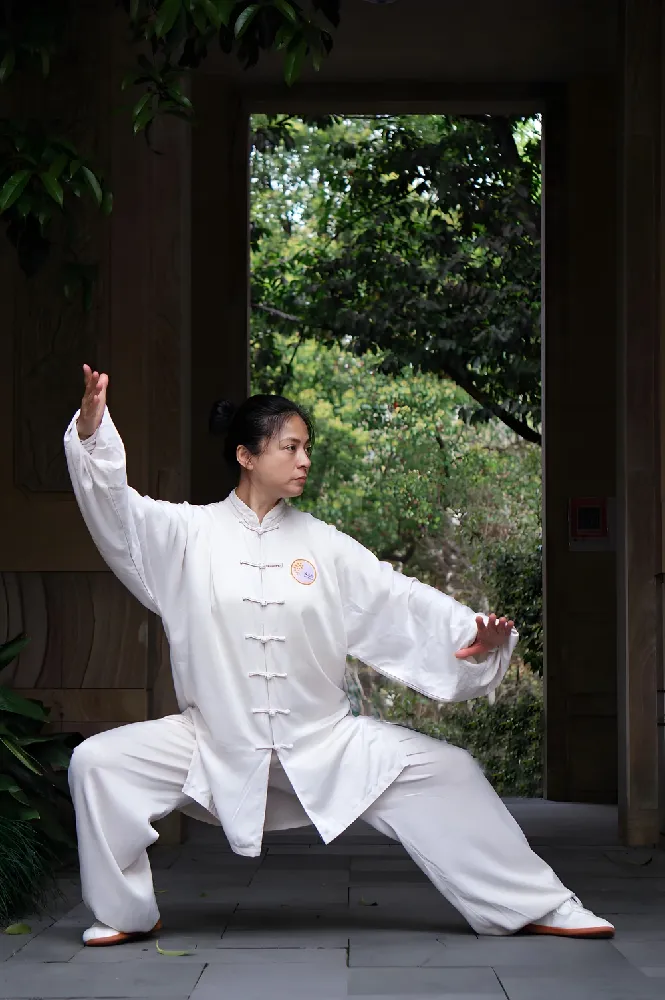
Everyday stress has a signature: overstimulation, racing thoughts, shallow breath, tension held in the jaw and shoulders, sleep that comes late and leaves early, a feeling of being wired but exhausted. None of this is clinical anxiety.
Clinical anxiety is different. Panic episodes. Worry spirals that do not stop and disrupt work or relationships. An inability to function.
The two words — stress and anxiety — get used interchangeably. In the research, they are different things, with different severities and different treatments. That distinction determines whether tai chi is enough. The clinical mechanism of anxiety — the vagus nerve, the HPA axis, the default mode network — is covered in depth in the anxiety spoke of this cluster, which you will find below. Here, we stay on the everyday-stress side.
| Everyday stress | Clinical anxiety | |
|---|---|---|
| Signature symptoms | Overstimulation, racing thoughts, shallow breath, tension held in the jaw and shoulders, sleep that comes late and leaves early, feeling wired but exhausted | Panic episodes; relentless worry that disrupts work or relationships; an inability to function |
| A state or a disorder? | A nervous-system state — not a diagnosis | A disorder with a distinct clinical mechanism (vagus nerve, HPA axis, default mode network) |
| Does it need professional care first? | No — it responds to practice | Yes — a clinician comes first |
| Tai chi’s role | Primary: the 3-5 minute emergency reset plus a cumulative practice that rebuilds HRV and lowers perceived stress | Complementary: support alongside professional care, never a replacement |
| When to see a clinician | If a clinical-level anxiety or mood problem persists despite consistent practice, escalate | Immediately — panic, sustained depression, or an inability to function calls for professional care, with tai chi as a complement |
This is the line the rest of the guide runs on: the everyday-stress state is one this practice can reset; the clinical-anxiety condition is one a clinician treats first.
The evidence: strong for everyday stress, honest about its limits
The research on tai chi and everyday stress is stronger than most people expect. In randomized trials, regular practice lowers perceived-stress scores with a moderate effect size — comparable to the stress reductions seen in trials of regular physical activity. Heart rate variability (HRV), the measure of how well your nervous system can brake under strain, improves reliably in regular practitioners. And some studies report cortisol, the stress hormone, dropping in the minutes after a session — an acute shift, not a sustained baseline change. The broader Tai Chi and Mental Health guide carries the full evidence review across the cluster.
HRV matters more than most people realize. It is not about how fast your heart beats. It is about how responsively it changes — accelerating when needed, decelerating when the threat passes. A low HRV means your nervous system is stuck with the accelerator pressed. A rising HRV means the brake is working again.
Even a single session changes the state. In a randomized comparison, one 20-minute tai chi session reduced state anxiety as effectively as a 30-minute brisk walk.
But I will be direct about the limits. The mental-health outcomes in these trials are everyday-stress outcomes: perceived stress, tension, mood, sleep, HRV. The clinical-trial base for diagnosed anxiety disorders is thinner and more mixed, and the full mechanism of clinical anxiety is a separate question — it lives in the anxiety neuroscience guide. If panic attacks or relentless worry are disrupting your life, the answer starts with a clinician. Tai chi can complement that care. It should never replace it. I teach the same boundary to every student: practice is not treatment. It is a reset.
What the tradition already knew
When a practitioner says stress is qi stagnation, they are describing physiology, not metaphysics. The mind and the body are literally stuck — contracted, bracing, repeating the same loop. The practice restores flow. It lets the breath and the body move together, instead of trying to “do nothing” to relax.
Two classical terms deserve de-mystification.
Song — usually translated as “relax” or “release” — is the skill of not bracing. It is nervous-system downshift, trainable and measurable. Shen is attention. Shen training is concentration practice. Neither is mystical, and both become immediate when you feel them in the body. When I teach abroad, the breakthrough almost never comes through translation. It comes when a student suddenly drops their shoulders and says “oh” — they feel song before they can name it.
And the slowness. This is the piece Western readers most often miss. Slow movement is not gentle exercise. Deliberate slowness is the physiological brake on an overstimulated default state. The movement is expansive and graceful — but the effect is targeted. The slower the motion, the more your nervous system must shift from fight-or-flight into the parasympathetic range. That is the point, not the side effect. For anyone who wants a longer, static version of the same downshift, standing meditation is the option to start with.
I teach teenagers this in schools, and they grasp it faster than adults. Their nervous systems are more overstimulated than any generation I have seen. They do not need a lecture. They need the brake.
The 3-5 minute emergency sequence
When I teach overwhelmed people — and I mean people who practice in meeting rooms, in cars, before hard conversations — I give them one sequence. It takes three to five minutes. No equipment. No one has to know.
1. Wuji standing. Feet parallel, knees soft, spine long, arms hanging. Stand still for one minute. Do not try to relax. Just notice where the body is bracing and allow it to drop. Standing posture is the most honest practice in tai chi: it shows you exactly where you hold your stress.
2. Slow cloud hands. Shift the weight left, then right. The hands trace a slow horizontal arc, palm turning, following the weight. The attention follows the hands. This is the key: the mind cannot stampede while it is tracking slow movement. One minute.
3. Holding the ball. Arms rise to chest height, rounded, as if cradling a large ball. Elbows drop. Shoulders release. The breath sinks toward the dan-tian — the lower belly. Let the breath move low and slow. One minute. If you are in a meeting, this step is invisible: it simply looks like sitting up straight.
4. Longer exhale. The simplest step, and the most powerful. Breathe in for four counts, out for six. A longer exhale engages the vagus nerve and activates the parasympathetic brake more reliably than almost anything else. Repeat for one minute.
That is the reset. Not a philosophy. Not a lifestyle overhaul. Three minutes of slow movement and a longer exhale, and the stampede loses its grip.
The cumulative reset
The emergency sequence resets the state. Regular practice rebuilds the capacity underneath it.
Three sessions a week — twenty minutes each — is enough. In eight to twelve weeks, the cumulative effects become measurable: lower perceived stress, better sleep, and an HRV baseline that keeps climbing. Tai chi raises HRV consistently in regular practitioners, which is why the calm begins to stick between sessions.
Here is the reframe I want to leave with you. Stress management usually becomes another task on your to-do list. Tai chi is not another task. It is the off-switch beneath it. You do not add it to the day. You step out of the stampede for three minutes, and the day recalibrates around you.
The three-step rule
Let me make the decision rule explicit.
Step one: Diagnose. Is this everyday stress — overstimulation, tension, racing thoughts, poor sleep, feeling wired? Or is it clinical anxiety — panic episodes, relentless worry that disrupts work and relationships, inability to function? Everyday stress responds to this practice. Clinical anxiety or depression needs professional care first. Tai chi complements that care.
Step two: Use it. When overwhelmed in the moment, run the emergency sequence: wuji standing, slow cloud hands, holding the ball, longer exhale. Three to five minutes. Train three sessions a week for the cumulative reset.
Step three: Measure. Track your stress level, physical tension, and sleep for 8-12 weeks. If they improve, you have found your off-switch. If a clinical-level anxiety or mood problem persists, escalate to a clinician or to cognitive behavioral therapy. Tai chi is a reset for a state. It is not a treatment for a disorder — and no honest teacher, mine included, will tell you otherwise.
The calm command
I grew up in Yangjia Alley in Guangfu Town, the birthplace of Yang-style tai chi. What I learned there was never about escaping the world. It was about restoring flow in the middle of it. The foundational skills — song, shen, slow movement — were built for this. The core essence survives because it works.
The stampede will return. That is the condition of modern days. But the calm command is always available. It is in your body, in three minutes, at your desk. Slow movement. Longer exhale. You do not have to think your way out of stress. You just have to give the nervous system the signal it already knows.
Float into the cluster
One guide cannot hold every thread of mental health. Here is where the rest of the cluster picks up:
- If your stress is more anxiety-like — panic episodes, relentless worry that disrupts function — the anxiety neuroscience guide explains the clinical mechanism and what works.
- For the full randomized-trial picture across anxiety, stress, sleep, and cognition, see the Tai Chi and Mental Health guide.
- For how the same practice sharpens memory, focus, and mood, see the cognitive health guide.
- For stress and anxiety that keep you awake at night, see the Sleep Hub.
Your stress relief questions, answered
- How long before I feel calmer with Tai Chi?
Some people feel the shift after a single session; others need a few weeks of consistency. The acute effect — a single 20-minute session can quiet state anxiety as well as a 30-minute brisk walk — comes fast. The cumulative reset — a climbing HRV baseline, lower perceived stress — builds over eight to twelve weeks of about three sessions a week.
- Is Tai Chi better than yoga or meditation for stress?
It depends on what makes stillness hard for you. Tai chi is a strong choice if sitting still feels like too much: it combines slow movement, breath, and focused attention in one practice. Yoga and meditation are excellent too. The wuji standing option in the emergency sequence gives you a doorway into both movement and stillness at once.
- What if I’m too overwhelmed to start?
Start smaller than you think you need. Just stand in wuji for one minute. Just lengthen one exhale. The sequence has no equipment, no special setting, and no hierarchy to meet — it meets you where you are, in a meeting or at your desk.
- How is a stress guide different from the anxiety guide?
They cover two different halves of the same family. This guide is the everyday-stress half: the nervous-system reset, cortisol and HRV, and a 3-5 minute emergency sequence. The anxiety guide is the clinical-anxiety half: the vagus-nerve, HPA-axis, and default-mode mechanism. If your symptoms are everyday stress, start here; if they look more like a clinical disorder, see a clinician first and use tai chi as a complement.
- Can I use the reset at work or in public?
Yes. Every step is designed to be invisible. Wuji standing can pass for standing still; holding the ball just looks like sitting up straight; the longer exhale reads as a calm breath. You can run the whole three-minute reset at your desk without anyone knowing.
Ready to begin?
New to the practice? Start with the Tai Chi for Beginners path, then run the emergency sequence above anytime stress spikes. For a guided, step-by-step approach built for real life, explore the Learn Tai Chi program.
⚠️ Not medical advice. This article is for educational purposes only and is not a substitute for professional medical advice. If you are experiencing panic attacks, sustained depression, or an inability to function, please consult a clinician.