How Qi Feels: Common Sensations in Qigong and Tai Chi
Key Takeaways
- Qi sensations follow a predictable 6-stage progression: warmth, tingling, heaviness, expansion, pulsation, unification
- Most beginners feel something in their hands within 10-15 minutes of standing meditation — the easiest entry point
- The Qi sensation correlates with 2 measurable changes: increased capillary blood flow and proprioceptive amplification
- These feelings are not special or spiritual — they are your nervous system waking up to signals it normally filters out
Expert Contributors: Master Mingde Chen, 12th Generation Tai Chi Inheritor & Dr. Jing Li, PhD, Medical Reviewer
Part of the Understanding Qi series: New to Qigong? Start here →
- ★ Series Overview — complete guide + free PDF download
- What Is Qi — the foundational definition
- Qi vs Energy — why Qi is not simply “life force”
- The Philosophy of Qi — from cosmic origin to modern relevance
- Five Types of Qi — Yuan, Gu, Zong, Ying, and Wei Qi explained
- Why Science Struggles with Qi — and what we can learn from that
- How Qi Feels — a beginner’s guide to direct sensation
- Qi in Tai Chi Practice — from theory to embodiment
You don’t need to believe in Qi to feel it. Just as you don’t need to understand meteorology to feel the wind on your skin.
Place your hands in front of you, palms facing each other about six inches apart. Slowly bring them closer together, then move them apart — like gently squeezing and releasing a soft balloon. Repeat this several times, breathing naturally.
Do you notice anything between your palms?
A slight warmth? A gentle tingling? A sense of resistance, as if something is there?
Whatever you’re feeling — even if it’s subtle, even if you’re not sure — that’s your first direct encounter with Qi. Not as a concept, but as an experience.
This guide will help you name what you’re feeling, understand why it happens, and deepen your ability to sense Qi through simple, accessible practices.
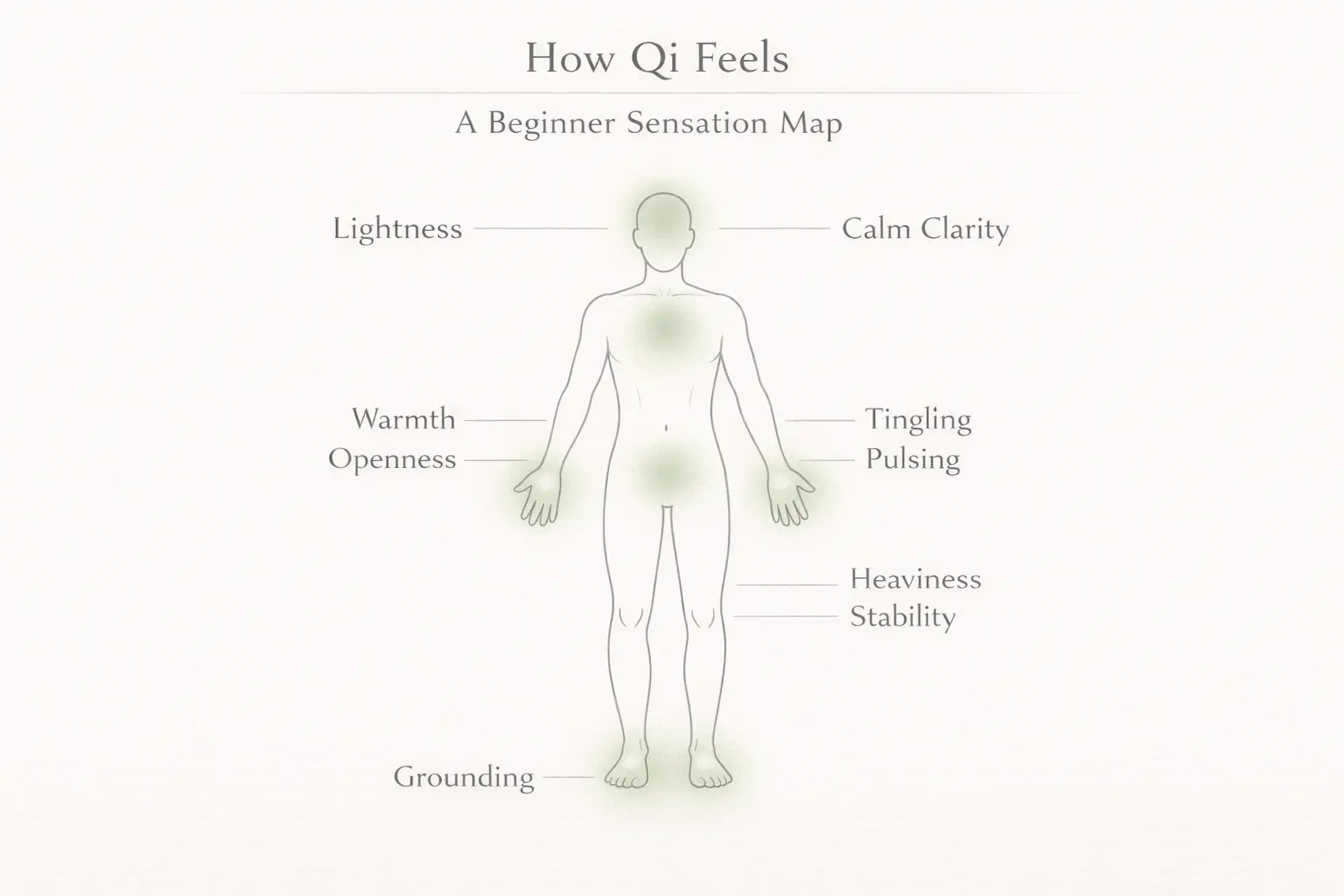
The Five Most Common Qi Sensations
Not everyone experiences all of these sensations, and they may appear in different orders. Your experience is unique to you — and that’s perfectly normal. What matters is learning to recognize and trust your own internal signals.
Warmth (热)
Warmth is the most common and often the first sensation practitioners notice. It typically begins in the palms, soles of the feet, or lower abdomen ( Dan Tian ), then gradually spreads.
- What it feels like : Like holding a warm pack, or a gentle current of heat flowing through the body. Some describe it as a pleasant, expansive warmth that seems to come from inside rather than from the skin’s surface.
- Where it appears : Often in the hands during standing meditation, in the lower back after practice, or along the spine as relaxation deepens.
- Practice tip : When you feel warmth, don’t chase it or try to make it stronger. Simply notice it, as if you’re observing a comfortable fire from a distance. The warmth is a sign that circulation is improving and tension is releasing.
Tingling (麻)
Tingling sensations range from subtle to quite pronounced. They’re often described as a mild electrical sensation, like gentle pins and needles, but without the discomfort of a limb “falling asleep.”
- What it feels like : A fine vibration, tiny bubbles moving under the skin, or a light prickling sensation. Some compare it to the feeling of a limb waking up, but softer and more pleasant.
- Where it appears : Most commonly in the fingertips, palms, and soles. With continued practice, it can extend along the arms and legs, following classical meridian pathways.
- Practice tip : Tingling is a sign that Qi is moving and that nerve endings are becoming more sensitive. If it feels intense, simply shift your attention to your breath — the sensation will settle on its own.
Fullness (胀)
Fullness is a sensation of expansion or pressure, as if the body part is gently inflating from within. Unlike tension, which feels hard and constricted, fullness feels spacious and alive.
- What it feels like : The palms may feel as if they’re holding a ball of dense air. The Dan Tian may feel rounded and full, like a soft ball. Some describe it as a “powerful emptiness” — present and substantial, yet not solid.
- Where it appears : Most noticeable in the hands during “holding the ball” postures, in the lower abdomen during deep relaxation, and sometimes in the whole body during standing meditation.
- Practice tip : Fullness is a sign that Qi is gathering. Don’t try to hold onto it or increase it — just let it be. If you feel too full, soften your attention and take a few deeper exhalations. These sensations of fullness and expansion are cultivated through Dantian Breathing (丹田呼吸) — the diaphragmatic engagement that gathers qi in the lower abdomen and creates the internal pressure felt as density.
Magnetism / Resistance (磁力感)
This is one of the most surprising sensations for beginners. It feels as if there’s an invisible force between your hands — pushing them apart when you try to bring them together, or pulling them together when you try to separate them.
- What it feels like : Like holding two magnets with the same poles facing each other — a springy, elastic resistance. Or like compressing a soft balloon that pushes back against your palms. Some describe it as a “thickening” of the space between the hands.
- Where it appears : Almost exclusively in practices where the hands are held facing each other, such as the “opening-closing” exercise or the preparatory posture of Tai Chi forms.
- Practice tip : This sensation is often the one beginners doubt most — “Am I imagining this?” Trust your experience. The resistance is real, even if it doesn’t register on instruments. Simply play with it, as if you’re exploring a subtle elastic medium.
Flow (流动感)
Flow is the most advanced of the common sensations, often appearing after consistent practice over weeks or months. It’s the feeling of Qi moving along specific pathways in the body.
- What it feels like : A gentle current moving under the skin, like warm water flowing through a channel. Sometimes it’s felt as a wave of sensation traveling along an arm or leg. Other times it’s a continuous circulation, like a slow internal tide.
- Where it appears : Along classical meridian routes — the inside of the arms, the front of the legs, the spine. Many practitioners first notice it in the arms during slow Tai Chi movements.
- Practice tip : When you feel flow, don’t try to direct it. Let it move naturally. Your job is simply to stay present and relaxed, allowing the movement to happen on its own.
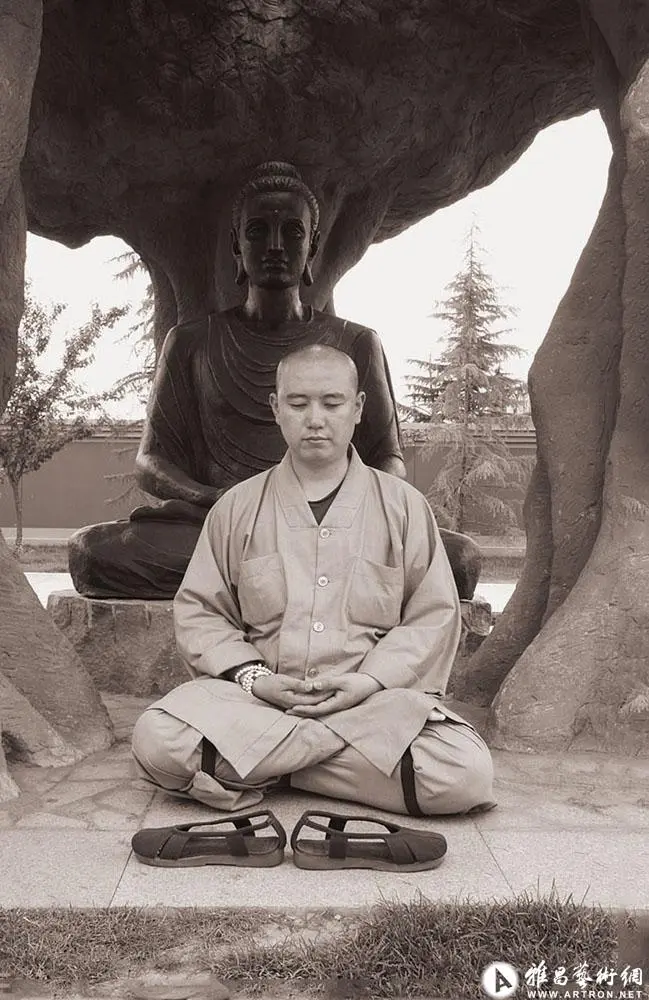
Why Do These Sensations Occur?
These sensations have both physiological explanations and traditional interpretations. Neither is “correct” — they are simply different languages describing the same experience. What matters is not which language you use, but that you recognize the experience itself.
Warmth
- Physiological : Relaxation allows blood vessels to dilate, increasing circulation to the skin and extremities. The sensation of warmth follows increased blood flow.
- Traditional : Yang Qi is rising, warming the body and promoting healthy function. Warmth indicates that Qi is abundant and circulating well.
Tingling
- Physiological : Nervous system sensitivity increases as background tension drops. Proprioceptors become more active, and microcirculation improves in capillaries.
- Traditional : Qi is moving through meridians, “activating” the channels and awakening the body’s subtle energy network.
Fullness
- Physiological : Muscles fully relax, allowing interstitial fluids to redistribute. Fascial networks become more hydrated and responsive, creating a sense of internal space.
- Traditional : Qi gathers at centers like the Dan Tian, condensing and becoming perceptible. Fullness indicates that Qi is being stored, not dispersed.
Magnetism / Resistance
- Physiological : The body’s subtle electromagnetic field becomes detectable through refined proprioception. The brain’s somatosensory map of the hands becomes more detailed, allowing perception of very weak sensory inputs.
- Traditional : External and internal Qi interact. The space between the hands is filled with Qi, creating a palpable field. This sensation is often called “Qi feeling” in classical texts.
Flow
- Physiological : Neural pathways become more efficient; coordination between brain, nerves, and muscles improves. The fascia — a continuous connective tissue network — transmits mechanical and electrical signals more fluidly. consistent with what current research on Qi and the body is exploring.
- Traditional : Qi circulates through the meridians, following the pathways mapped in classical Chinese medicine. Flow indicates that blockages are clearing and the energy body is becoming integrated.
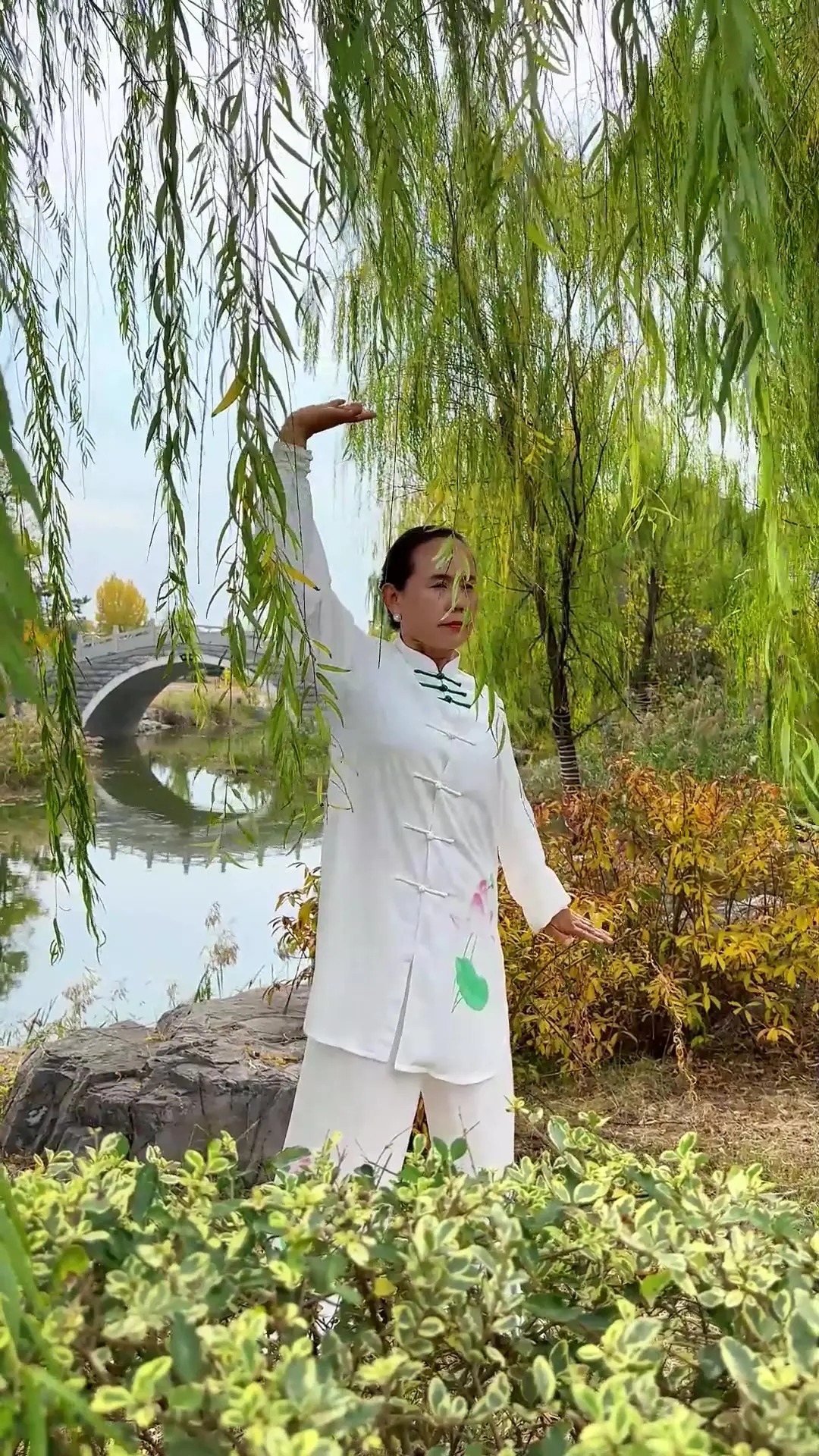
Simple Practices to Cultivate Qi Sensation
These three exercises are among the most reliable ways to begin feeling Qi. They require no special equipment, no prior experience — only a few minutes of your attention each day.
Exercise 1: Standing Meditation (站桩)
Standing meditation is the foundation of Qi cultivation in many internal arts. It teaches the body to relax while maintaining structural integrity — the perfect conditions for Qi to become perceptible.
How to practice :
- Stand with feet shoulder-width apart, knees slightly bent (no more than directly over the toes).
- Tuck the tailbone gently under, as if sitting on a tall stool. This aligns the lower back.
- Relax the shoulders, let the arms hang naturally, then bring them forward as if holding a large, lightweight ball at chest height.
- Close your eyes or lower your gaze to the floor a few feet ahead.
- Breathe naturally through your nose. Don’t try to control the breath — just observe it.
- Hold this posture for 5 minutes to start, gradually working up to 15–20 minutes.
What to expect : In the first few minutes, you may notice discomfort in the legs or back — this is normal. As you relax into the posture, warmth may appear in the hands, then spread up the arms. A sense of fullness in the lower abdomen often follows. Some practitioners feel a magnetic resistance between the hands.
Many Tai Chi practitioners first notice these sensations during simple standing exercises. If you’d like a structured introduction, our beginner Tai Chi guide covers exactly these foundations — and our 5-stage learning path shows how these sensations develop over time.
Exercise 2: Opening-Closing Qi Practice (开合拉气)
This is a moving meditation that makes the space between your hands tangible. It’s often taught as a first exercise in Qigong classes because it produces sensations quickly.
How to practice :
- Sit or stand comfortably, with spine relatively straight.
- Bring your hands in front of your chest, palms facing each other, as if holding a ball about shoulder-width apart.
- Slowly open the hands, moving them apart while inhaling. Feel for any resistance or elasticity between your palms.
- Slowly close the hands, moving them together while exhaling. Notice if the space between them seems to thicken or resist compression.
- Repeat for 3–5 minutes, moving at a slow, continuous pace.
What to expect : Many people feel something on the very first try — warmth, tingling, or a springy resistance. If you feel nothing at first, simply continue; the sensation often appears after a few sessions. This practice is excellent for developing sensitivity quickly.
Exercise 3: Dan Tian Warming (丹田温养)
The Dan Tian — the lower abdomen, about two inches below the navel — is considered the primary reservoir of Qi in the body. Warming this area with attention helps Qi gather and become perceptible.
How to practice :
- Lie on your back or sit comfortably, with spine relatively straight.
- Place both hands gently on your lower abdomen, palms resting over the Dan Tian area.
- Close your eyes and bring your attention to the space beneath your hands.
- Breathe naturally, but with each inhalation, imagine warm, nourishing energy flowing into the Dan Tian. With each exhalation, silently say the word “song” (松) — the Chinese character for “relax.”
- Continue for 5–10 minutes. This practice is especially effective before sleep.
What to expect: A gentle warmth often develops in the lower abdomen. Some feel a pulsing or throbbing, others a sense of fullness or even a “ball” of sensation. If you notice nothing at first, simply enjoy the relaxation — the sensations will come with time.
A Traditional Teaching
“Don’t chase the sensations. Don’t try to make them happen. Just set up the conditions — correct posture, relaxed breath, soft attention — and let the sensations come to you. They will, in their own time. And when they do, don’t grab onto them. Just notice them, and continue practicing. Sensations come and go. The practice remains.”
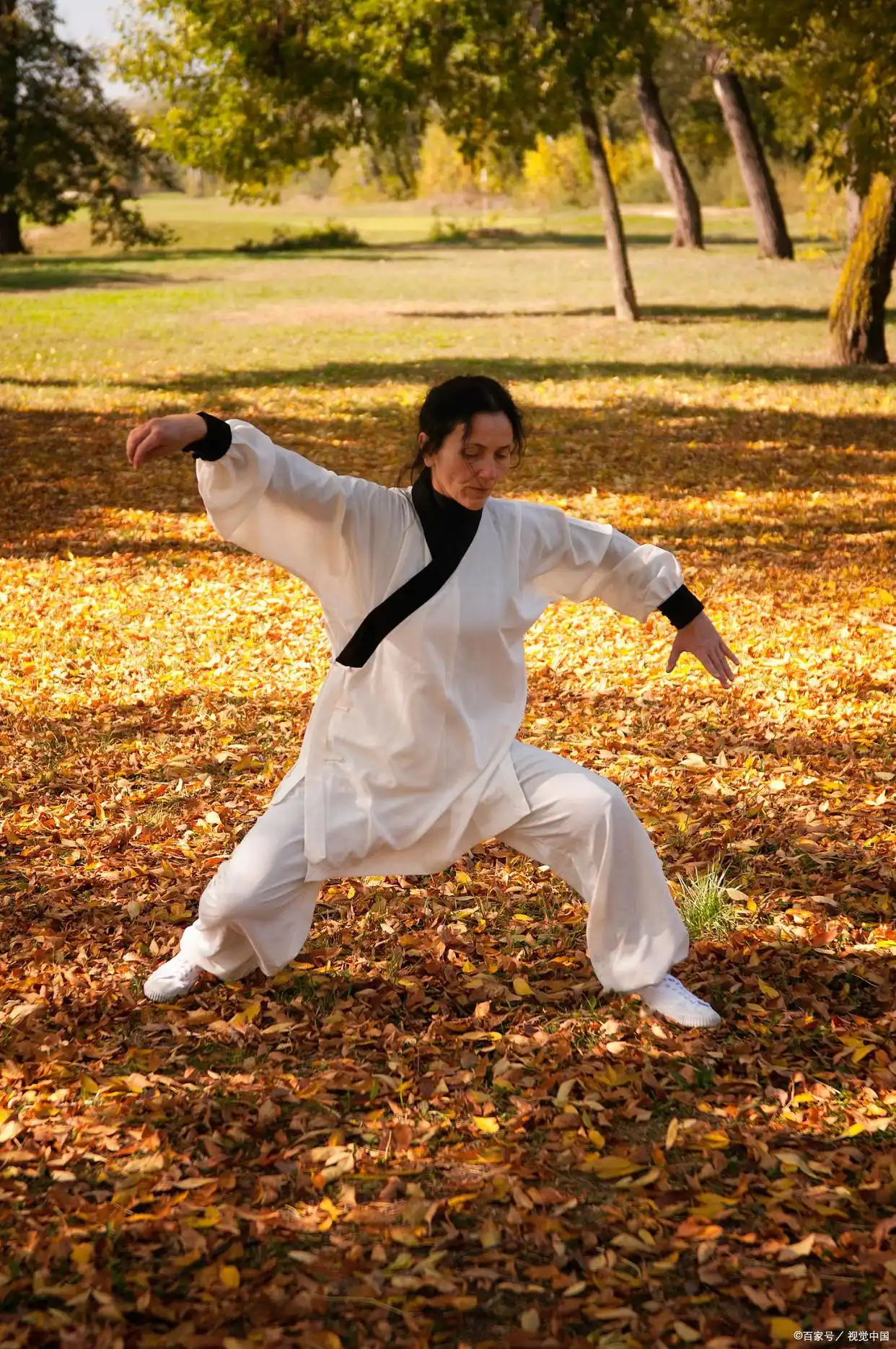
Common Questions and Concerns
“I don’t feel anything. Am I doing it wrong?”
Not at all. People experience Qi at different rates. Some notice sensations in their first practice session; others take weeks or months. Factors like stress level, natural sensitivity, and ability to relax all play a role.
The most important advice: don’t measure progress by sensations. Measure it by consistency. If you’re practicing regularly, you’re succeeding. The sensations will arrive when your body is ready.
“I feel something, but how do I know it’s not imagination?”
This is perhaps the most common question. Here are three ways to distinguish genuine sensation from imagination:
- Consistency : Real sensations tend to appear in the same areas each time you practice. Imagination is more variable.
- Stability : Genuine sensations last for a period of time; they don’t flicker in and out with each thought.
- Autonomy : Real sensations have their own rhythm — they arise, change, and fade on their own. You don’t have to “make” them happen.
Beyond these tests, consider this: the question itself is a form of judgment. Instead of asking “Is this real?” try asking “What am I noticing right now?” The experience itself is what matters.
“The sensations feel too strong. What should I do?”
If a sensation feels overwhelming or uncomfortable:
- Soften your attention. Don’t focus so intensely on the sensation.
- Shift your awareness to your breath, or open your eyes briefly.
- If discomfort persists, reduce your practice time or take a break for a few days.
In rare cases, very strong sensations can indicate that you’re tensing or forcing. The remedy is always more relaxation.
“I had strong sensations at first, but now they’re weaker. Did I lose my progress?”
No. Sensations naturally fluctuate. They may be strong on some days, subtle on others. This is normal and not a sign of regression. In fact, as you progress, the focus shifts from having “big” sensations to being able to perceive very subtle ones. The goal is sensitivity, not intensity.
“Should I try to move the sensations around?”
Not intentionally. Let the sensations move on their own if they want to. Your job is to observe, not to direct. Attempting to “push” Qi with your mind can lead to tension and imbalance.
“What’s the next step after I feel Qi consistently?”
Once you have a stable experience of Qi, you can begin to work with it more consciously — using it to guide movement, to enhance relaxation, and eventually to integrate it into your Tai Chi forms. That’s the subject of our next article.
A Traditional Teaching
“Qi sensations are like the scenery along a journey. They can be beautiful, interesting, sometimes even surprising. But if you stop to stare at every view, you’ll never reach your destination. The destination is health, clarity, and integration. The sensations are just signs you’re on the right path.”
Beyond Sensation — From Experience to Integration
Sensation Is Not the Goal
It’s easy, especially in the beginning, to become fascinated by Qi sensations. They’re novel, intriguing, and can feel quite remarkable. But the true purpose of Qi practice is not to accumulate interesting experiences — it’s to cultivate a healthier, more integrated state of being.
Sensations are feedback. They tell you something about your current state: whether you’re relaxed or tense, whether energy is moving freely or stuck, whether your attention is placed well. But they are not the point.
Sensations Change
Over months and years of practice, the quality of your sensations will evolve. What begins as coarse warmth or tingling may become finer, more subtle, more pervasive. You may feel less “drama” in your practice but a deeper sense of ease and wholeness. This is progress.
Sensation as Guidance
As your sensitivity develops, you can use sensations to guide your practice. If you feel a lack of sensation in an area, it may be telling you that area is tense or blocked. If you feel warmth spreading, you know that circulation is improving. The sensations become an inner compass.
The Final Stage: From Feeling Qi to Being Qi
The ultimate aim of Qi cultivation is not to have impressive sensations, but to reach a state where you no longer need to focus on sensations at all. Qi becomes so integrated into your experience that it’s simply part of how you move, how you breathe, how you live. You don’t “feel” it as separate — you are it.
A Traditional Teaching
“When you first learn to play an instrument, you hear every note separately. Later, you stop hearing the notes and start hearing the music. The same with Qi. At first, you notice the sensations. Later, you stop noticing them — and start living in the state they point to.”
Conclusion: Your Sensations Are Your Teacher
You don’t need to believe in Qi to feel it. You don’t need to understand its philosophy to benefit from it. You only need to practice — consistently, gently, with patience.
The warmth in your palms, the tingling in your fingertips, the magnetic space between your hands — these are not imagination. They are real experiences, accessible to anyone who takes the time to notice.
Let them be your first teacher. Let them show you that there’s more to your body than you usually perceive. And when you’re ready, let them guide you deeper — into the forms , into the practice, into the state where Qi is not something you feel, but something you are.
Where to Go Next
Now that you can feel Qi, how do you bring it into your Tai Chi practice? How do movements like Cloud Hands or Single Whip become expressions of Qi, not just physical shapes?
→ Qi in Tai Chi Practice: From Theory to Embodiment
Or, if you want to understand the learning stages where these sensations naturally develop:
→ How Tai Chi Is Actually Learned: The 5-Stage Journey
Related Articles
- What Is Qi — Definition and Glossary
- Qi vs Energy: Why Qi Is Not Just “Life Energy”
- The Philosophy of Qi: From Cosmic Origin to Modern Relevance
- Why Western Science Struggles to Understand Qi
- Not All Qi Is the Same: The 5 Types of Qi in Qigong and Chinese Medicine
- Core Principles of Tai Chi: 8 Foundational Concepts Explained
🔍 Go Deeper: The Complete Qi Knowledge System
This article guided you through the most common Qi sensations — warmth, tingling, fullness, magnetism, flow. Yet sensation is only the gateway; the real transformation comes from integrating Qi into practice.
We’ve compiled all 7 in‑depth Qi articles (over 10,000 words) into one free 50+ page PDF ebook, Understanding Qi . From philosophy, science, and taxonomy to direct sensation — everything you need in one place.
Master Mingde Chen
12th generation Chen-style inheritor with decades of teaching experience.
View all articles →