Why Western Science Struggles to Understand Qi — And What We Can Learn From It
Key Takeaways
- Qi cannot be directly measured because it is a functional model, not a physical substance — like "software" in a computer
- Scientific attempts to validate Qi have produced inconsistent results: some studies show effects, others fail to replicate
- The placebo-controlled trial model is poorly suited to Qi research — you cannot "blind" a practitioner to their own intention
- Tai Chi's health benefits are well-evidenced regardless of Qi's metaphysical status — the practices work with or without belief
Expert Contributors: Master Mingde Chen, 12th Generation Tai Chi Inheritor & Dr. Jing Li, PhD, Medical Reviewer
Part of the Understanding Qi series:
- ★ Series Overview — complete guide + free PDF download
- What Is Qi — the foundational definition
- Qi vs Energy — why Qi is not simply “life force”
- The Philosophy of Qi — from cosmic origin to modern relevance
- Five Types of Qi — Yuan, Gu, Zong, Ying, and Wei Qi explained
- Why Science Struggles with Qi — and what we can learn from that
- How Qi Feels — a beginner’s guide to direct sensation
- Qi in Tai Chi Practice — from theory to embodiment
Imagine you were a scientist from another planet.
You have instruments that can measure temperature, pressure, electrical fields, and chemical signals with exquisite precision. You observe a human placing their palms together, closing their eyes, and reporting a sensation of warmth and subtle pressure between them.
Your instruments detect small changes in heat and electrical activity — but not the experience itself. The person insists something is there. Your instruments show nothing your programming recognizes as a discrete phenomenon.
Would you conclude the experience is unreal?
Or simply that your instruments are measuring only part of what is happening?
This is precisely the situation Western science finds itself in when it encounters Qi. The phenomena are real to those who experience them. The effects are measurable in clinical studies. Yet Qi itself remains elusive — not because it doesn’t exist, but because the tools designed to measure one kind of reality struggle to capture another.
Why Qi Is Hard to Measure
The Instrument Problem
No device currently exists that can “detect Qi” directly. We have EEG for brain waves, fMRI for blood flow, thermography for heat patterns, and sensitive electrical meters for skin resistance. Each of these can measure something associated with Qi practice:
- Acupuncture points exhibit lower electrical resistance than surrounding tissue
- Qigong practitioners show distinct brainwave patterns
- Infrared cameras sometimes reveal warmth following meridian pathways
But these are correlates — traces left by something we don’t yet know how to capture. They are not the phenomenon itself, any more than a footprint is the animal that made it.
The Context Problem
Qi is not a fixed substance waiting to be detected. It is state-dependent — arising under specific conditions of relaxation, intention, and body alignment. Laboratory environments often disrupt these conditions. Being covered with electrodes while lying in an MRI machine is not conducive to the subtle internal awareness that makes Qi perceptible.
Think of it this way: if you tried to study “concentration” by measuring brainwaves while a subject was distracted by alarms and flashing lights, you wouldn’t learn much about concentration. Similarly, studying Qi in a clinical setting may tell us more about the setting than about Qi.
An Honest Analogy
Love itself cannot be directly measured, but its physiological and behavioral correlates can be studied — heart rate, hormone levels, brain activity, behavioral patterns. Few would conclude love doesn’t exist because we lack a “love meter.” The same humility is appropriate when considering Qi.
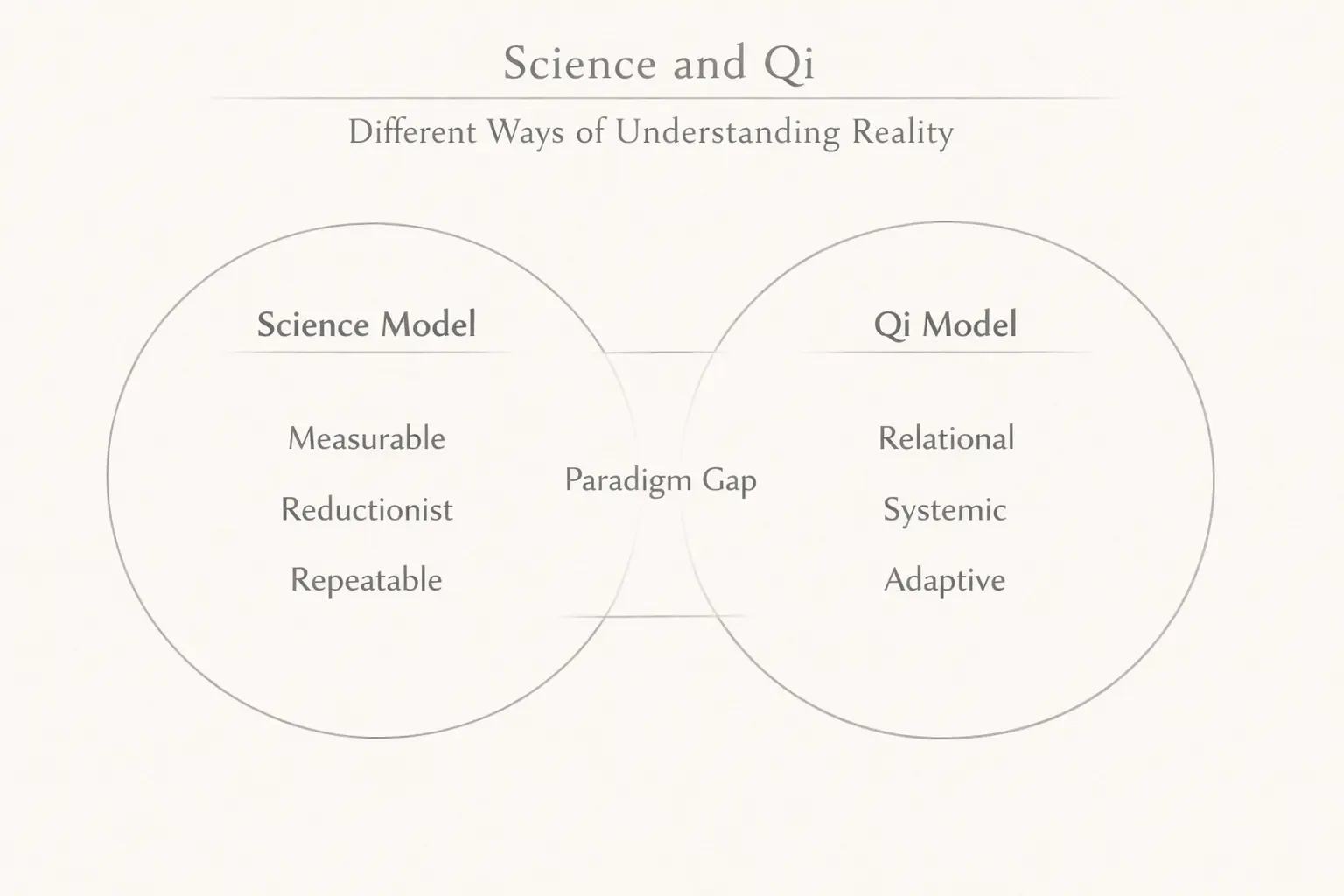
Two Different Investigative Traditions
The Western Scientific Paradigm: Reduction and Quantification
Modern science is built on reductionism: break complex phenomena into their smallest components, measure them precisely, and use those measurements to predict behavior. This approach has been extraordinarily successful — in physics, chemistry, molecular biology, and countless other fields.
Its implicit assumption is powerful: what is real can be quantified; what cannot be quantified is either unreal or not yet ready for science. This assumption works brilliantly for phenomena that are stable, isolable, and repeatable under controlled conditions.
The Classical Chinese Paradigm: Relation and Process
Classical Chinese medicine emerged from a completely different tradition: long-term internal observation by generations of practitioners. Its method was not measurement but pattern recognition — noticing how sensations, symptoms, and bodily states cohered into regular sequences over time.
The result was a map of relationships: meridians connecting organs, Qi flowing in cycles, the interplay of Yin and Yang. Not a map of things, but a map of processes. The question was never “What is Qi made of?” but “How does Qi behave?”
Two Traditions, Not Two Worlds
It’s important not to frame this as “Western science vs. Chinese medicine” in opposition. They are two investigative traditions asking different questions and using different tools. Both produce knowledge. They simply illuminate different aspects of the same underlying reality.
The Forest Analogy
Two people walk through a forest. One counts trees, measures heights, calculates biomass. The other notices seasonal changes, animal movements, the feel of the air under the canopy. Both are studying the forest. They are simply asking different questions — and both sets of answers are true.
Modern Research — Phenomena Associated with Qi
Science cannot yet measure Qi directly. But over the past several decades, researchers have accumulated a body of evidence describing phenomena consistently associated with Qi practice. These findings don’t “prove” Qi exists, but they do suggest that something real is happening — something that deserves serious investigation.
Acupuncture and Meridian Research
Acupuncture points have been shown to exhibit lower electrical resistance and higher conductance than surrounding tissue. This has been replicated in multiple studies and is one of the most robust findings in acupuncture research.
More strikingly, tracer studies using radioisotopes show that when injected at acupuncture points, the tracer follows pathways distinct from blood or lymph circulation — pathways that correspond closely to classical meridian maps. These pathways are not anatomical structures in the conventional sense, but they are functionally demonstrable.
Interpretation: These are not “proof of Qi” but traces of an underlying system whose nature remains incompletely understood. Something is there; we just don’t yet know how to describe it in conventional terms.
Physiological Changes During Qigong
Experienced practitioners show measurable shifts when entering Qigong states:
- Alpha wave synchronization in EEG, indicating a relaxed but alert mental state
- Increased heart rate variability, a marker of autonomic nervous system balance
- Changes in blood oxygen levels and peripheral circulation
Long-term practitioners demonstrate enhanced immune function (elevated Natural Killer cell activity) and reduced inflammatory markers. A 2007 study in Psychosomatic Medicine found that regular Tai Chi practice increased NK cell activity in older adults by over 50%.
Interpretation: These are not Qi itself but the body’s response to Qi practice. They demonstrate that something physiologically significant is occurring, even if we can’t yet name it.
Infrared Imaging and “Propagated Sensation”
Some studies have observed infrared temperature changes along meridian pathways during Qigong practice. These thermal patterns appear to follow classical meridian lines and can be detected with modern thermographic cameras.
The classical phenomenon of “propagated sensation along meridians” (PSM) — a feeling of warmth, tingling, or movement following meridian lines — has been documented in multiple studies. When asked to trace the path of their sensation, subjects often draw lines that match classical meridian maps with remarkable accuracy.
Interpretation: These are the most visually striking correlates yet found. They suggest that the meridian system, whatever its physical basis, has real functional significance that can be both felt and measured.
A Researcher’s Perspective
From a biophysical perspective, we are exploring the concept of a biofield — the continuous electromagnetic, thermal, and informational field that surrounds and penetrates the living body. The dynamic integration of these fields may be the physical basis of what traditional traditions call Qi. We don’t yet have instruments that can measure the whole field in real time, non-invasively. That’s a technical limitation, not evidence that Qi doesn’t exist.
Why the Struggle Is Valuable
Science at Its Best Meets Its Edge
Scientific history shows that difficult phenomena often lead to new paradigms. Quantum physics emerged because classical physics couldn’t explain subatomic behavior. Relativity emerged because Newtonian physics couldn’t explain light’s constant speed. The scientific worldview expanded each time — not by rejecting the old, but by incorporating the new into a larger framework.
Qi presents a similar challenge. Not because it’s unscientific, but because understanding it may require new scientific frameworks that can accommodate:
- Non-local effects (acupuncture points influencing distant organs)
- State-dependent phenomena (Qi appearing only under specific conditions)
- Observer effects (the practitioner’s intention influencing outcomes)
A Paradigm Shift in Progress?
Concepts like systems biology, complexity theory, and embodied cognition are moving science toward more holistic frameworks — a shift that connects to the philosophical foundations of Qi developed over millennia. The idea that living systems are integrated, dynamic wholes — not just collections of parts — resonates deeply with classical Qi thinking.
Researchers in fields as diverse as fascia studies, psychoneuroimmunology, and biofield science are increasingly finding that the body cannot be understood solely through its components. The relationships between parts matter as much as the parts themselves.
Qi research may contribute to, and benefit from, this broader shift. The struggle to understand Qi is not a sign of failure — it’s a sign that science is being asked to grow.
A Traditional Teacher’s Perspective
“The ancients said: ‘Superior students hear of the Way and diligently practice it. Ordinary students hear of it and half-believe, half-doubt. Inferior students hear of it and laugh loudly.’ If you wait for science to prove Qi before you believe, you may wait a very long time. But if you practice standing meditation for fifteen minutes a day for three months, you will have your own answer. Science is someone else’s experience. Qi is yours.”
What This Means for Practice
Accept Uncertainty Without Abandoning Experience
Many important things in life are real without being measurable: meaning, beauty, love, trust. We don’t stop experiencing them just because they resist quantification. The same can be true for Qi.
Qi practice is not a scientific experiment. It is the cultivation of a capacity for perception. Just as a musician develops the ability to hear subtle differences in pitch, a Qigong practitioner develops the ability to perceive subtle differences in bodily sensation. The perception is real, even if it doesn’t register on an instrument.
Cultivate Inner Sensitivity
Daily practices — standing meditation , abdominal breathing, Dan Tian focus — are not “techniques for gathering Qi” in the sense of accumulating a substance. They are methods for developing sensitivity to processes that are always present but usually below the threshold of awareness.
With consistent practice, your perception of Qi will become clearer, more stable, more useful — even if no external instrument can verify it. You will know it the way you know when you’re tired or hungry or happy: directly, without need for proof.
Science and Practice : Complementary, Not Competing Science tells us about mechanisms that may underlie Qi: the fascial network’s electrical conductivity, the nervous system’s role in regulating internal states, the nervous system’s role in regulating internal states, the immune system’s response to relaxation. These insights connect to what current Tai Chi research is uncovering.
Practice tells us about direct experience of Qi: how it feels when it moves, how it responds to intention, how it changes with different forms and postures. This is equally valuable — it’s the data of lived experience.
These are different levels of description, not contradictory truths. A complete understanding requires both.
A Final Suggestion
Don’t be troubled by “science hasn’t proven it yet.” Science is just beginning to seriously study the complexity of human consciousness. The complexity of Qi is no less profound. Give yourself time. Let your body be your laboratory. Your experience is data too.
Conclusion: Science Will Catch Up — But Your Experience Is Available Now
The struggle between science and Qi is not a sign that Qi is unreal. It is a sign that science is still developing the tools to understand phenomena of this kind. Every major advance in scientific understanding came from confronting phenomena that existing frameworks couldn’t explain. Qi is no different.
As a practitioner, you stand at a unique intersection: access to an ancient tradition of internal observation spanning thousands of years, and exposure to modern scientific discoveries that may one day reframe what you already know from direct experience.
The invitation is simple : continue to practice, continue to explore, and remain curious. Read the research, but don’t wait for its conclusions. Your body knows things that instruments cannot yet measure.
The science will catch up eventually. But your experience is available now.
Where to Go Next
If Qi is a real phenomenon that science is still learning to approach, how does it actually feel in the body? That’s the subject of our next article — a practical guide to perceiving Qi directly.
→ How Qi Feels: A Beginner’s Guide to Sensation
Or, if you want to understand the philosophical framework that makes sense of Qi without needing scientific proof:
→ The Philosophy of Qi: From Cosmic Origin to Modern Relevance
Related Articles
- What Is Qi — Definition and Glossary
- Qi vs Energy: Why Qi Is Not Just “Life Energy”
- The Philosophy of Qi: From Cosmic Origin to Modern Relevance
- Not All Qi Is the Same: The 5 Types of Qi in Qigong and Chinese Medicine
- Qi in Tai Chi Practice: From Theory to Embodiment
- Tai Chi Research: 8 Scientific Trends Revealing the Health Benefits
🔍 Go Deeper: The Complete Qi Knowledge System
This article examined why Qi resists conventional scientific measurement — not because it’s unreal, but because different investigative traditions ask different questions.
We’ve compiled all 7 in‑depth Qi articles (over 10,000 words) into one free 50+ page PDF ebook, Understanding Qi . From philosophy, science, and taxonomy to direct sensation — everything you need in one place.
Master Mingde Chen
12th generation Chen-style inheritor with decades of teaching experience.
View all articles →