Qi vs Energy: Why Qi Is Not Just “Life Force”
Key Takeaways
- Translating Qi as "energy" is misleading — Qi is closer to "informational substrate" that organizes biological processes
- Western research on Qi points to bioelectricity: measurable voltage differentials across acupuncture points change during Tai Chi
- Studies using infrared thermography show 1-3°C temperature increases in hands and feet during Qi cultivation practice
- The translation problem explains why "energy healing" sounds mystical in English — but the underlying physiology is real
Expert Contributors: Master Mingde Chen, 12th Generation Tai Chi Inheritor & Dr. Jing Li, PhD, Medical Reviewer
Part of the Understanding Qi series:
- ★ Series Overview — complete guide + free PDF download
- What Is Qi — the foundational definition
- Qi vs Energy — why Qi is not simply “life force”
- The Philosophy of Qi — from cosmic origin to modern relevance
- Five Types of Qi — Yuan, Gu, Zong, Ying, and Wei Qi explained
- Why Science Struggles with Qi — and what we can learn from that
- How Qi Feels — a beginner’s guide to direct sensation
- Qi in Tai Chi Practice — from theory to embodiment
If you search for “What is Qi?” the most common answer you’ll find is “life energy.”
It’s a convenient translation. It fits neatly into a Western worldview that already has a place for “energy” — from the calories you burn to the electricity that powers your phone.
But here’s the problem : Qi is not energy.
Not in the way physics defines energy. Not in the way your fitness tracker measures it. Not even in the way most people imagine it.
This isn’t just semantics. How you understand Qi determines how you practice Tai Chi and Qigong — and whether you ever feel it at all.
Before You Read Further : A 30‑Second Experiment Place your hands in front of you, palms facing each other about six inches apart. Slowly bring them closer together, then move them apart — like gently squeezing and releasing a soft balloon.
Do this for 30 seconds. Breathe naturally. Don’t force anything.
What do you feel between your palms?
Warmth? Tingling? A gentle pressure, almost magnetic? A sense that something is there, even though you can’t see it?
That sensation — familiar to countless practitioners across centuries — is your first direct experience of Qi. Not energy. Not metaphor. Felt experience.
Hold onto that feeling. It’s the anchor for everything that follows.
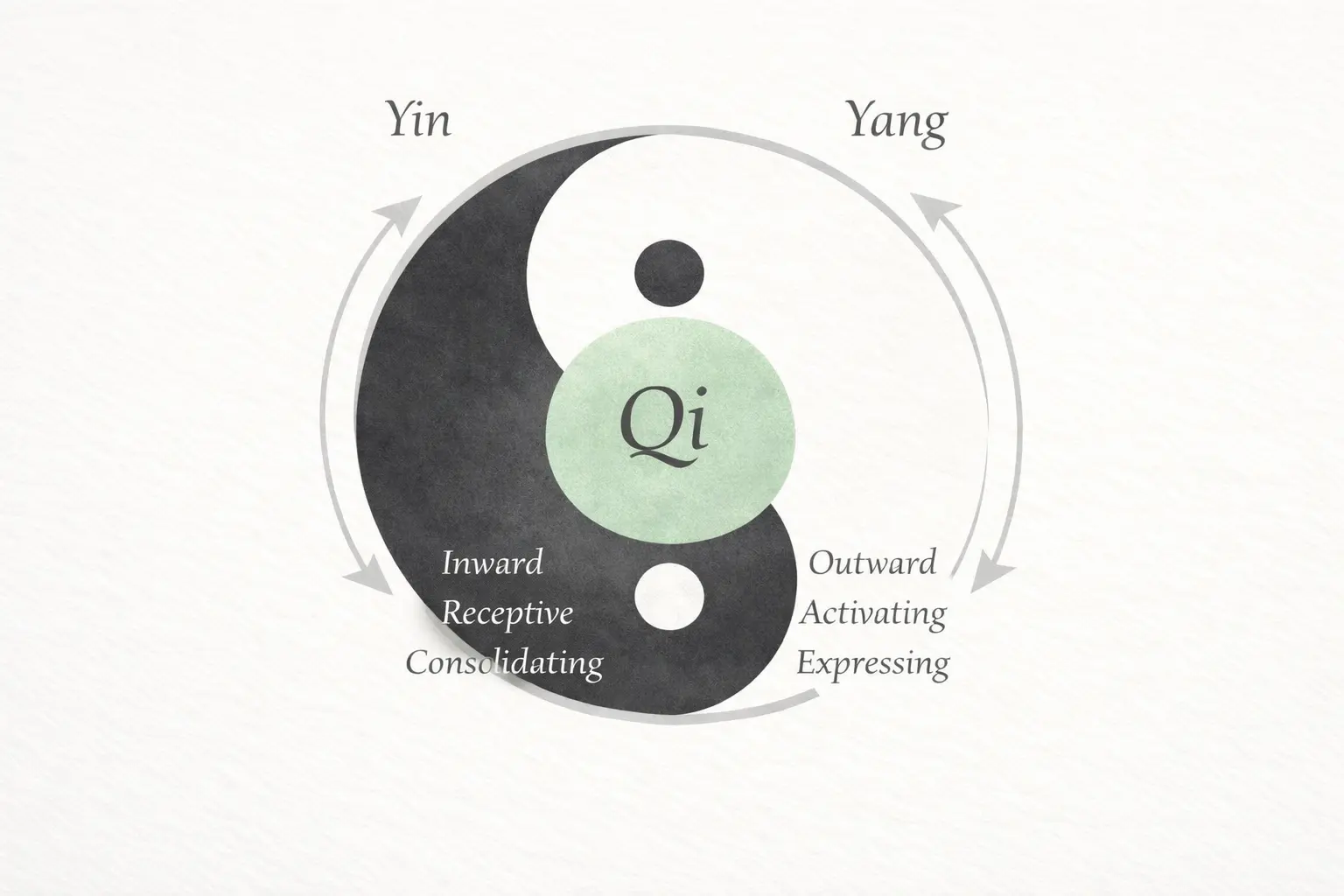
A Historical Accident: How Qi Became “Energy”
To understand why “energy” is misleading, we have to look back 150 years.
In the 19th century, when Western missionaries and sinologists first encountered Chinese medicine, they faced a problem: there was no word in English for “气.” So they reached for the closest concept they had — “energy.”
At the time, energy was becoming the star of Western science. The laws of thermodynamics were newly formulated. The principle of energy conservation was revolutionizing physics. “Energy” was in the air.
It was a convenient translation. But convenience came at a cost.
The translation was never meant to be precise. It was a placeholder, a bridge between two worlds that barely understood each other. But that placeholder hardened into dogma. Today, “Qi is energy” is repeated so often that few stop to question it.
Yet the mismatch is profound:
- Energy can be measured in joules and calories. Qi cannot.
- Energy follows strict conservation laws. Qi can be depleted and replenished in ways that defy simple accounting.
- Energy is a scalar — it has magnitude but no direction. Qi flows through meridians, rises and sinks, enters and exits.
If Qi were energy, these differences would be impossible. So what is Qi really?
Qi Is Process, Not Substance
The Chinese character for Qi (气) — explored in depth in our Qi definition and glossary — originally depicted steam rising from rice — something invisible yet undeniably present, something that moves and transforms rather than sitting inert.
This origin is telling. Qi is not a thing in the Western sense — not a particle, not a fluid, not a form of energy. It is a process, a quality of activity, the way life expresses itself through living systems.
The Zhuangzi, one of the foundational texts of Taoism, puts it plainly:
“The birth of a human being is the gathering of Qi. When Qi gathers, there is life; when it disperses, there is death.” — Zhuangzi, “Knowledge Rambling in the North”
Notice what this says: Qi is not something you have. It is something that gathers. Life itself is a temporary concentration of Qi, like a whirlpool in a river. The water in the whirlpool is constantly changing, but the form — the gathering — persists.
This is why the great scholar of Chinese philosophy Roger Ames writes:
“Qi is best understood not as a substance, but as the dynamic process through which the world continually forms and transforms.”
Energy, by contrast, is a substance-like quantity that can be stored, transferred, and converted. It doesn’t “gather” or “disperse” in the way Qi does. It simply changes form.
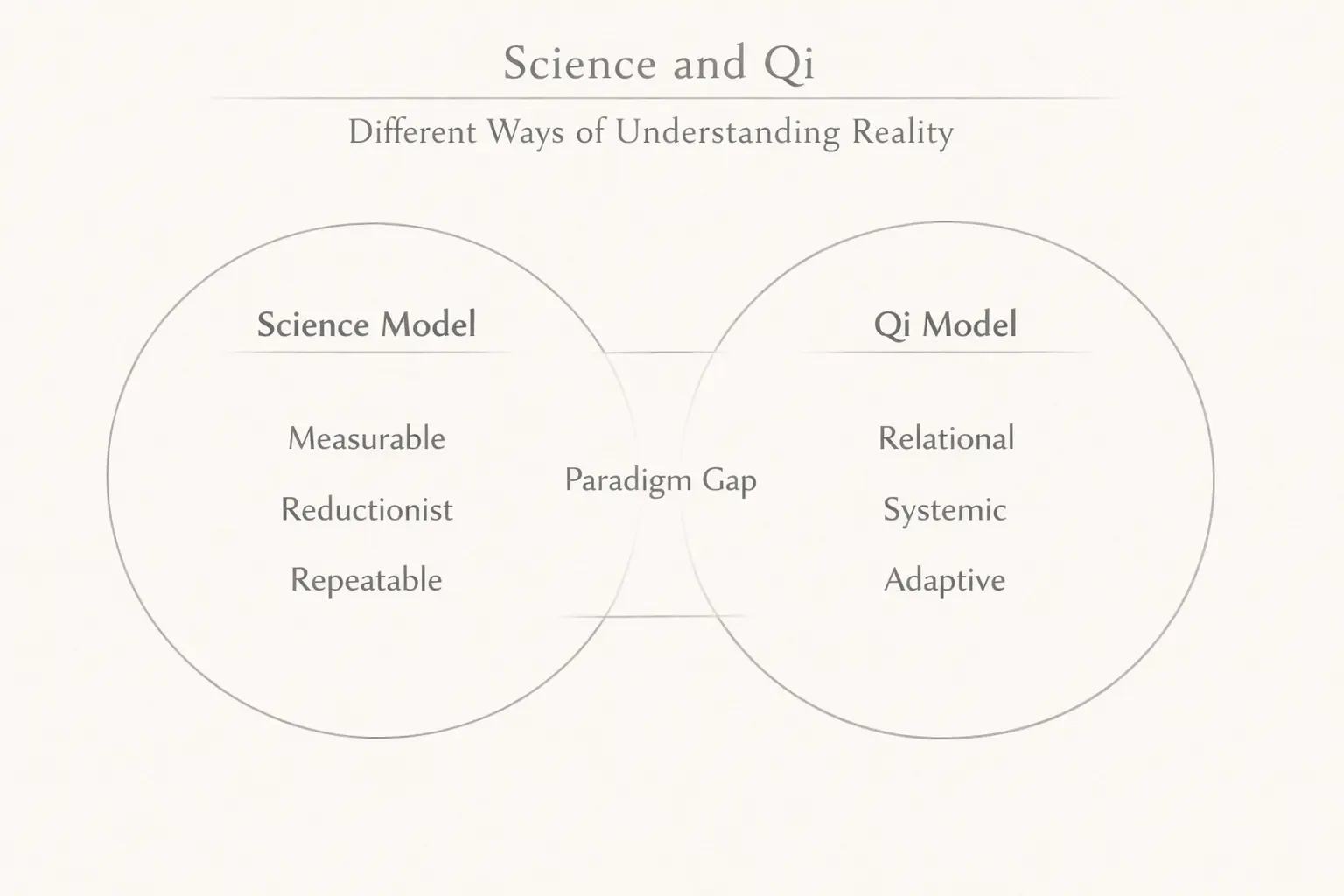
Two Different Worldviews — Qi Monism vs. Western Atomism
The confusion between Qi and energy runs deeper than vocabulary. It reflects two fundamentally different ways of understanding the world.
The Western View: Atoms and Energy
Western science, from the ancient Greeks onward, has been shaped by atomism — the idea that the world is made of tiny, discrete particles moving in empty space. Democritus said it 2,400 years ago: “Nothing exists except atoms and the void.”
Energy fits neatly into this picture. It’s a property of particles, a quantity that can be calculated and conserved. Even when we talk about “fields” — electromagnetic fields, gravitational fields — we tend to think of them as something that particles have or generate.
The method that flows from this worldview is reductionism: to understand something, break it down into its smallest parts. Find the particles. Measure the energy.
The Chinese View: Qi as Continuous Field
Chinese philosophy, by contrast, is built on Qi monism — — a framework explored in depth in The Philosophy of Qi . the understanding that the world is a continuous, unified field of Qi. There are no gaps, no void. As the Song dynasty philosopher Zhang Zai wrote:
“The Great Void is nothing other than Qi. … It contracts and expands, rises and falls, moves and turns — never for a moment does it cease.”
In this view, the world is not a collection of separate things. It is a single, dynamic process differentiating into temporary forms — rocks, trees, animals, you. When something seems “solid,” it’s just Qi moving slowly. When something seems “empty,” it’s Qi moving too subtly to perceive.
Qi isn’t something things have. It’s what things are.
Why This Matters for Understanding Qi
When you try to understand Qi through the lens of atomism and energy, you’re asking the wrong questions:
- “What particle carries Qi?” — There is none.
- “How many joules of Qi does a person have?” — The question is meaningless.
- “Can Qi be converted into other forms of energy?” — This misunderstands what Qi is.
From a biophysical perspective, some researchers suggest that Qi may be better understood as a systemic state of the body — the integrated functioning of the nervous, endocrine, immune, and circulatory systems. When these systems work together smoothly, Qi flows. When they’re disrupted, Qi stagnates.
Energy metabolism is part of this picture, but it’s only one part. Qi includes information flow, coordination, timing, and relationship — things that don’t reduce to joules.
Qi in Chinese Medicine — From Philosophy to Function
If Qi is the world’s fundamental process, how does it operate in the human body? Chinese medicine answers this question with remarkable precision.
Qi differentiates. It takes on specific roles, flows through specific pathways, and responds to specific practices. The classical texts describe at least five functional types — covered in full in The Five Types of Qi :
| Qi Type | Role in the Body | Source |
|---|---|---|
| Yuan Qi (Original Qi) | Life’s fundamental driving force; powers growth, development, reproduction | Inherited from parents; stored in kidneys |
| Gu Qi (Grain Qi) | Extracted from food; provides daily energy | Digestion by spleen and stomach |
| Zong Qi (Gathering Qi) | Governs breathing and heart function; links respiration to circulation | Combines Gu Qi with air in the chest |
| Ying Qi (Nutritive Qi) | Flows in meridians, nourishing organs and tissues | Refined from Gu Qi |
| Wei Qi (Defensive Qi) | Circulates under the skin, defending against illness | Derived from Gu Qi and kidney yang |
These are not different “kinds” of energy. They are different functions of the same underlying process — just as a river can be a source of drinking water, a transportation route, and a habitat for fish, all at once.
The Huangdi Neijing (Yellow Emperor’s Classic) states a principle that guides diagnosis and treatment:
“All diseases arise from Qi. When Qi is disturbed — rising, sinking, stagnating, dispersing inappropriately — illness follows.”
Notice what this implies: Health is not about having “enough” Qi in a quantitative sense. It’s about Qi moving correctly — the right amount in the right place at the right time.
This is why Chinese medicine treats illness by regulating Qi’s movement, not by “adding energy.” Acupuncture, herbs, and Qigong all aim to restore proper flow, not to increase a quantity.
Why This Distinction Changes Your Practice
If you think of Qi as energy, your practice will look one way. If you understand Qi as life process, your practice will look very different.
If You Think Qi Is Energy:
- You try to accumulate it — as if it were a substance you could store.
- You focus on feeling more — stronger sensations, bigger experiences.
- You might force your breath or tense your body, trying to make something happen.
- You ask: “How do I get more Qi?”
The result? Tension. Frustration. And ironically, less Qi flow — because tension blocks it.
If You Understand Qi as Process:
- You focus on removing blocks — relaxing, releasing, letting go.
- You trust that when conditions are right, Qi naturally gathers.
- You attend to alignment — body structure, breath rhythm, mental intention.
- You ask: “What’s preventing Qi from flowing?”
A common teaching in traditional Tai Chi lineages puts it simply:
“Qi is not something you use. Qi is something you cultivate. You cannot force it. You can only invite it.”
When you stand in Wuji stance with a relaxed spine and soft knees, when you breathe without strain, when your attention settles gently in the Dan Tian — Qi gathers. Not because you “pulled” it in, but because you created the conditions.
Yi Leads Qi — The Role of Intention
One of the most famous principles in internal arts is “ yi leads Qi” (意到气到). Where intention goes, Qi follows.
If Qi were energy, this principle would be nonsense. Intention can’t move energy. But if Qi is a process — the integrated functioning of body and mind — then intention is part of the process.
Think of it this way: When you intend to lift your arm, your nervous system coordinates hundreds of muscles in perfect sequence. You don’t think about each muscle. You just intend, and the arm moves. Intention organizes the process.
It’s the same with Qi. When you intend to sink your Qi to the Dan Tian, your whole system responds — breath deepens, tension releases, awareness settles. The Qi “follows” because intention guides the process.
This is why Tai Chi is sometimes called “moving meditation.” Every movement is an act of intention, shaping the flow of Qi through the body.
Conclusion: Qi Is Not Energy — It’s Life Itself
The translation of Qi as “energy” was a historical accident — a 19th‑century placeholder that became a modern dogma. It’s time to retire it.
Qi is not a form of energy. It’s not a substance you can measure in joules. It’s not something you “use up” or “store.”
Qi is the process of life itself — the gathering, flowing, transforming that makes a body alive. It’s what you feel between your palms in that simple experiment. It’s what deepens when you stand still and breathe. It’s what moves when intention guides.
And the good news? You don’t need to understand physics to work with Qi. You only need to listen — to your body, your breath, your inner sensation.
A final teaching from traditional practice :
“Don’t chase Qi. Don’t force it. Just relax, align, and breathe. Qi will find its own way.”
Where to Go Next
If Qi is the process of life, how does it organize itself in the body? That’s where the five types of Qi come in — a practical map of how Qi functions in health and practice.
→ Not All Qi Is the Same: The 5 Types of Qi in Qigong and Chinese Medicine
Or, if you’re curious what Qi actually feels like before diving deeper into theory:
→ How Qi Feels: A Beginner’s Guide to Sensation
Related Articles
- What Is Qi — Definition and Glossary
- The Philosophy of Qi: From Cosmic Origin to Modern Relevance
- How Qi Feels: A Beginner’s Guide to Sensation
- How Tai Chi Is Actually Learned: The 5-Stage Journey
🔍 Go Deeper: The Complete Qi Knowledge System
This article clarified why Qi cannot be reduced to the Western concept of “energy” — a historical accident that still misleads practitioners today. But this distinction is only the beginning.
We’ve compiled all 7 in‑depth Qi articles (over 10,000 words) into one free 50+ page PDF ebook, Understanding Qi . From philosophy, science, and taxonomy to direct sensation — everything you need in one place.
Master Mingde Chen
12th generation Chen-style inheritor with decades of teaching experience.
View all articles →