Beyond Energy: The Philosophy of Qi — Ancient Wisdom Meets Modern Science
Key Takeaways
- The concept of Qi predates Tai Chi by 2,500+ years — first recorded in the Zhou dynasty (1046–256 BCE) as cosmic vapor
- Neo-Confucian philosophers (11th–12th century) systematized Qi into a rational framework linking matter and energy as one substance
- Qi philosophy solves a problem Western science still struggles with: the mind-body connection — how intent becomes physical change
- Tai Chi is unique among martial arts because it applies Qi philosophy as practical technique, not abstract theory
Expert Contributors: Master Mingde Chen, 12th Generation Tai Chi Inheritor & Dr. Jing Li, PhD, Medical Reviewer
Part of the Understanding Qi series:
- ★ Series Overview — complete guide + free PDF download
- What Is Qi — the foundational definition
- Qi vs Energy — why Qi is not simply “life force”
- The Philosophy of Qi — from cosmic origin to modern relevance
- Five Types of Qi — Yuan, Gu, Zong, Ying, and Wei Qi explained
- Why Science Struggles with Qi — and what we can learn from that
- How Qi Feels — a beginner’s guide to direct sensation
- Qi in Tai Chi Practice — from theory to embodiment
If you’ve practiced Qigong or Tai Chi, you’ve been told that Qi is “energy.”
But here’s the problem: that translation is incomplete — and misleading.
In Chinese philosophy, Qi is not just the energy inside your body. It’s the substance of the cosmos, the rhythm of the seasons, the foundation of morality, and the bridge between matter and consciousness.
This article takes you beyond the simplified “energy” model. You’ll discover:
- How ancient Chinese thinkers saw Qi as the building block of everything
- Why Qi philosophy is now influencing modern physics, biology, and medicine
- What “Qi” really means — and why it matters for your practice and your life
What Is Qi, Really? A Definition
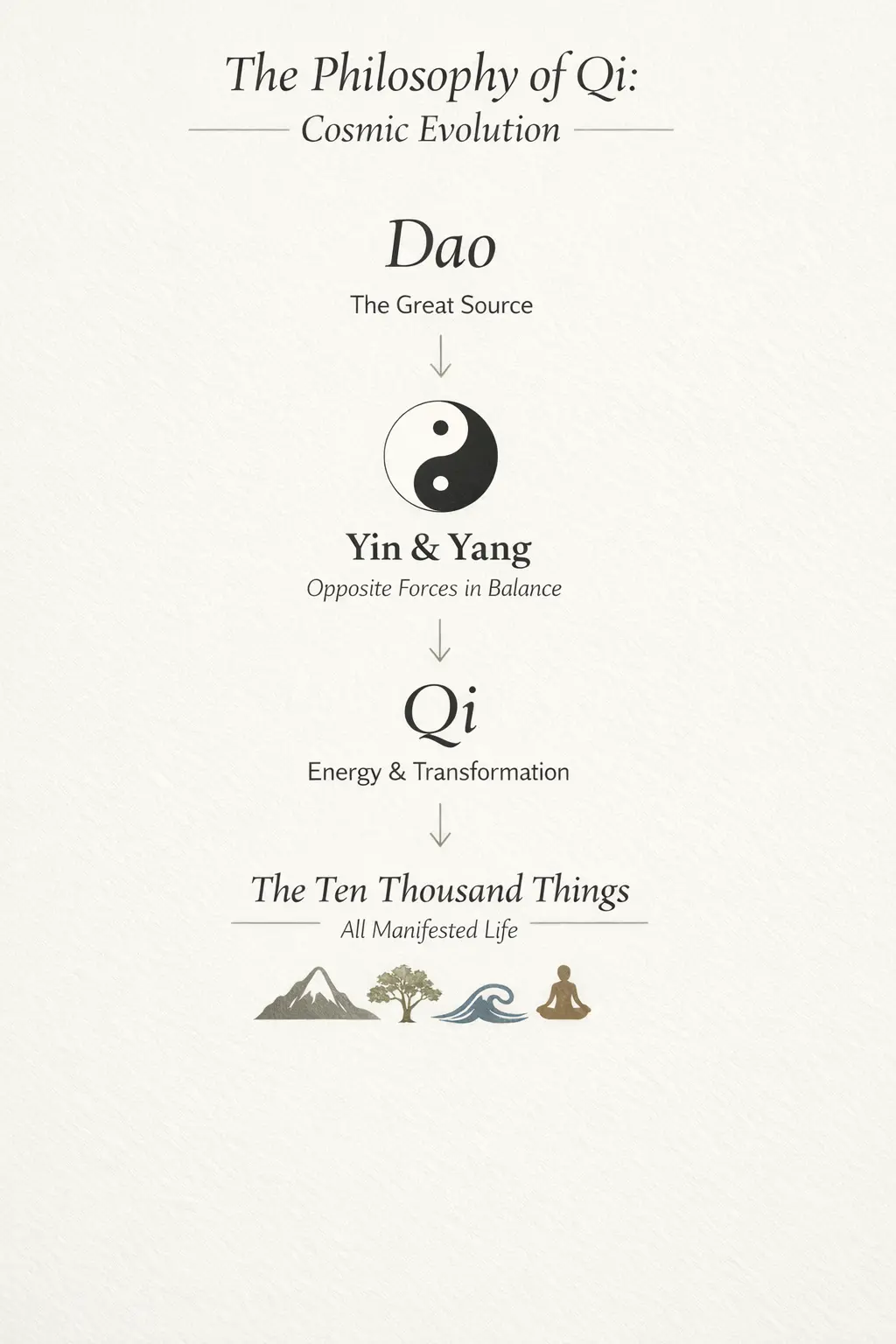
Qi (气) is the fundamental, ever‑moving substance that constitutes the universe and all life within it. It is both matter and energy, form and function — the animating force that connects heaven, earth, and humanity.
This definition may sound abstract, but it becomes concrete when we explore its philosophical roots and practical applications.
Before Philosophy, There Was Experience
Before Qi was a philosophical concept, it was a felt experience.
Perhaps you’ve noticed it yourself:
- The warmth that rises in your palms after a few minutes of standing still
- The sense of fullness or gentle pressure in your lower abdomen when you breathe softly
- The way your body feels heavier, more rooted, after a slow Tai Chi form
- The almost electric tingling that runs through your arms when you hold a posture just right
These sensations are familiar to many practitioners of Tai Chi and Qigong . Ancient Chinese thinkers had these same experiences. They simply asked a question that changed everything: What if these sensations are not separate from the world — what if they are the world, experienced from the inside?
Their answer became the philosophy of Qi. But the starting point was always the same as yours: a body, breathing, noticing.
Philosophical Foundations — Qi as the Origin and Vitality of the Universe
Qi Monism: The One Substance That Becomes All Things
Ancient Chinese philosophy holds that Qi is the most basic constituent of the cosmos. It is formless yet continuous, dynamic yet unified. As the Zhuangzi states:
“The birth of a human being is the gathering of Qi. When Qi gathers, there is life; when it disperses, there is death.” — Zhuangzi, “Knowledge Rambling in the North”
This passage reveals two profound insights:
- Qi is the material cause of all existence.
- Life and death are merely different states of Qi’s concentration and dispersion.
The Interplay of Yin‑Yang and Five Phases
Qi is not a homogeneous blob. It differentiates into Yin Qi and Yang Qi, whose interaction generates the Five Phases (Wood, Fire, Earth, Metal, Water). These phases, in turn, drive the cycles of nature and the functions of the human body.
The Song Dynasty philosopher Zhang Zai (1020–1077) famously declared:
“The Great Void is nothing other than Qi. … It contracts and expands, rises and falls, moves and turns — never for a moment does it cease.” — Zhang Zai, Correcting Youthful Ignorance
For Zhang, Qi is not just a passive stuff; it is active, self‑organizing, and inherently intelligent. This idea resonates with modern concepts of self‑organizing systems and emergent complexity.
Qi and Life: The Energetic Blueprint of the Body
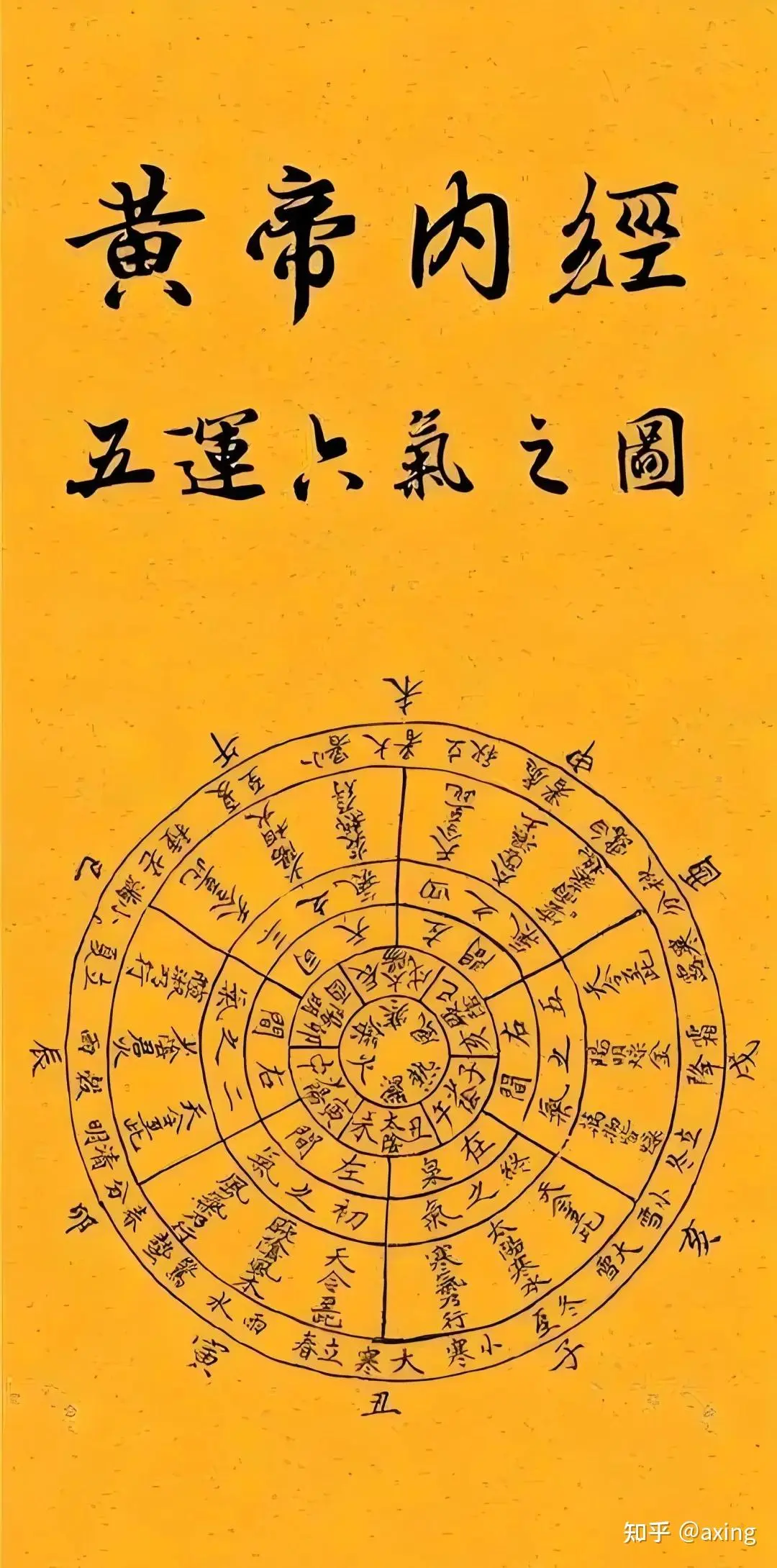
In the Huangdi Neijing (Yellow Emperor’s Classic), Qi is the very fabric of human life:
“Heaven and Earth combine their Qi to produce the human being.” — Suwen, Chapter 25
Within the body, Qi differentiates into functional types: Yuan Qi (Original Qi), Zong Qi (Gathering Qi), Ying Qi (Nutritive Qi), and Wei Qi (Defensive Qi) — each with a distinct role in sustaining health. This physiological model is not a metaphor; it has guided Chinese medicine for over two millennia and is now being investigated by modern science.
Qi as Moral Spirit: Mencius’ “Floodlike Qi”
Qi also possesses a moral dimension. The Confucian philosopher Mencius (4th century BCE) spoke of cultivating a “floodlike Qi” (浩然之气):
“It is the Qi that is supremely vast and unyielding. If one cultivates it with integrity and does not harm it, it will fill the space between Heaven and Earth.” — Mencius, 2A:2
This “floodlike Qi” is not a physical substance but a state of moral courage and spiritual power. It arises from acting in alignment with one’s conscience and grows through righteous deeds. For Mencius, Qi bridges the inner world of intention and the outer world of action — a theme that later became central to martial arts and Qigong.
Master Mingde Chen reflects: “In Tai Chi, we often say ‘ Yi leads Qi’ — intention guides energy. Mencius understood this 2,400 years ago. The floodlike Qi is what you feel when you move with complete conviction, without a shred of doubt. It’s the same force that makes a Tai Chi form powerful without being tense.”
Historical Evolution — From Visible Vapor to Cosmic Principle
The concept of Qi did not spring into existence fully formed. It evolved over centuries, accumulating layers of meaning.
| Period | Key Developments |
|---|---|
| Pre‑Qin (before 221 BCE) | Qi refers to natural phenomena: clouds, wind, breath. The Guanzi introduces “jing Qi” (refined Qi) as the essence of life. |
| Han Dynasty (206 BCE–220 CE) | Wang Chong develops “Yuan Qi” (Primordial Qi) theory, arguing that the universe is spontaneously generated from Qi — a direct challenge to superstition. |
| Song‑Ming Neo‑Confucianism (960–1644) | Zhang Zai and Zhu Xi integrate Qi with “Li” (principle). Zhang’s “Great Void is Qi” becomes a foundational statement. Zhu Xi sees Qi as the material that Li patterns. |
| Late Imperial China (17th–19th c.) | Wang Fuzhi asserts the primacy of Qi: “Outside Qi there is no isolated Li.” Qi is fully real and independent. |
This evolution shows a steady deepening: from concrete vapor to metaphysical substrate, from passive matter to active intelligence. Qi becomes a concept flexible enough to serve medicine, cosmology, and ethics simultaneously.
Dr. Jing Li notes: “What impresses me as a scientist is that this ancient idea kept refining itself without losing its core insight: that the world is a dynamic, interconnected whole. That’s exactly what modern systems biology is rediscovering.”
Core Characteristics — How Qi Behaves
To work with Qi — whether in practice or in theory — you must understand its fundamental properties.
1. Continuity (无形无隙)
Qi is formless and fills all spaces. Unlike discrete particles, Qi has no gaps; it is a continuous field. The Guanzi says:
“Below, it produces the five grains; above, it becomes the arrayed stars. It flows between Heaven and Earth.” — Guanzi, “Inner Work”
This continuity makes Qi the perfect medium for action at a distance — explaining how acupuncture points can influence distant organs, or how intention can affect another person’s Qi field.
2. Dynamism (气化流行)
Qi never rests. It constantly undergoes transformation (气化):
- Condensing to form matter
- Dispersing to return to the formless
- Rising and falling to create cycles (day/night, seasons, life stages)
The Yijing (Book of Changes) captures this:
“The interaction of the firm and the yielding gives rise to transformation and change.” — Xici, Part I
Every Tai Chi movement embodies this principle: opening and closing, storing and releasing, rising and sinking. The form is a choreography of Qi’s own nature.
3. Holism (万物一气)
Because everything is made of Qi, everything is interconnected. The same Qi that flows through your meridians also circulates in the atmosphere, moves the planets, and shapes the mountains. The Yijing again:
“Things of the same Qi seek one another.” — Xici, Part I
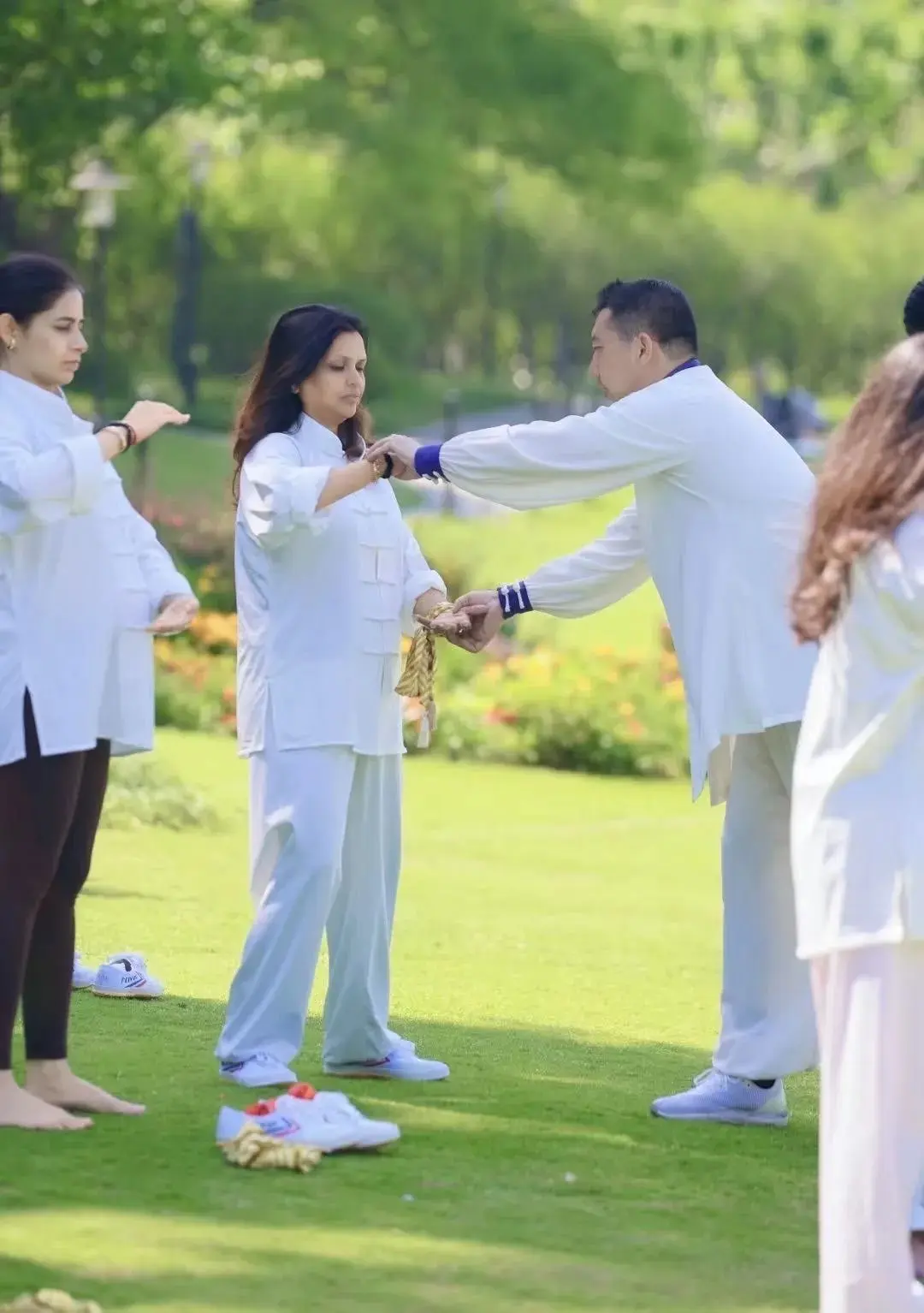
This is not mystical oneness — it’s a practical principle of resonance. When you practice outdoors in spring, your Qi resonates with the rising Yang Qi of nature, enhancing your own vitality. When you practice with a partner, your Qi fields interact, enabling the sensitivity known as “ listening Jin .”
Master Mingde Chen shares: “I’ve practiced under waterfalls, in ancient forests, and in modern studios. The Qi always feels different — not because the practice changes, but because the environment’s Qi changes. A good practitioner learns to harmonize with whatever Qi is present. That’s the real meaning of ‘unity of Heaven and humanity.’”

East Meets West — Qi vs. Air, Atom, and Energy
Western readers often ask: “Is Qi like oxygen? Like atoms? Like energy?” The answer requires a careful comparison.
| Aspect | Chinese Qi | Western Analogues |
|---|---|---|
| Origin of concept | Abstracted from natural phenomena (clouds, wind, breath) | Ancient Greek pneuma (air, breath) – Anaximenes’ “air is the origin” |
| Philosophical direction | Pragmatic: serves medicine, ethics, self‑cultivation | Theoretical: seeks truth about the world’s ultimate nature |
| Modern resonance | Compared to quantum fields, dark matter, biofields | Superseded by atomic theory, but “field” in physics echoes Qi’s continuity |
Anaximenes of Miletus (6th century BCE) proposed that air (pneuma) is the primary substance: when rarefied it becomes fire, when condensed it becomes wind, cloud, water, earth, stone. This sounds remarkably like Qi — yet the two traditions diverged:
- Greek thought moved toward atomism (Democritus) — discrete particles moving in a void.
- Chinese thought retained field theory — continuous Qi without gaps.
Today, modern physics is rediscovering the value of field concepts. Quantum field theory describes particles as excitations of underlying fields — a picture not unlike “Qi condensing into form.” Some theorists even propose that dark matter might be a form of Qi yet to be characterized.
Dr. Jing Li observes: “As a biomechanist, I’m fascinated by the fascia — the connective tissue network that runs throughout the body. It’s continuous, electrically conductive, and responsive to mechanical forces. Some researchers now call it the ‘living matrix’ — it behaves exactly like the Qi meridians described in classical texts. We’re not saying fascia is Qi, but it’s a plausible physical substrate.”
Conclusion: Why Qi Philosophy Matters for Your Practice
Understanding the philosophy of Qi transforms your Tai Chi or Qigong practice in three ways:
- Depth — You realize that every movement is a microcosm of cosmic processes. Opening is not just opening; it’s the expansion of Qi that gave birth to the universe.
- Connection — You feel less separate from your surroundings. The Qi in your Dan Tian and the Qi in the trees are the same substance — you are not practicing in nature, you are practicing as nature.
- Purpose — You see self‑cultivation as participation in the larger order. Cultivating your Qi is not selfish; it’s aligning yourself with the Dao.
The philosophy of Qi is not a relic of the past. It is a living framework — one that is increasingly relevant in a world searching for holistic solutions to complex problems. From systems biology to embodied cognition research, scientists are finding conceptual parallels with the ancient insight that living systems function as integrated, dynamic wholes. The language is different — but the territory may be the same.
For practitioners of Qigong and Tai Chi, understanding this deeper philosophy turns practice into a profound dialogue with the cosmos. You no longer just “feel energy” — you participate in a process that has been contemplated for millennia.
And that, perhaps, is the most profound gift of Qi philosophy: it reminds us that we are not separate from the universe. We are the universe, breathing.
Related Glossary Terms
- Yuan Qi — Original Qi, the fundamental vitality inherited at birth
- Zong Qi — Gathering Qi, formed in the chest from breath and food
- Ying Qi — Nutritive Qi, flowing in the meridians to nourish organs
- Wei Qi — Defensive Qi, protecting the body’s surface
- Dan Tian — The primary energy center where Qi is stored
- Yi — Intention, which leads Qi according to the classical hierarchy
Struggling to feel Qi in your practice?
From One Qi to Five
If Qi is one continuous, dynamic field — the substance of the universe and the vitality of your body — how does it actually function in human health?
The answer, according to classical Chinese medicine, is that Qi differentiates. It takes on specific roles, flows through specific pathways, and responds to specific practices.
This is where the five types of Qi in Chinese medicine come in — a practical framework that has guided healing and cultivation for over two millennia.
→ Continue reading: Not All Qi Is the Same: The 5 Types of Qi in Qigong and What They Do
🔍 Go Deeper: The Complete Qi Knowledge System
This article traced Qi’s philosophical journey — from Zhuangzi and Zhang Zai to its resonance with modern systems thinking. Yet philosophy alone cannot make Qi tangible.
We’ve compiled all 7 in‑depth Qi articles (over 10,000 words) into one free 50+ page PDF ebook, Understanding Qi . From philosophy, science, and taxonomy to direct sensation — everything you need in one place.
Master Mingde Chen
12th generation Chen-style inheritor with decades of teaching experience.
View all articles →