Qi in Tai Chi Practice: How to Cultivate and Express Qi Through Movement
Key Takeaways
- Qi in Tai Chi is a felt experience, not a belief — practitioners consistently report warmth, tingling, and expansion during practice
- The sensation correlates with 3 measurable changes: increased microcirculation, parasympathetic activation, and fascial hydration
- Three mechanisms cultivate Qi: intention-directed awareness (Yi), coordinated breath, and structural alignment — practiced in 20-min sessions
- You don't need to "believe in Qi" to benefit — the physical practices that generate the sensation work regardless of belief system
Expert Contributors: Master Mingde Chen, 12th Generation Tai Chi Inheritor & Dr. Jing Li, PhD, Medical Reviewer
Part of the Understanding Qi series: New to Qigong? Start here →
- ★ Series Overview — complete guide + free PDF download
- What Is Qi — the foundational definition
- Qi vs Energy — why Qi is not simply “life force”
- The Philosophy of Qi — from cosmic origin to modern relevance
- Five Types of Qi — Yuan, Gu, Zong, Ying, and Wei Qi explained
- Why Science Struggles with Qi — and what we can learn from that
- How Qi Feels — a beginner’s guide to direct sensation
- Qi in Tai Chi Practice — from theory to embodiment
A Common Experience
Many people come to Tai Chi looking for “Qi” — often described as energy flowing through the body.
Some try to feel it. Others try to control it. Most end up confused.
If you’ve ever felt warmth, tingling, or a subtle sense of flow during standing meditation — but lost it the moment you started moving — you’re not alone.
This article will show you why that happens — and how Qi actually works in real Tai Chi practice.
You’ve stood in Wuji stance and felt warmth in your palms. You’ve practiced opening-closing and noticed the magnetic space between your hands. You’ve even begun to recognize the tingling, fullness, and flow that signal Qi moving through your body.
But then you start your Tai Chi form — and somehow, the Qi disappears.
Your attention scatters. Your movements feel mechanical. The subtle sensations that were so clear in stillness seem to vanish once you start moving.
This is one of the most common experiences for Tai Chi practitioners — and also one of the most misunderstood. The problem isn’t that you’ve lost your connection to Qi. It’s that you’re trying to bring a static experience into a dynamic practice without understanding how Qi actually works in movement.
This article will change that.
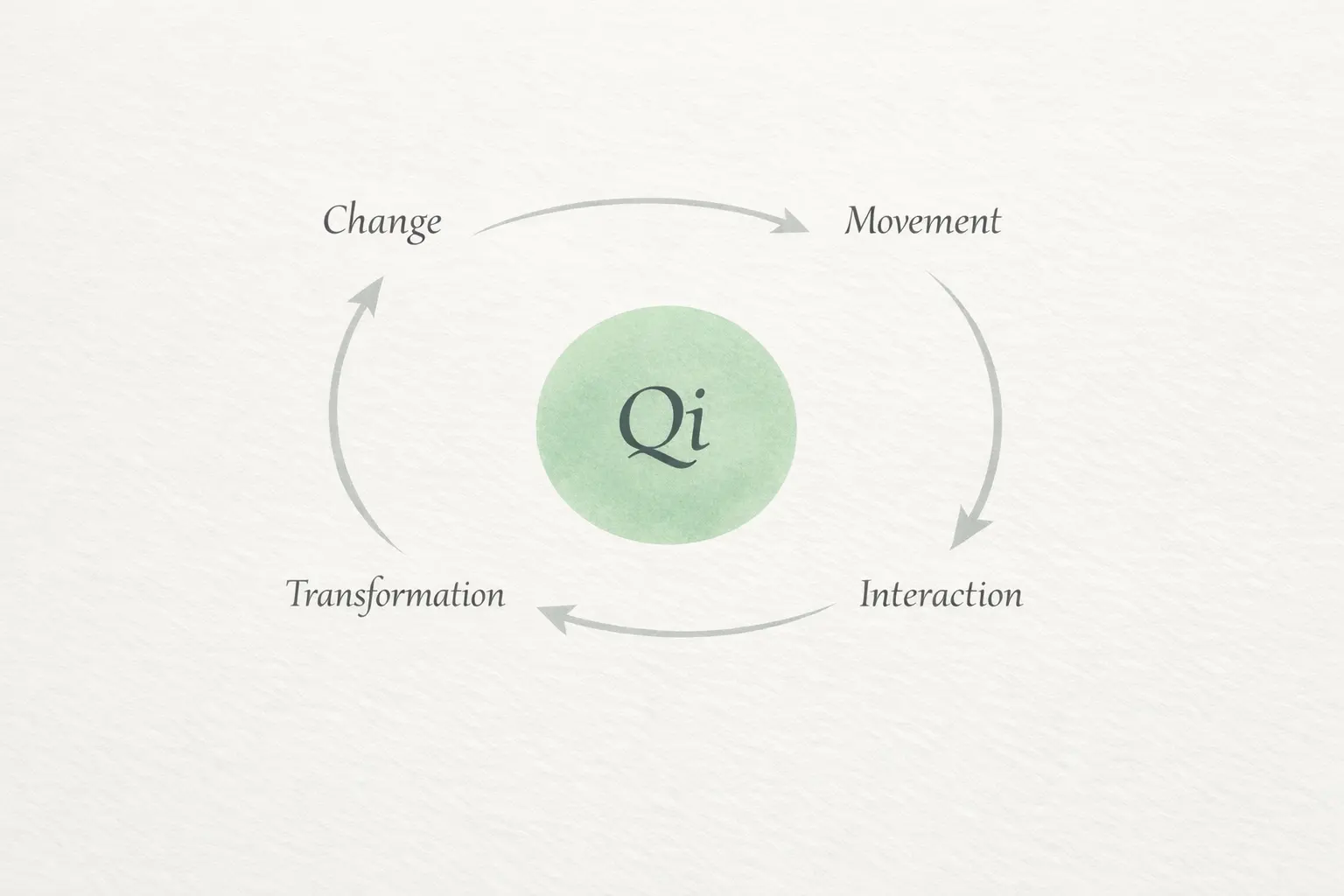
A Common Misunderstanding — Qi in Tai Chi Is Not “Energy Projection”
The Trap of Modern Language
Many contemporary descriptions portray Tai Chi as moving “energy” through the body. You may have heard phrases like “send your Qi outward” or “project energy through your hands.” While well-intentioned, this language often creates a misleading mental picture.
Beginners start trying to push Qi with their mind, or force sensations through their limbs. They concentrate harder, tense their muscles, and hold their breath — exactly the opposite of what allows Qi to arise naturally.
What Traditional Teaching Says
A common saying in Tai Chi lineages offers a crucial correction:
“Do not move Qi directly. Move the body correctly, and Qi will follow.”
This single sentence contains the entire secret of Qi in Tai Chi practice. Qi is not something you control with your will. It is something that emerges when the conditions are right — when your structure is aligned, your breath is calm, and your attention is present but soft.
Trying to manipulate Qi directly leads to:
- Muscular tension — which blocks the very pathways Qi needs to flow
- Shallow breathing — which deprives the system of the oxygen and internal pressure that support Qi circulation
- Mental strain — which fragments attention and prevents the unified state where Qi becomes perceptible
In traditional training, the focus is always on the fundamentals first. Qi is the result, not the method.
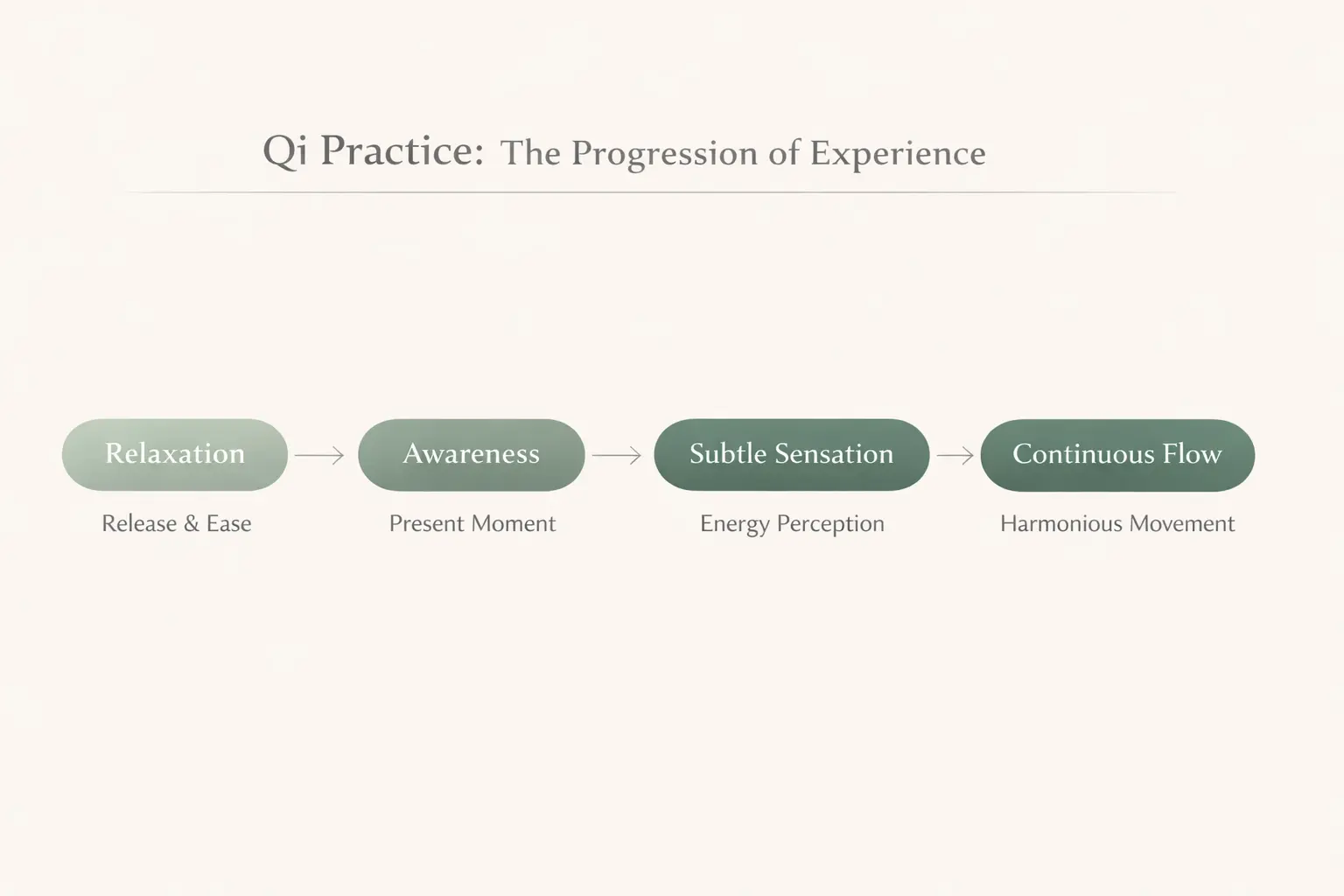
The Three Conditions — Body, Breath, and Mind
Qi in Tai Chi does not need to be created or controlled.
It naturally emerges when three conditions are aligned:
- Body — structure is open and connected
- Breath — calm, deep, and unforced
- Mind — present, relaxed, and continuous
When these three come together, Qi is simply what the body feels like when it works as one system.
Classical Tai Chi manuals describe practice through three interconnected adjustments: regulating the body, regulating the breath, and regulating the mind. When these three align, Qi emerges naturally — not as something added, but as the natural expression of a body functioning as an integrated whole.
Regulating the Body (调身)
Correct alignment allows force and pressure to distribute efficiently through the body. Key structural elements include:
- A relaxed but upright spine — not rigidly straight, but gently elongated as if suspended from above
- Weight sinking through the legs — not collapsing, but settling into the ground like a heavy tree rooted deep
- Open joints — particularly the shoulders, hips, and knees, allowing continuity through the entire kinetic chain
- Coordinated movement of hips and waist — the “commander” that directs all motion
When these conditions are present, practitioners often report sensations of flow, warmth, or internal connectivity. Traditional texts describe this as Qi circulating through the meridians . From a physiological perspective, it reflects optimal fascial elasticity, coordinated muscle activation, and efficient neural signaling.
Regulating the Breath (调息)
Tai Chi breathing is typically slow, natural, and abdominal. Unlike forceful breathing exercises, the emphasis is on allowing the breath to deepen on its own as the body relaxes.
Deep, relaxed breathing influences:
- Autonomic nervous system balance — shifting from sympathetic (fight-or-flight) to parasympathetic (rest-and-digest)
- Blood circulation — the diaphragm’s movement massages internal organs and assists venous return
- Internal pressure dynamics — rhythmic changes in thoracic and abdominal pressure create a gentle pumping action that moves fluids through the body
Traditional language describes this as “Qi descending to the Dan Tian .” In practice, it feels like the breath settling into the lower abdomen, creating a sense of centeredness and stability that supports all movement. This method is called Dantian Breathing (丹田呼吸) — the intentional use of diaphragmatic engagement and 360-degree abdominal expansion to settle the breath and gather qi in the lower belly.
Regulating the Mind (调心)
Attention in Tai Chi is calm and continuous. Instead of concentrating forcefully, the practitioner maintains a soft awareness of posture and movement — not gripping, not wandering, simply present.
This quality of attention is what the classics mean by “ Yi leads Qi” (意到气到). It’s not that the mind “pushes” energy. Rather, attention organizes the body’s resources. When you intend to lift your arm, your nervous system coordinates hundreds of muscles without conscious effort. The same principle applies on a more subtle level: where attention rests, blood flow increases, tension releases, and sensation deepens.
When body, breath, and mind are aligned in this way, Qi is not something you feel separately. It becomes the quality of the experience itself — the sense of wholeness, ease, and aliveness that pervades well-practiced movement.
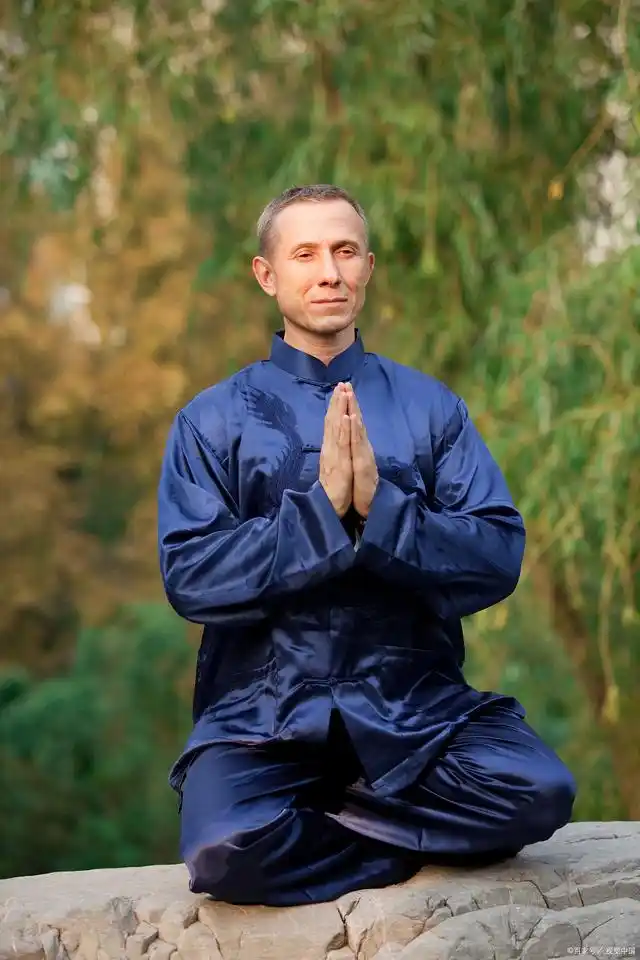
Four Qualities of Qi in Tai Chi Movement
Once posture, breathing, and attention are aligned, practitioners often notice specific changes in the quality of their movement. These are not “proof” that Qi exists — they are simply descriptions of how a well-coordinated body feels from the inside.
Continuity (连贯)
Movements feel connected rather than segmented. The body begins to move as one coordinated unit, without breaks or jerks. This is sometimes described as “ silk reeling “ — the image of drawing silk from a cocoon in a continuous, unbroken thread.
- Traditional explanation : Qi flows continuously through the meridians.
- Practical experience : When you perform Cloud Hands with continuity, each shift of weight, each turn of the waist, each movement of the arms feels like part of a single gesture — not a sequence of separate positions.
Elasticity (弹性)
Instead of rigid strength, movement gains a spring-like responsiveness. The body feels pliable yet full, like a well-inflated ball that returns to shape when pressed.
- Traditional explanation : Qi fills the body and creates internal support.
- Practical experience : In postures like Ward Off (掤), the arms feel rounded and alive — not muscled, but held by an inner fullness that makes them both soft and unyielding.
Rootedness (根劲)
Practitioners feel stable and grounded without stiffness. Force travels through the legs and into the ground rather than remaining in the upper body. When pushed, the whole body absorbs and transfers the force, rather than local resistance.
- Traditional explanation : Qi sinks to the Dan Tian and the feet.
- Practical experience : In Single Whip, the front leg can be lifted without losing balance — not because of strength, but because the weight has truly settled through the standing leg and into the ground.
Effortless Power (不用力的力)
When movements are coordinated properly, power emerges with surprisingly little muscular effort. This is what the Tai Chi classics call “using intention rather than brute strength” (用意不用力).
- Traditional explanation : Qi moves the body; the muscles simply follow.
- Practical experience : In Push, the force that issues from the palms seems to come from the ground, through the legs, directed by the waist — the arms themselves contribute almost nothing.
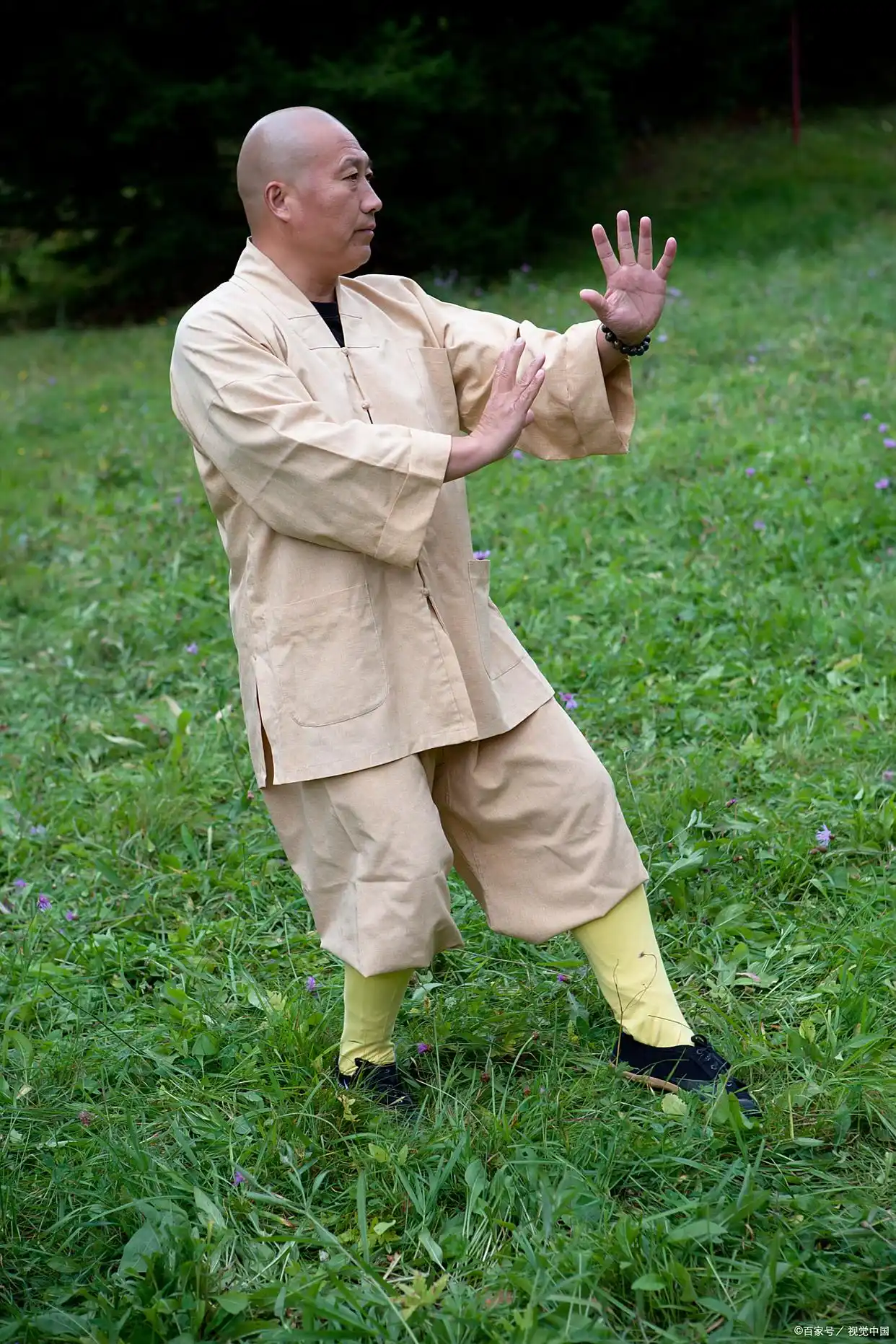
Qi in Classic Forms — A Practical Guide
The qualities described above don’t appear by magic. They emerge from correct practice — and they can be cultivated by paying attention to how Qi moves through specific forms.
Commencement (起势) — The First Breath of Qi
- Movement : Stand with feet together, then step to shoulder width. Slowly raise arms to shoulder height, then gently lower them.
- Qi focus : As arms rise, inhale and feel Qi rising from the ground, up through the legs, into the Dan Tian, and out to the palms. As arms lower, exhale and feel Qi sinking back to the Dan Tian and down into the earth.
- Practice tip : Don’t focus on the arm muscles. Instead, notice what lifts the arms — a sense of buoyancy, as if they’re floating on water. That buoyancy is Qi in its most accessible form.
- What you might feel : Warmth in the palms as they rise; a sense of fullness in the lower abdomen as they descend.
Cloud Hands (云手) — The Flow of Qi
- Movement : Weight shifts side to side as hands trace circles in front of the body, coordinated by the waist.
- Qi focus : Imagine your hands are moving through a viscous medium — water, or dense air. Feel the resistance. As the left hand rises, sense Qi flowing from the left side of the waist, up through the arm, to the palm. As the right hand sinks, feel Qi returning to the Dan Tian.
- Practice tip : The waist turns slightly ahead of the hands. Let the waist “lead” the Qi, and let the hands follow like ribbons attached to it.
- What you might feel : Magnetic resistance between the hands; a sense of being surrounded by an elastic sphere; warmth or tingling spreading through the arms.
Single Whip (单鞭) — Gathering and Releasing Qi
- Movement : Right hand forms a hook; left hand sweeps outward as weight shifts forward.
- Qi focus : During the gathering phase (forming the hook), feel Qi concentrate in the fingertips of the right hand — a gathering of energy, like winding a spring. During the release (pushing with the left palm), feel Qi surge from the Dan Tian, through the chest, and out through the left palm.
- Practice tip : Don’t push with the left arm. Instead, let the Qi “push” it — feel the arm extend as if inflated from within.
- What you might feel : Tingling in the hook hand; warmth or fullness in the left palm; a sense of expansion across the upper back (what classics call “Qi sticking to the back”).
Grasp Sparrow’s Tail (揽雀尾) — The Four Essential Energies
This sequence contains four movements — Ward Off, Roll Back, Press, and Push — each with a distinct Qi quality.
- Ward Off (掤) — Qi expands outward in all directions, creating a rounded, protective structure. Feel the arms as if filled with air, buoyant and unyielding.
- Roll Back (捋) — Qi draws inward and backward, as if reeling in silk. Feel the hands lightly adhering to an imaginary opponent’s arm, guiding their energy past you.
- Press (挤) — Qi gathers and then projects forward in a focused way. One hand presses against the other wrist, concentrating the whole body’s Qi into a single point.
- Push (按) — Qi sinks first, then rises and issues forward. Feel the weight settle through the legs, then the ground’s rebound travel up and out through the palms.
Practice tip : Between each movement, don’t stop the Qi. Let it continue moving internally, like water flowing from one chamber to the next.
What you might feel : The whole body working as one unit; each posture having a distinct internal “texture”; a sense that the form is doing itself, with you merely observing.
Three Simple Practices to Deepen Your Qi Awareness
If maintaining Qi awareness throughout a full form feels challenging, these focused practices can help. Each takes only a few minutes and can be done as a warm-up or stand-alone exercise.
Slow Continuous Movement
Choose a short sequence — perhaps just the first three movements of your form. Perform them at an extremely slow pace, taking 30–60 seconds per movement.
What to notice :
- Can you keep the movement absolutely continuous, without micro-pauses at transitions?
- Does the quality of sensation in your hands and body remain constant throughout?
- Where do you feel the impulse to “try” or “force”? Can you soften there?
After a few minutes of this practice, return to your normal pace. Most practitioners find that the slowness has “charged” their awareness — the Qi sensations remain clearer even at regular speed.
Weight Sinking
Stand in a posture — any posture — and simply notice your weight. Then, without changing the shape, gently allow the weight to settle more deeply through your legs and feet. Not collapsing, just releasing.
What to notice :
- Does the quality of sensation in your lower body change?
- Do you feel more connected to the ground?
- Does the upper body feel lighter or more spacious?
This practice cultivates what classics call “Qi sinking” — the foundation of rootedness and stability.
Breath Following Movement
Perform a simple repetitive movement — raising and lowering your arms, or shifting weight side to side. Don’t try to control your breath. Just let it happen naturally, and notice how it coordinates with the movement.
What to notice :
- Does your breath naturally want to coordinate with the motion?
- If you let it, does the movement feel easier or more fluid?
- Can you sense a relationship between the breath cycle and the ebb and flow of Qi sensations?
Over time, this natural coordination becomes automatic — and with it, the sense of Qi flowing with each breath.
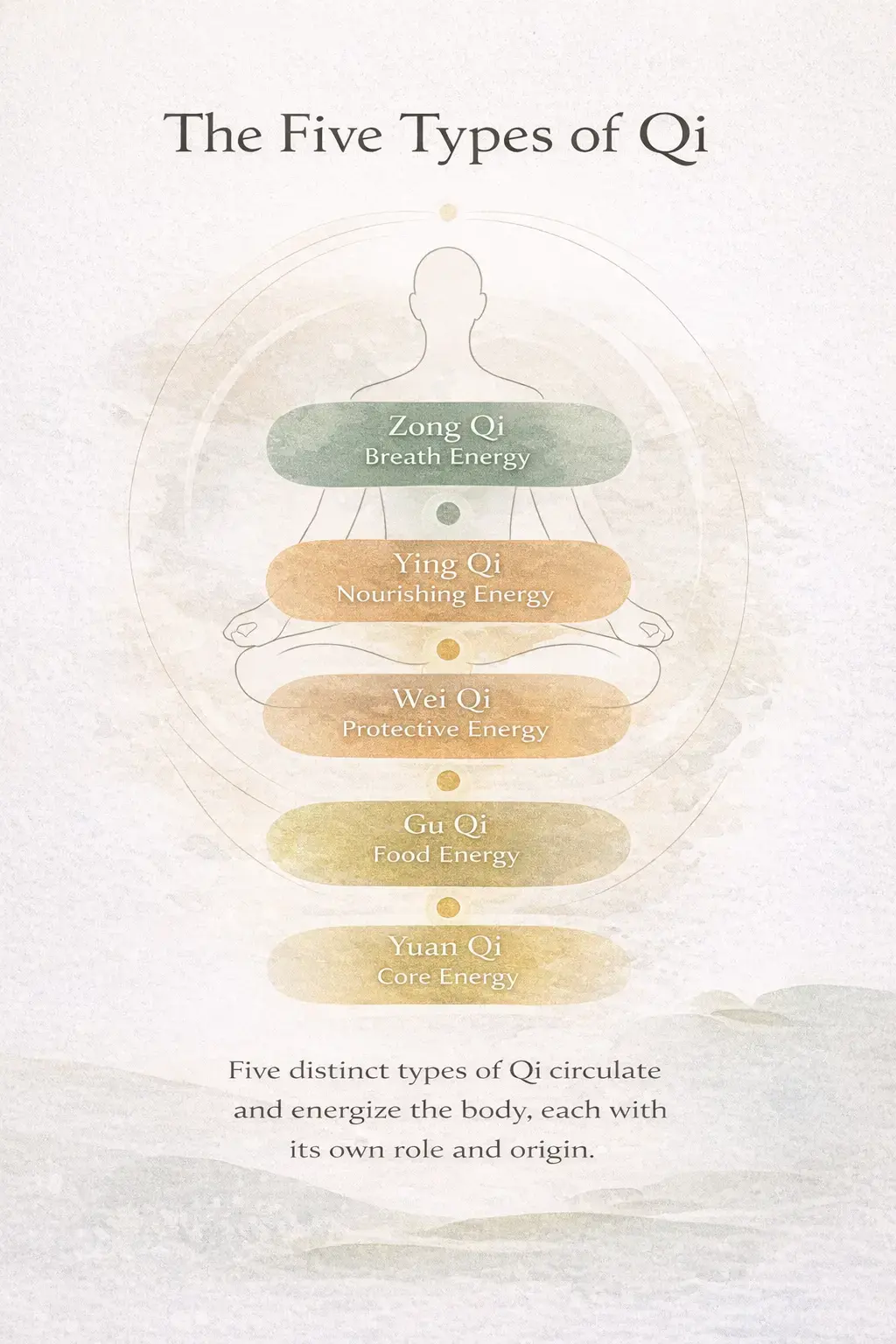
The Five Qi Types in Tai Chi Practice
For those who have followed our series, you’re already familiar with the five functional types of Qi. Here’s how each one manifests in Tai Chi practice.
Yuan Qi (元气) — The Foundation
Yuan Qi is the deep vitality you’re born with. In Tai Chi, it’s what allows you to practice without depleting yourself.
- How it appears : After practice, you feel energized rather than exhausted. Your recovery between sessions is quick. Over months and years, your health and vitality gradually improve.
- How to preserve it : Don’t force. Don’t push through pain. Don’t practice when exhausted. End each session with a few moments of stillness, allowing Qi to return to the Dan Tian.
Zong Qi (宗气) — The Powerhouse
Zong Qi governs the coordination of breath and heart function. In Tai Chi, it’s what makes your movements both powerful and sustainable.
- How it appears : Your breath deepens naturally during practice. You can sustain effort without getting out of breath. When you issue force, it feels connected to your whole body, not just your arms.
- How to cultivate it : Practice deep, relaxed abdominal breathing. Let the breath and movement synchronize naturally. In push hands, notice how breath coordinates with issuing and receiving force.
Ying Qi (营气) — The Nourisher
Ying Qi flows in the meridians, nourishing organs and tissues. In Tai Chi, it’s what makes your practice feel restorative.
- How it appears : After practice, you feel nourished — warm, loose, and comfortably tired. Over time, your general health improves: better digestion, smoother skin, more restful sleep.
- How to cultivate it : Move with continuity, avoiding jerky or disconnected motions. Let each posture “breathe” — a moment of fullness before the next transition. End practice with a few minutes of standing, allowing Ying Qi to settle.
Wei Qi (卫气) — The Protector
Wei Qi circulates just under the skin, defending against illness. In Tai Chi, it’s what makes you resilient — both in practice and in daily life.
- How it appears : You get sick less often. When you do get sick, you recover faster. In push hands , your sensitivity to your partner’s intention sharpens. This is the foundation of Listening Jing .
- How to cultivate it : Practice outdoors when weather permits (dressed appropriately). Include some faster, more dynamic movements to circulate Wei Qi to the surface. After practice, lightly brush or tap the skin to awaken its sensitivity.
Gu Qi (谷气) — The Fuel
Gu Qi is derived from food and drink. In Tai Chi, it’s what provides the energy for practice.
- How it appears : You have consistent energy throughout your practice. You don’t “hit a wall” or feel drained mid-session.
- How to cultivate it : Eat moderately before practice — neither full nor fasting. Pay attention to how different foods affect your practice energy. Over time, you’ll naturally gravitate toward what supports you.
The Integrated State
When all five Qi types are balanced and functioning together, practice takes on a new quality. Movements feel effortless. Awareness remains clear from start to finish. After practice, you feel neither depleted nor over-energized — simply centered, clear, and whole.
Classical texts describe this state as “Qi full, blood abundant, spirit clear” (气足血旺神清). It’s not a mystical attainment — it’s the natural result of consistent, correct practice over time.
Common Questions and Concerns
“I can feel Qi in standing meditation, but lose it when I move. What should I do?”
This is the most common transition point in Tai Chi training. The solution is to move more slowly. Reduce your speed until you can maintain awareness of your body, breath, and sensation continuously. It may feel absurdly slow at first — that’s fine. Speed will return naturally as the connection stabilizes.
“My Qi sensations come and go. Am I regressing?”
Sensations naturally fluctuate with your physical state, mood, environment, and many other factors. Strong sensations are not a sign of progress, and weak sensations are not a sign of regression. The real measure is consistency of practice and the overall quality of your movement.
“How do I know if my Qi is moving correctly?”
Correct Qi movement feels:
- Comfortable — not painful, sharp, or distressing
- Connected — part of the whole, not isolated
- Natural — arising on its own, not forced
If you experience persistent pain, intense pressure, or sensations that feel “wrong,” reduce your focus on Qi and return to basics: check your posture, relax your breath, soften your attention. When in doubt, consult an experienced teacher.
“What about reverse breathing? Should I use it in forms?”
Reverse abdominal breathing (吸气时腹部内收, 呼气时腹部外鼓) is a valuable tool, but not for beginners. First establish natural, relaxed breathing in your forms. Only when that feels completely effortless can you begin to experiment with reverse breathing in specific applications — usually issuing movements. Even then, never force it. Let the breath pattern emerge naturally from the movement’s intention.
A Traditional Teaching
“Don’t put the cart before the horse. First learn the form until it’s in your bones. Then learn to breathe with it. Then the Qi will come on its own. Trying to force Qi before the body is ready is like trying to drive a car before learning to steer.”
Conclusion: Qi Is the Body Working as One System
Throughout this series, we’ve explored Qi from multiple perspectives:
- What it is — not a mystical substance, but the process of life itself
- How it differs from energy — a functional distinction that changes how we practice
- Why science struggles with it — because different investigative traditions ask different questions
- How it feels — warmth, tingling, fullness, magnetism, flow
- How it functions in the body — as five interrelated types with distinct roles
This article brings those threads together. In Tai Chi practice, Qi is not something you add to correct movement. It is what correct movement feels like from the inside.
When your structure is aligned, your breath is calm, and your attention is present but soft — when body, breath, and mind work together as one system — then the movement itself becomes the expression of Qi.
- You don’t need to “send” Qi to your hands. When your posture is open and your shoulders are released, it’s already there.
- You don’t need to “pull” Qi into your Dan Tian. When your breath settles and your weight sinks, it’s already home.
- You don’t need to “project” Qi through your palms. When your whole body coordinates in a single intention, the force that emerges is Qi in motion.
The paradox is this: when you stop trying to control Qi and simply practice correctly, Qi appears on its own. It was never something to acquire. It was only something to uncover.
Start Experiencing Qi — A Simple Daily Practice
Understanding Qi begins with direct experience. You don’t need complex techniques — just a few minutes of correct practice.
- Stand in Wuji posture
- Relax your entire body
- Let your breath settle naturally
- Place gentle attention in your hands
Don’t try to create Qi. Don’t try to control it.
Just notice what arises.
This is where Qi begins — not as an idea, but as a living experience.
Where to Go Next
This article completes our core Qi series, but your exploration is just beginning. Here are some natural next steps:
- Standing Meditation (Zhan Zhuang) — The foundation of all Qi cultivation
- Tai Chi for Beginners — A complete introduction to practice
- Push Hands — How Qi awareness develops through partner work
- The 5 Stages of Learning Tai Chi — Understand where you are in your journey
- Core Principles of Tai Chi — The 8 foundational concepts behind Qi in practice
The Complete Qi Knowledge Series
- What Is Qi — Definition and Glossary
- Qi vs Energy: Why Qi Is Not Just “Life Energy”
- The Philosophy of Qi: From Cosmic Origin to Modern Relevance
- Not All Qi Is the Same: The 5 Types of Qi in Qigong and Chinese Medicine
- Why Western Science Struggles to Understand Qi
- How Qi Feels: A Beginner’s Guide to Sensation
- Qi in Tai Chi Practice (you are here)
🔍 Go Deeper: The Complete Qi Knowledge System
This article showed you how Qi moves through forms like Cloud Hands and Single Whip — turning theory into embodied practice. But mastering Qi requires a solid grasp of its full spectrum.
We’ve compiled all 7 in‑depth Qi articles (over 10,000 words) into one free 50+ page PDF ebook, Understanding Qi . From philosophy, science, and taxonomy to direct sensation — everything you need in one place.
Master Mingde Chen
12th generation Chen-style inheritor with decades of teaching experience.
View all articles →